Univariate, Bivariate and Multivariate Analysis
In the world of data, analysis is all about finding meaningful patterns and insights hidden inside numbers. Different types of analysis help us understand data from different perspectives.
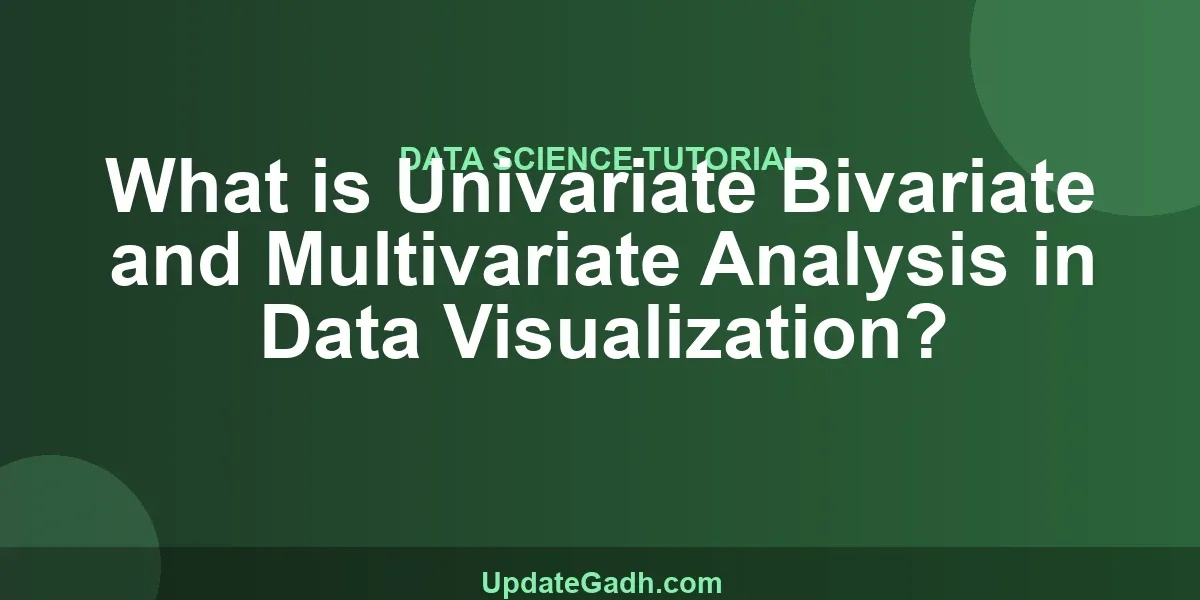
Univariate, Bivariate, and Multivariate Analysis are three important approaches used in data analysis and data visualization. Each approach focuses on a different number of variables and helps answer different types of questions.
Table of Contents
Complete Advance AI Topics: Click Here
SQL Tutorial: Click Here
Understanding the Types of Data
Before performing any type of analysis, it is important to understand the data you are working with. Data can generally be divided into two major categories:
- Categorical Data: Data that represents groups or categories, such as gender, payment method, department, or yes/no responses.
- Numerical Data: Data represented using numbers. It can be further divided into:
- Discrete Data: Countable values, such as the number of students in a class.
- Continuous Data: Measurable values, such as height, weight, temperature, or salary.
Pro Tip: Proper preprocessing is important before visualization. Clean the data, use consistent formats, group values where necessary, and organize categories properly to create meaningful visualizations.
Univariate Analysis – One Variable at a Time
Univariate analysis focuses on only one variable at a time. It is mainly used to understand the distribution, central tendency, and spread of a variable.
Some common questions answered by univariate analysis include:
- What is the average value?
- What is the most common value?
- How is the data distributed?
- Are there any unusual or extreme values?
Common Visualizations for Univariate Analysis
| Visualization | Best For |
|---|---|
| Histogram | Understanding the distribution of numerical data |
| Bar Chart | Comparing categorical values |
| Pie Chart | Showing parts of a whole |
| Box Plot | Understanding spread, median, and outliers |
| Line Graph | Showing trends over time |
Summary Statistics in Univariate Analysis
- Mean: The average value of the data.
- Median: The middle value when the data is arranged in order.
- Mode: The most frequently occurring value.
- Standard Deviation: Measures how spread out the data is.
- Quartiles: Divide ordered data into four sections.
Univariate Analysis Example in Python
import seaborn as sns
import matplotlib.pyplot as plt

tips = sns.load_dataset("tips")

sns.histplot(tips["total_bill"], kde=True)

plt.title("Histogram of Total Bill")
plt.xlabel("Total Bill")
plt.ylabel("Frequency")

plt.show()
The goal of univariate analysis is to understand the shape, center, spread, and unusual values of a single variable.
Bivariate Analysis – Two Variables and Their Relationship
Bivariate analysis examines two variables together to understand whether there is a relationship or pattern between them.
For example, we might want to understand the relationship between total bill and tip in a restaurant dataset.
Common Visualizations for Bivariate Analysis
| Visualization | Best For |
|---|---|
| Scatter Plot | Examining relationships between two numerical variables |
| Box Plot | Comparing a categorical variable with a numerical variable |
| Violin Plot | Comparing distributions across categories |
Correlation in Bivariate Analysis
Correlation is commonly used to measure the strength and direction of a relationship between two numerical variables.
- +1: Perfect positive relationship
- -1: Perfect negative relationship
- 0: No linear relationship
A positive correlation generally means that as one variable increases, the other tends to increase. A negative correlation means that one variable tends to decrease as the other increases.
Bivariate Analysis Example in Python
sns.scatterplot(data=tips, x="total_bill", y="tip")

plt.title("Scatter Plot of Total Bill vs. Tip")
plt.xlabel("Total Bill")
plt.ylabel("Tip")

plt.show()
Bivariate analysis is useful for identifying relationships, trends, differences, and possible predictive patterns between two variables.
Multivariate Analysis – Working with 3 or More Variables
When an analysis involves three or more variables, it is called Multivariate Analysis. This approach helps us understand multiple relationships and interactions within a dataset.
For example, instead of analyzing only total bill and tip, we could also consider variables such as smoker status, gender, day, and time.
Common Visualizations for Multivariate Analysis
| Visualization | Best For |
|---|---|
| Pair Plot | Comparing relationships between multiple variables |
| Heatmap | Displaying a correlation matrix |
| 3D Plot | Visualizing relationships among three variables |
| Parallel Coordinates | Exploring high-dimensional datasets |
Multivariate datasets can become difficult to visualize and interpret. Techniques such as Principal Component Analysis (PCA) can be used to reduce the number of dimensions while retaining important information.
Multivariate Analysis Example in Python
sns.pairplot(data=tips, hue="smoker")

plt.suptitle("Pair Plot of Tips Dataset (Colored by Smoker)")
plt.show()
Multivariate analysis can reveal patterns, interactions, relationships, and outliers that may not be visible when variables are analyzed individually or in pairs.
Difference Between Univariate, Bivariate and Multivariate Analysis
| Analysis Type | Number of Variables | Main Purpose | Common Visualizations |
|---|---|---|---|
| Univariate | 1 | Understand one variable | Histogram, Bar Chart, Box Plot |
| Bivariate | 2 | Understand the relationship between two variables | Scatter Plot, Box Plot, Violin Plot |
| Multivariate | 3 or more | Understand multiple relationships and interactions | Pair Plot, Heatmap, 3D Plot |
Why Should You Learn These Analysis Techniques?
You can think of these three techniques like preparing a cake:
- Univariate: Examine each ingredient separately.
- Bivariate: Study how two ingredients interact with each other.
- Multivariate: Analyze all the ingredients together and understand how they contribute to the final result.
Similarly, these analysis techniques help data professionals understand datasets from simple to complex perspectives.
Learning these methods can help you:
- Make better data-driven decisions.
- Discover hidden patterns and insights.
- Identify relationships between variables.
- Detect unusual values and outliers.
- Communicate findings clearly using visualizations.
YT:- DecodeIT
Conclusion
Data visualization is not simply about creating attractive charts. It is about presenting data in a way that helps us understand meaningful patterns and relationships.
Univariate analysis helps us understand one variable, Bivariate analysis helps us study the relationship between two variables, and Multivariate analysis helps us explore multiple variables and their interactions.
Once you understand these three approaches, you can choose the right analysis and visualization technique for your dataset and turn raw data into useful insights.
So, choose your dataset, select the right visualization, and start exploring your data.
Keywords
univariate bivariate and multivariate analysis examples, univariate bivariate and multivariate analysis pdf, univariate bivariate and multivariate analysis using data visualization, difference between univariate bivariate and multivariate analysis, univariate analysis, what is univariate bivariate and multivariate analysis with examples, difference between univariate bivariate and multivariate analysis pdf, univariate bivariate and multivariate analysis in python, univariate bivariate and multivariate analysis in data visualisation example, univariate bivariate and multivariate analysis in data visualisation questions