Data Science Use Cases
In today’s technology-driven world, data science has become an important force behind innovation and digital transformation. By combining statistics, machine learning, algorithms, and modern technologies, data scientists turn large volumes of raw data into meaningful insights that help organizations make smarter decisions.
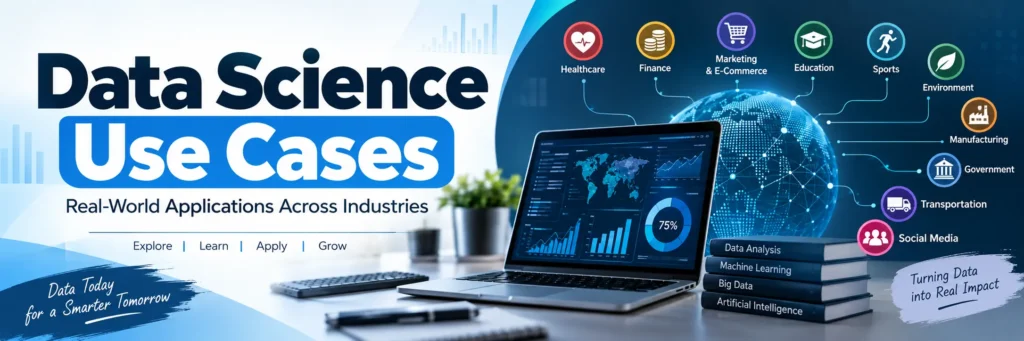
Data science is being used across almost every major industry, including healthcare, finance, marketing, education, sports, manufacturing, transportation, and government. These applications help organizations improve efficiency, understand customers, reduce risks, and discover new opportunities.
In this article, we will explore some of the most important data science use cases and real-world applications.
Table of Contents
Complete Advance AI Topics: Click Here
SQL Tutorial: Click Here
1. Healthcare
a) Disease Diagnosis and Prognosis
Data science can help healthcare professionals identify diseases at an early stage. Machine learning models can analyze patient records, medical images, genetic information, and other healthcare data to identify patterns associated with conditions such as cancer, diabetes, and heart disease.
Early detection can support faster treatment decisions and improve patient outcomes.
b) Drug Discovery
Data science is also transforming pharmaceutical research. Machine learning models can analyze large datasets, predict molecular behavior, and identify promising drug candidates.
This can help researchers reduce the time and resources required during different stages of drug discovery.
c) Telemedicine and Remote Monitoring
Data science plays an important role in modern telemedicine and remote patient monitoring. Healthcare platforms can analyze patient information and real-time health data to support remote consultations and monitoring.
These data-driven systems can help healthcare providers deliver more efficient and personalized services.
2. Finance
a) Automated Trading
Financial institutions use data science to analyze historical market information, price movements, and other signals. Algorithmic trading systems can process this information quickly and execute trades based on predefined strategies.
b) Credit Scoring
Banks and financial institutions use data science to evaluate the creditworthiness of customers. Models can consider factors such as income, repayment history, existing credit, and other relevant financial information.
This helps lenders make more informed decisions while managing financial risk.
c) Fraud Detection
Fraud detection is one of the most important applications of data science in finance. Machine learning algorithms can identify unusual transaction patterns and flag potentially suspicious activity.
Real-time analysis helps financial organizations detect fraud more quickly and protect customers and their assets.
3. Marketing and E-Commerce
a) Personalized Marketing
Businesses analyze customer behavior, preferences, purchase history, and interactions to create personalized marketing campaigns.
Data science allows companies to recommend relevant products, customize content, and target customers with more effective campaigns.
b) Customer Churn Prediction
Customer churn prediction helps companies identify customers who may stop using their products or services.
By analyzing historical customer data, businesses can identify common churn patterns and create targeted retention strategies to improve customer loyalty.
c) Price Optimization
E-commerce businesses use data science to optimize product pricing. Algorithms can analyze customer demand, competitor prices, market conditions, and historical sales data to support better pricing decisions.
Dynamic pricing can help businesses respond to changing market conditions more effectively.
4. Education
a) Personalized Learning
Data science can make education more personalized by analyzing student performance, learning progress, and engagement.
Based on these insights, educational platforms and institutions can recommend suitable learning materials and approaches for individual students.
b) Predictive Analytics for Student Success
Educational institutions can use predictive analytics to identify students who may be struggling academically or are at risk of dropping out.
Early identification allows educators to provide additional support and take appropriate action to improve academic outcomes.
5. Sports Analytics
a) Performance Optimization
Sports organizations use data science to analyze athlete performance, training sessions, match statistics, and video footage.
Coaches can use these insights to improve training programs, develop game strategies, monitor performance, and reduce the risk of injuries.
b) Enhancing Fan Engagement
Data science also helps sports teams understand their audiences. Fan behavior can be analyzed to deliver personalized content, interactive experiences, recommendations, and digital services.
This creates stronger connections between sports organizations and their fans.
6. Environmental Science
a) Climate Modeling
Data science helps researchers study climate patterns by analyzing historical weather information, atmospheric measurements, carbon emissions, and other environmental data.
These models can improve our understanding of environmental changes and support better planning and decision-making.
b) Disaster Prediction
Predictive analytics can process information from satellites, sensors, weather systems, and historical records to identify potential risks associated with natural disasters.
Better forecasting and early-warning systems can help communities prepare for events such as hurricanes, wildfires, floods, and other disasters.
7. Manufacturing
a) Quality Control
Manufacturing companies use data science to monitor production processes and identify defects. Data from sensors and production systems can be analyzed to detect quality problems at an early stage.
This helps reduce waste, improve product quality, and maintain consistent production standards.
b) Predictive Maintenance
Predictive maintenance is another important data science application in manufacturing. Machine sensor data can be analyzed to identify signs of potential equipment failure.
Instead of waiting for a machine to break down, companies can schedule maintenance in advance, reducing downtime and operational costs.
8. Government and Public Policy
a) Crime Prediction and Prevention
Government agencies can use data analytics to study crime patterns and identify areas that may require additional resources.
When used responsibly, these insights can support better resource planning and public safety initiatives.
b) Healthcare Policy and Resource Allocation
Governments use data-driven analysis to plan healthcare services, allocate resources, and respond to large-scale public health challenges.
Data science can help decision-makers understand demand and distribute resources such as healthcare facilities, staff, medicines, and vaccines more effectively.
9. Transportation and Logistics
a) Route Optimization
Transportation and delivery companies use data science to optimize routes. Algorithms can analyze traffic conditions, weather, road information, delivery locations, and other factors.
Optimized routes can reduce travel time, fuel consumption, and delivery delays.
b) Supply Chain Optimization
Data science helps businesses improve supply chain operations by forecasting demand, monitoring inventory, and identifying potential disruptions.
Better forecasting and planning can help organizations maintain appropriate inventory levels while reducing unnecessary costs.
10. Social Media and Sentiment Analysis
a) Sentiment Analysis
Sentiment analysis uses natural language processing and machine learning to understand opinions and emotions expressed in online content.
Businesses can analyze customer feedback and social media discussions to understand public opinion, identify trends, and improve their products or services.
b) Content Recommendation Systems
Recommendation systems are a common application of data science on digital platforms. They analyze user behavior, interests, viewing history, and interactions to recommend relevant content.
These systems are widely used to recommend videos, articles, products, music, and other digital content.
Advantages of Data Science Use Cases
- Data-Driven Decision Making: Organizations can make better decisions using measurable insights and historical data.
- Enhanced Customer Insights: Businesses can better understand customer needs, preferences, and behavior.
- Operational Efficiency: Data-driven automation and optimization can reduce costs and improve processes.
- Innovation in Products and Services: Customer and market data can help businesses develop better products and services.
- Fraud Detection and Prevention: Machine learning can identify suspicious patterns and potentially fraudulent activities.
- Healthcare Improvements: Data analysis can support diagnosis, treatment planning, research, and healthcare management.
- Personalized Marketing: Companies can create more relevant campaigns based on customer behavior.
- Faster Scientific Research: Large datasets can be analyzed efficiently to support scientific discoveries.
- Improved Customer Service: Data-driven systems and AI-powered tools can provide faster and more personalized customer support.
- Competitive Advantage: Businesses can identify market trends and respond to changing customer demands more effectively.
YT:- DecodeIT
Disadvantages of Data Science Use Cases
- Data Privacy Concerns: Collecting and processing personal information can create privacy and regulatory challenges.
- Data Quality Issues: Incomplete, inaccurate, or biased data can produce unreliable results.
- High Implementation Costs: Data science projects may require significant investment in infrastructure, software, and skilled professionals.
- Complexity and Expertise Requirements: Advanced data science projects require knowledge of statistics, programming, machine learning, and domain-specific concepts.
- Model Interpretability: Some complex machine learning models can be difficult to understand and explain.
- Ethical Challenges: Poorly designed models can reproduce or amplify existing biases.
- Cybersecurity Risks: Large collections of valuable data can become attractive targets for cyberattacks.
- Over-Reliance on Data: Organizations may make poor decisions when they depend entirely on models without considering human judgment and context.
- Data Silos: Data stored across separate systems can make it difficult to obtain a complete view of an organization.
- Scalability Challenges: Processing and storing increasingly large datasets can require substantial computing resources.
Conclusion
Data science has moved far beyond being simply a popular technology term. It has become an important part of modern business, research, healthcare, education, government, and many other industries.
From predicting diseases and detecting financial fraud to optimizing supply chains and personalizing online experiences, data science helps organizations turn information into actionable insights.
As datasets continue to grow and technologies such as machine learning and artificial intelligence evolve, the number of practical data science use cases will continue to expand.
Understanding these real-world applications is an excellent starting point for anyone interested in learning data science and exploring its career opportunities.
Keywords
data science use cases, 5 real life examples of data science applications, top 10 applications of data science, data science use cases for beginners, data science examples, applications of data science, applications of data science in engineering,