Data Collection Tools in Healthcare
The Evolution of Data Collection in Healthcare
Data collection is the foundation of modern healthcare. It helps healthcare professionals generate actionable insights, build predictive models, improve decision-making, and ultimately enhance patient outcomes. As technology has advanced, healthcare data collection has become more accurate, efficient, and capable of supporting real-time analysis.
Today, technologies such as Artificial Intelligence (AI), Machine Learning (ML), Natural Language Processing (NLP), and Blockchain are transforming how healthcare data is collected, processed, and managed. These technologies help address important challenges related to data quality, security, availability, and integration.
According to research by Frost & Sullivan, AI in healthcare was projected to grow significantly, with data gathering being an important area of demand. AI-powered solutions can streamline data collection, reduce manual errors, and support real-time analytics. This makes data-driven decision-making more efficient and can contribute to improved patient care and healthcare operations.
Table of Contents
Complete Advance AI Topics: Click Here
SQL Tutorial: Click Here
Challenges in Data Collection: Precision and Availability
One of the major challenges in healthcare data collection is obtaining accurate, complete, and high-quality data. Human limitations, inconsistent methodologies, and documentation errors can introduce inaccuracies and bias into collected information.
Missing or incomplete data can also reduce the effectiveness of analysis. When important information is unavailable, researchers and healthcare professionals may find it difficult to produce reliable conclusions or make informed decisions.
Sampling errors and confidence interval issues can further complicate healthcare research. Without sufficient and representative data, researchers may struggle to identify meaningful patterns or apply their findings effectively to patient care and medical research.
Another challenge is that personnel responsible for collecting data may not always have complete knowledge of the context surrounding the information they record. Proper training and standardized data collection procedures are therefore essential for maintaining consistency and data quality.
Download New Real Time Projects :- Click here
Security Concerns in Healthcare Data Collection
Security is a critical consideration when collecting and managing healthcare data. Patient information is highly sensitive, and even organizations with strong security protocols may face vulnerabilities that could result in data breaches or unauthorized access.
Healthcare organizations need to implement appropriate security technologies and practices to protect data throughout its lifecycle. Technologies such as Blockchain and AI-based security solutions can support data integrity, traceability, and protection against unauthorized access.
A security-focused approach is essential for protecting patient confidentiality, maintaining data reliability, reducing security risks, and supporting compliance with applicable regulatory requirements.
Essential Data Collection Tools in Healthcare
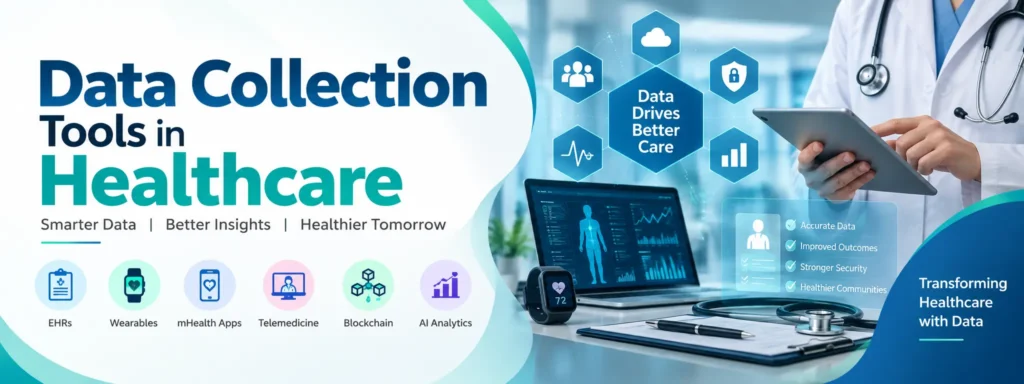
Healthcare institutions use a variety of digital tools and technologies to improve the accuracy, efficiency, and security of data collection. Some of the commonly used tools include:
- Electronic Health Records (EHRs): EHR systems digitize and organize patient information in a centralized repository. They make it easier for authorized healthcare professionals to access and share patient information, supporting better coordination of care.
- Wearable Devices and IoT Sensors: Smartwatches, fitness trackers, and medical-grade sensors can continuously collect health-related information. Real-time data from these devices can help monitor patient well-being and support chronic disease management.
- Mobile Health (mHealth) Apps: Mobile healthcare applications enable patients to report symptoms, monitor medication adherence, track health information, and participate in remote consultations. These capabilities provide additional sources of patient-generated data.
- Telemedicine Platforms: Telemedicine platforms collect information generated during remote healthcare consultations. The resulting data can contribute to patient monitoring and the development of more personalized healthcare solutions.
- Blockchain-Based Data Management: Blockchain can provide mechanisms for maintaining data integrity and traceability. Its use in healthcare data management can help strengthen security and reduce risks associated with unauthorized modification or fraudulent activities.
- AI-Powered Data Analytics Tools: AI-based analytics platforms can process large healthcare datasets, identify patterns, and generate predictive insights. These capabilities can support clinical decision-making as well as healthcare operational efficiency.
Enhancing Data Collection Through Enterprise Data Warehouses (EDW)
Healthcare organizations can improve the effectiveness of their data collection tools by integrating them with Enterprise Data Warehouses (EDWs). An EDW provides a centralized environment for storing and organizing information collected from multiple healthcare systems.
EDWs can help organizations improve data compatibility, scalability, and interoperability. Bringing information from different sources into a structured environment makes it easier to analyze healthcare data and develop more comprehensive insights.
Healthcare institutions must also consider data governance and regulatory compliance. Secure data-sharing processes, appropriate metadata management, and consistent governance practices help maintain the accuracy, security, and ethical management of healthcare information.
By improving EDW infrastructure and data pipelines, healthcare organizations can make information more accessible for research, analysis, reporting, and patient care.
Capturing Better Data at the Source
Improving healthcare data collection begins with capturing accurate information directly at the source. Technologies such as AI and Blockchain can contribute to more secure and reliable data collection and retrieval processes.
Technology alone, however, is not enough. Healthcare professionals also need appropriate training in data collection and documentation practices. Well-trained personnel can record patient information more accurately, helping reduce errors and improve overall data integrity.
Effective data capture also requires scalable and adaptable software solutions. As healthcare data volumes continue to increase, organizations need systems capable of supporting real-time processing, integration, and analysis.
Seamless interoperability between different healthcare data collection tools is equally important. When systems can exchange information effectively, organizations can build more complete datasets and generate more useful insights.
Conclusion
Data collection tools are playing an increasingly important role in modern healthcare. Technologies such as EHRs, IoT devices, mHealth applications, telemedicine platforms, Blockchain, and AI-powered analytics are helping organizations collect and manage healthcare information more efficiently.
Although challenges related to data accuracy, availability, security, and integration remain, continued advancements in AI, Blockchain, and IoT are creating new opportunities for improving healthcare data management.
By adopting a strategic approach to data collection, healthcare organizations can strengthen data quality, improve operational efficiency, support research, and enable better-informed patient care. Reliable and secure data collection will remain an essential part of the continued digital transformation of healthcare.
Keywords
data collection tools in healthcare, public health data collection methods, data collection tools in healthcare examples, importance of data collection in healthcare, data collection tools in healthcare patient data, hospital data collection ppt, data collection tools in research, tools of data collection pdf, hiv data collection tools, examples of data collection tools in healthcare, data collection tools for quality improvement in healthcare, what is data collection in healthcare, what are data collection tools, data collection tools in healthcare ppt, data collection tools in nursing research, data collection tools in healthcare nursing, data collection tools in healthcare pdf, what are data collection tools in healthcare, data collection tools in healthcare research, types of data collection tools in healthcare