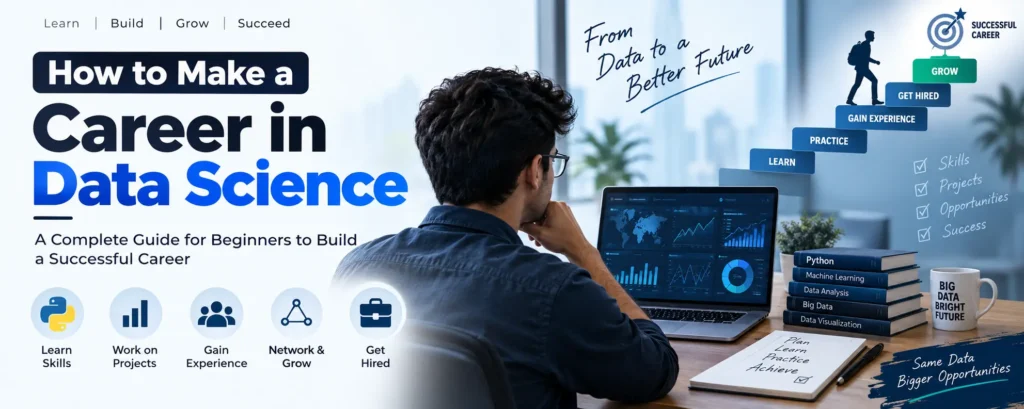
How to Make a Career in Data Science
Data science has become one of the most promising career options in today’s data-driven world. As businesses increasingly depend on data to make strategic decisions, the demand for skilled data science professionals continues to grow.
For beginners, getting started in this rapidly evolving field can seem challenging. However, with the right learning path, practical experience, and continuous improvement, you can build a successful career in data science.
Complete Advance AI Topics: Click Here
SQL Tutorial: Click Here
1. Understand What Data Science Really Is
Before entering the field, it is important to understand what data science actually involves.
Data science is an interdisciplinary field that combines computer science, statistics, mathematics, and domain-specific knowledge to extract useful insights from structured and unstructured data.
Key Concepts to Learn
- Data Collection and Cleaning
- Statistical Modeling and Analysis
- Machine Learning Algorithms
- Data Visualization
- Big Data Technologies
- Data Storytelling
Think of data science as a journey that begins with raw data and ends with useful insights that support better decision-making.
2. Build the Right Educational Foundation
A strong educational foundation can help you develop the mathematical, analytical, and programming knowledge required for data science. There are several ways to enter the field.
Formal Education
- A bachelor’s degree in engineering, mathematics, statistics, computer science, or a related field.
- A master’s degree in data science, machine learning, artificial intelligence, statistics, or a related specialization.
Online Certifications and MOOCs
Online learning platforms such as Coursera, edX, Udemy, and DataCamp provide courses covering Python, statistics, machine learning, deep learning, and other important data science topics.
Self-Study
- Read books such as Python for Data Analysis by Wes McKinney.
- Study Hands-On Machine Learning by Aurélien Géron.
- Follow practical tutorials and GitHub projects.
- Build projects while learning instead of focusing only on theory.
3. Master the Core Skills
To become a successful data scientist, you need a combination of technical knowledge and soft skills.
Hard Skills
- Programming: Python, R, and SQL
- Mathematics and Statistics: Probability, hypothesis testing, and linear algebra
- Machine Learning: Supervised learning, unsupervised learning, and model tuning
- Data Wrangling: Pandas, NumPy, and real-world data cleaning
- Data Visualization: Matplotlib, Seaborn, Plotly, and Tableau
- Tools and Libraries: Scikit-learn, TensorFlow, and Jupyter Notebook
- Cloud Computing: Basic knowledge of AWS, Google Cloud, or Azure
- Version Control: Git and GitHub
Soft Skills
- Clear communication with technical and non-technical stakeholders
- Problem-solving and logical thinking
- Collaboration with cross-functional teams
- Responsible and ethical use of data
- Adaptability and willingness to learn
4. Build an Impressive Data Science Portfolio
A portfolio acts as a digital resume and demonstrates what you can actually accomplish beyond your academic qualifications.
Tips for Building Your Portfolio
- Work on real-world projects such as sentiment analysis, sales forecasting, or stock price prediction.
- Participate in Kaggle competitions.
- Contribute to open-source projects.
- Publish your projects on GitHub.
- Create a personal data science blog or website.
- Document your complete process, including data cleaning, analysis, modeling, visualization, and conclusions.
A well-documented project helps recruiters understand not only your technical skills but also how you approach and solve problems.
5. Start Networking Early
Networking can help you discover opportunities, learn from experienced professionals, and understand how data science works in the real world.
Ways to Network
- Join relevant LinkedIn groups and follow data science professionals.
- Attend technology meetups, webinars, and conferences.
- Participate in Kaggle forums and data science communities.
- Take part in events such as PyData, DataHack, and NeurIPS.
- Connect with professionals and request informational interviews.
6. Gain Practical Experience Through Internships
If you are starting your career, internships can provide valuable practical experience and help you understand how organizations solve real-world data problems.
Consider applying for internships in areas such as:
- Data Analytics
- Data Engineering
- Machine Learning
- Business Intelligence
You can also consider entry-level roles such as Data Analyst, Business Intelligence Analyst, or Junior Data Scientist.
These positions can help you develop professional experience while building the skills required for more advanced data science roles.
7. Prepare for the Data Science Job Search
Once you have developed your skills and portfolio, approach the job search strategically.
Optimize Your Resume
- Highlight measurable results from your projects.
- Mention the tools and technologies you used.
- Explain the business value of your projects.
- Include relevant certifications and hackathon achievements.
- Add links to your GitHub profile and portfolio.
Prepare for Interviews
Revise important topics such as:
- Python or R
- SQL
- Statistics and probability
- Machine learning algorithms
- Data structures and algorithms
- Data science case studies
Practice coding and interview questions using platforms such as LeetCode, InterviewBit, and Pramp.
Build Your Online Brand
Keep your LinkedIn profile updated and regularly share useful content, projects, technical insights, and your learning experiences.
8. Commit to Continuous Learning
The data science landscape changes quickly. Technologies and techniques that are popular today may become outdated as new approaches emerge.
How to Stay Ahead
- Follow data science blogs and publications.
- Read technical articles and research papers.
- Participate in online communities.
- Continue building practical projects.
- Explore areas such as AutoML, MLOps, Prompt Engineering, and Explainable AI.
Continuous learning is one of the most important habits for long-term growth in data science.
9. Explore Data Science Career Growth Options
As you gain experience, you can specialize in different areas of data and artificial intelligence.
Popular Specializations
- Data Engineer
- Machine Learning Engineer
- NLP Specialist
- AI Researcher
- Business/Data Analyst
- BI Developer
Leadership Paths
- Data Science Team Lead
- Data Science Manager
- Director of Data Science
Experienced professionals can also explore opportunities in teaching, consulting, or developing their own data science products and startups.
10. Respect Ethics and Data Privacy
Working with data comes with significant responsibility. Data scientists should understand the ethical and privacy implications of the systems they build.
- Follow applicable data protection regulations such as GDPR.
- Identify and reduce bias in machine learning models.
- Work toward fairness in AI systems.
- Respect user privacy.
- Maintain transparency when developing and deploying data-driven systems.
YT:- DecodeIT
Conclusion
Building a career in data science is more than following a technology trend. It is a long-term learning journey that combines programming, statistics, machine learning, analytical thinking, and domain knowledge.
Start by understanding the fundamentals, develop the right technical skills, build practical projects, create a strong portfolio, and gain real-world experience. At the same time, continue networking and learning as the field evolves.
Stay curious, build consistently, use data responsibly, and keep improving your skills. With the right approach, you can create a rewarding career in data science.
Keywords
How to Make a Career in Data Science, career in data science in India, career in data science for freshers, how to start a career in data science with no experience, which degree is best for data scientist, data science course, data science career path and salary, data science jobs in demand, how to get a career in data science, career in data science after 12th, data science portfolio, data science salary, data science career How to Make a Career in Data Science