What is Amazon Glacier
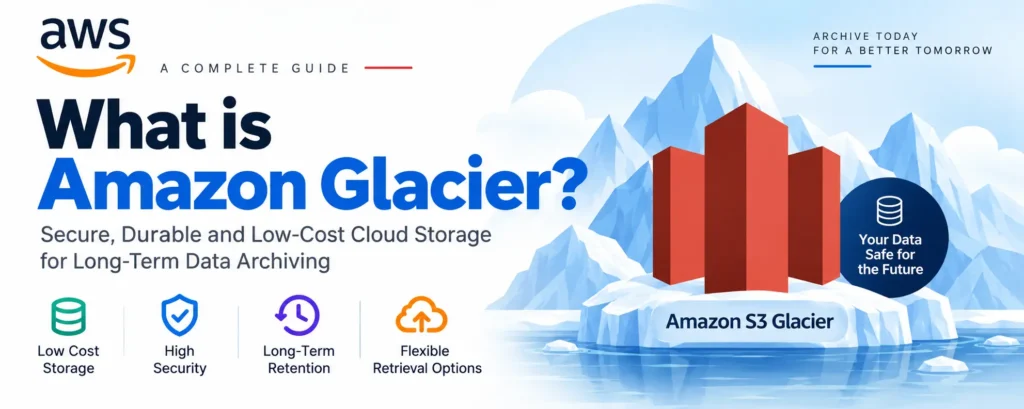
Amazon Glacier, now known as Amazon S3 Glacier, is a cloud storage service from Amazon Web Services (AWS) designed for secure, durable, and cost-effective long-term data archiving. It is particularly useful for data that is rarely accessed but needs to be preserved for backups, compliance, audits, or historical purposes.
Within the AWS storage ecosystem, different storage options are designed for different access requirements. Amazon S3 Glacier focuses on reducing storage costs for data that does not need to be accessed frequently.
Complete Advance AI Topics: Click Here
SQL Tutorial: Click Here
What is Amazon S3 Glacier?
Amazon S3 Glacier provides low-cost cloud storage for data archiving and long-term backup. It is designed for organizations and applications that need to retain large amounts of data while keeping storage expenses low.
Unlike frequently accessed Amazon S3 storage classes, Glacier is intended for data that can tolerate longer retrieval times. It also integrates with Amazon S3 lifecycle policies, allowing data to automatically move from frequently accessed storage to archival storage according to defined rules.
Amazon Glacier Terminology
Before working with Amazon S3 Glacier, it is useful to understand some of its important concepts:
- Vault: A vault is a container used to organize and store archives in the original Amazon Glacier vault-based service.
- Archive: An archive is the actual data stored in Glacier, such as a document, image, backup, or other file.
- Jobs: Jobs are operations performed on archived data, such as retrieving an archive or generating an inventory.
Vault Operations in Amazon Glacier
Vault-level operations allow you to manage archived data and control how it is accessed and protected.
- Create and configure vaults using AWS management tools, APIs, CLI, or SDKs.
- Configure Amazon SNS notifications for completed jobs.
- Generate vault inventory reports containing information about stored archives.
- Use Vault Lock to establish compliance controls and prevent unwanted changes to retention policies.
Managing Archives in Glacier
Glacier archives can be uploaded and managed using AWS APIs, SDKs, and command-line tools. Large files can also be uploaded using multipart upload capabilities.
When archived data is needed, you initiate a retrieval job. The retrieval time and cost depend on the Glacier storage class and retrieval option being used.
Amazon Glacier Retrieval Options
Amazon S3 Glacier provides different retrieval options so organizations can choose an appropriate balance between speed and cost. The exact retrieval times depend on the Glacier storage class.
| Retrieval Option | Typical Speed | Suitable For |
|---|---|---|
| Expedited | Minutes | Urgent data recovery |
| Standard | Minutes to hours, depending on storage class | Regular archive retrieval |
| Bulk | Hours | Large-scale, non-urgent retrievals |
Retrieval availability and pricing vary by the specific S3 Glacier storage class, so you should check the current AWS pricing before selecting a retrieval option.
Amazon Glacier API for Developers
Developers can interact with Glacier programmatically through AWS APIs and SDKs. These capabilities can be integrated into applications, backup systems, and automated data-management workflows.
Common operations include:
- Creating and deleting vaults
- Uploading and retrieving archives
- Starting archive retrieval jobs
- Generating inventory reports
- Configuring vault notifications
AWS SDKs are available for popular programming languages, including Java, Python, .NET, and others.
Important Features of Amazon S3 Glacier
- Low-Cost Archival Storage: Glacier is optimized for storing data that is rarely accessed.
- Durability: AWS provides highly durable storage infrastructure for archived data.
- Security: Glacier integrates with AWS security services and supports encryption.
- Lifecycle Management: Amazon S3 lifecycle rules can automatically transition objects to archival storage classes.
- Vault Lock: Helps organizations implement retention and compliance controls.
- Inventory: Inventory operations help manage large collections of archived data.
- Automation: AWS CLI, APIs, and SDKs allow Glacier workflows to be automated.
Amazon Glacier Pricing
Amazon S3 Glacier pricing depends on factors such as the storage class, amount of data stored, requests, retrieval volume, and data transfer. Because AWS pricing can change, it is important to use the current AWS pricing information or pricing calculator when estimating costs.
| Factor | Impact on Cost |
|---|---|
| Storage | Based on the amount of archived data stored |
| Retrieval | Depends on retrieval type and storage class |
| Requests | API and other requests may incur charges |
| Data Transfer | Charges may apply depending on where data is transferred |
How to Get Started with Amazon S3 Glacier
- Create an AWS account and access the Amazon S3 service.
- Create an S3 bucket for your data.
- Configure a lifecycle policy to transition objects to an appropriate S3 Glacier storage class.
- Use the AWS Management Console, AWS CLI, or SDKs to manage your data.
- Configure appropriate security, retention, and notification settings for your workload.
What is Amazon Glacier Used For?
Amazon Glacier is commonly used for data that needs to be retained for a long period but is not accessed regularly.
- Database backups
- Disaster recovery archives
- Compliance and regulatory records
- Historical data
- Application backups
- Media and document archives
- Long-term enterprise data retention
Amazon Glacier vs Amazon S3
Amazon S3 is a broader object-storage service with storage classes designed for different access patterns. S3 Glacier storage classes are part of the Amazon S3 storage ecosystem and are optimized for archival workloads.
The key difference is the intended access pattern: frequently accessed data is generally better suited to an appropriate standard S3 storage class, while rarely accessed data that must be retained for longer periods can be moved to a Glacier storage class to reduce storage costs.
YT:- DecodeIT
Final Thoughts
Amazon S3 Glacier is a practical solution for organizations that need secure, durable, and economical long-term data storage. Its integration with Amazon S3, lifecycle management, security controls, and multiple retrieval options makes it useful for backups, compliance, disaster recovery, and archival workloads.
Whether you are managing data for a small application or a large enterprise, choosing the right Glacier storage class can help balance storage cost, retrieval speed, and data-retention requirements.
Keywords
what is Amazon Glacier, Amazon Glacier, Amazon S3 Glacier, Amazon Glacier pricing, pricing calculator, Amazon Glacier storage, Amazon Glacier used for, AWS, how Amazon Glacier works, Amazon Glacier retrieval, S3 Glacier Flexible Retrieval, vault, archive, Amazon S3 and Glacier, Amazon S3 Glacier and EC2