
The Harsh Reality of Being a Data Scientist
In today’s digital world, the role of a Data Scientist is often portrayed as one of the most prestigious and rewarding careers in technology. Social media, tech conferences, and online communities frequently present data science as a high-paying profession filled with innovation, exciting challenges, and unlimited opportunities.
But the reality is much more complicated.
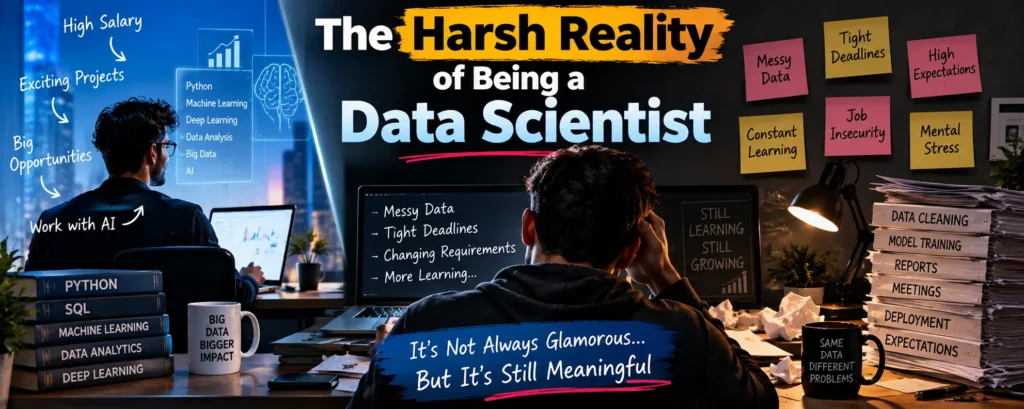
Behind the impressive job titles and advanced machine learning models, data scientists often deal with messy datasets, tight deadlines, changing requirements, business pressure, and the constant need to learn new technologies.
So, what is it really like to work as a data scientist?
Let’s take a realistic look at the responsibilities, challenges, job-market realities, and pressures that come with a career in data science.
Complete Advance AI Topics: Click Here
SQL Tutorial: Click Here
Who Is a Data Scientist?
A data scientist is a professional who works with large amounts of data to discover useful patterns, generate insights, and support better business decisions.
Data scientists typically combine several areas of knowledge, including:
- Programming
- Statistics
- Machine Learning
- Data Analysis
- Data Visualization
- Domain Knowledge
However, data science is not only about writing Python code or training machine learning models. Data scientists also need to communicate their findings to stakeholders, understand business requirements, collaborate with different teams, and make sure their solutions actually solve meaningful problems.
What Do Data Scientists Actually Do?
The glamorous version of data science often focuses on machine learning models and artificial intelligence while ignoring much of the day-to-day work involved in getting those models to work properly.
Here are some of the major responsibilities that data scientists deal with in real-world projects.
1. Data Preprocessing
Before a data scientist can build a model, the data usually needs significant preparation.
Real-world datasets can contain missing values, duplicate records, inconsistent formats, incorrect entries, and irrelevant information. Cleaning and preparing this data can take a large portion of a project.
Common tasks include:
- Handling missing values
- Removing duplicate records
- Correcting inconsistent data
- Detecting outliers
- Transforming variables
- Preparing data for machine learning
It may not be the most exciting part of data science, but good data preprocessing is essential for reliable results.
2. Model Development and Statistical Analysis
Once the data is prepared, data scientists can begin exploring patterns and developing analytical or machine learning solutions.
Depending on the business problem, this might involve customer segmentation, fraud detection, demand forecasting, recommendation systems, classification, regression, or other predictive tasks.
Building a successful model rarely happens in a single attempt. Data scientists often need to experiment with different approaches, evaluate results, tune parameters, and improve their models repeatedly.
3. Domain Knowledge Integration
Technical knowledge alone is not enough to become an effective data scientist.
A data scientist must understand the industry and business context in which the data is being used. For example, a data scientist working in healthcare needs to understand relevant clinical processes and regulations, while someone working in finance needs knowledge of markets, risk, and financial behavior.
A technically accurate model can still fail if it does not make sense in the real-world context.
4. Effective Communication
Communication is one of the most underestimated skills in data science.
A data scientist may create a highly accurate model, but the work has little value if business leaders cannot understand what the results mean or how they should be used.
Data scientists therefore need to explain complex findings using clear language, visualizations, reports, and presentations that non-technical stakeholders can understand.
Breaking the Myths: What Data Science Isn’t
Many people believe that being a data scientist means spending most of the day building advanced algorithms, experimenting with artificial intelligence, and working with futuristic technologies.
Those things can certainly be part of the job, but they represent only one part of the overall role.
In reality, data scientists often spend considerable time:
- Working with incomplete or disorganized datasets
- Understanding business requirements
- Translating business problems into analytical problems
- Validating and cleaning data
- Explaining results to non-technical teams
- Managing expectations across departments
- Learning new tools and technologies
The Tough Truths of the Job
Too Much Data, Not Enough Time
Organizations generate enormous amounts of data, but having more data does not automatically make analysis easier.
Data may come from multiple systems and sources, with different formats and varying levels of quality. Understanding which data is reliable and useful can itself become a major challenge.
Never-Ending Learning Curve
Technology in data science changes rapidly. New libraries, frameworks, machine learning techniques, cloud platforms, and AI technologies appear regularly.
As a result, data scientists need to continuously improve their skills. Learning is not something that stops after getting the job. Staying relevant often requires regular practice and learning outside normal working hours.
Pressure to Deliver Results
Businesses usually expect data science projects to produce measurable value.
Whether the goal is increasing revenue, reducing costs, improving customer retention, detecting fraud, or identifying new opportunities, organizations want results. When a project takes longer than expected or fails to deliver measurable business value, the pressure on the data science team can increase significantly.
Ethical Dilemmas
Data science also comes with serious ethical responsibilities.
Working with personal or sensitive information can raise questions about privacy, security, fairness, and responsible data usage. Machine learning models can also inherit biases from the data used to train them.
Data scientists therefore need to think beyond model accuracy and consider the potential impact of their solutions on real people.
Emotional and Mental Strain
Long Hours and High Expectations
Tight deadlines, demanding stakeholders, changing project requirements, and unexpected technical problems can sometimes result in long working hours.
When several responsibilities come together, maintaining a healthy balance can become difficult.
Mental Fatigue and Burnout
Data science involves solving complex and uncertain problems. A project may require hours of analysis without producing an immediate answer.
When this intellectual workload is combined with deadlines and high expectations, it can contribute to mental fatigue and burnout.
Poor Work-Life Balance
During critical project periods, data scientists may find it difficult to completely disconnect from work.
Constantly checking project updates, responding to messages, or thinking about unresolved problems can gradually blur the boundary between professional and personal life.
Job Market Realities
Fierce Competition
Data science remains an attractive career option, but that also means competition can be intense.
The growth of bootcamps, online courses, university programs, and career-switching opportunities has brought many new candidates into the field. Having a data science certificate alone is often not enough to stand out.
Practical experience, strong fundamentals, projects, communication skills, and domain knowledge can make a significant difference.
Job Insecurity
Although data science is an important function for many organizations, data science teams are not completely protected from economic downturns or organizational restructuring.
Changes in business priorities, budgets, and company strategy can affect data-related roles just like other technology positions.
Constant Evolution
The data science field continues to evolve rapidly. Technologies such as generative AI, AutoML, edge computing, large language models, and modern data engineering platforms continue to influence how data professionals work.
Adaptability is therefore one of the most important qualities for anyone planning a long-term career in data science.
How to Cope: Practical Strategies
Prioritize Mental Well-Being
Maintaining a sustainable working routine is important in a demanding technical career.
Setting reasonable boundaries, taking regular breaks, spending time away from screens, and seeking professional support when necessary can help prevent excessive stress from building up.
Build a Support Network
You do not have to handle every challenge alone.
Connecting with other data professionals, joining communities, finding mentors, and discussing challenges with peers can provide valuable perspective and support.
Keep Learning Strategically
Continuous learning is important, but trying to learn everything at once can quickly become overwhelming.
Instead of constantly jumping between technologies, focus on developing depth in an area that interests you. This could include fields such as:
- Natural Language Processing
- Computer Vision
- Data Engineering
- Machine Learning
- Generative AI
- Data Analytics
Strategic learning is generally more sustainable than trying to follow every new trend.
Download New Real Time Projects: Click here
Conclusion
Data science is a powerful and exciting career that offers opportunities to solve meaningful problems and work with technologies that are changing the way organizations operate.
However, the profession is not always as glamorous as it appears online.
Behind the impressive models and successful projects are hours of data cleaning, experimentation, debugging, communication, learning, and dealing with uncertainty. Data scientists may also face tight deadlines, business pressure, ethical challenges, intense competition, and changing job requirements.
Understanding these realities can help aspiring and existing data scientists prepare for both the opportunities and challenges of the profession.
With the right mindset, strong technical and communication skills, a supportive network, and a commitment to continuous but focused learning, data scientists can build sustainable careers and make meaningful contributions in a data-driven world.
Written by Team
Stay updated with the latest insights, career tips, and tech realities in the world of data.
Keywords
Data Scientist, Data Science, Harsh Reality of Being a Data Scientist, Data Scientist Career, Data Science Career, Data Science Jobs, Data Scientist Challenges, Data Science Reality, Data Scientist Skills, Machine Learning Career, Data Science Job Market, Data Science Challenges