
Introduction
Convolutional Neural Networks (CNNs) are a class of deep learning models primarily designed to process data with a grid-like structure, especially images. CNNs are highly effective at identifying visual patterns because they learn features automatically from input data.
A CNN typically begins by detecting simple features such as edges, lines, and textures. As the data passes through deeper layers, the network combines these features to recognize more complex patterns such as shapes, objects, and faces.
This hierarchical learning process makes CNNs one of the most important architectures for computer vision and image-based applications.
Related Tutorials:
- Complete Python Course with Advanced Topics
- SQL Tutorial
- Machine Learning Tutorial
- Deep Learning Tutorial
Complete Advance AI Topics: Click Here
SQL Tutorial: Click Here
What is a Convolutional Neural Network?
A Convolutional Neural Network (CNN) is a type of deep neural network designed to learn spatial and hierarchical features from structured data. CNNs are especially useful for images because they preserve the spatial relationship between pixels while extracting meaningful features.
CNNs were strongly influenced by research into biological vision, and the development of modern CNNs was pioneered by researchers including Yann LeCun. They are widely used for image classification, object detection, image segmentation, facial recognition, medical image analysis, and many other computer vision tasks.
Understanding CNN Layers
A CNN is generally built using several types of layers. Each layer performs a specific operation and contributes to the overall learning process.
- Convolutional Layer
- Padding and Stride
- Pooling Layer
- Fully Connected Layer
- Dropout Layer
- Activation Functions
These components work together to transform raw input data into useful features and, ultimately, predictions.
1. Convolutional Layer
The convolutional layer is one of the most important components of a CNN. It applies small learnable filters, also called kernels, to the input image to detect useful patterns.
During convolution, a filter moves across the input and performs mathematical operations on small regions of pixels. The resulting values form a feature map.
Depending on what the network learns, different filters can detect features such as:
- Edges
- Corners
- Textures
- Curves
- Shapes
In deeper CNN layers, these simple features can be combined to recognize increasingly complex structures.
Important Concepts in Convolution
- Parameter Sharing: The same filter weights are reused across different spatial locations, significantly reducing the number of parameters.
- Local Connectivity: Each neuron focuses on a small local region of the input rather than connecting to every input pixel.
- Feature Extraction: Filters automatically learn useful visual patterns during training.
A convolutional layer is commonly followed by an activation function such as ReLU to introduce non-linearity.
2. Padding and Stride
Padding and stride control how a convolutional filter operates on the input and influence the size of the resulting feature map.
Padding
Padding adds extra pixels around the boundary of an input. Zero padding, one of the most common approaches, adds pixels with a value of zero.
Padding can help preserve spatial dimensions and allows filters to process information near the edges of an image more effectively.
Stride
Stride determines how many pixels the filter moves after each operation.
- A stride of 1 moves the filter one pixel at a time.
- A larger stride reduces the spatial dimensions of the output more quickly.
- Stride can therefore affect both computational cost and the amount of spatial information retained.
Convolution Output Size
For a single spatial dimension, the output size can be calculated as:
Output Size = ((W – F + 2P) / S) + 1
- W = Input size
- F = Filter size
- P = Padding
- S = Stride
For the formula to produce an integer output size, the selected dimensions, padding, filter size, and stride must be compatible.
3. Pooling Layer
A pooling layer is used to reduce the spatial dimensions of feature maps. This process, known as downsampling, can reduce computation and the number of values that later layers need to process.
Pooling can also make learned representations less sensitive to small spatial changes in the input.
Common Types of Pooling
Max Pooling
Max pooling selects the largest value from each region of the feature map. It is useful when the strongest detected feature is the most important information.
Average Pooling
Average pooling calculates the average value of the elements within each selected region.
For example, a 2 × 2 pooling window with a stride of 2 can reduce the height and width of a feature map by approximately half.
4. Fully Connected Layer
The Fully Connected (FC) layer connects each neuron in one layer to the neurons in the next layer. It is similar to the layers used in traditional feedforward neural networks.
In traditional CNN architectures, the feature maps produced by convolution and pooling layers are eventually converted into a one-dimensional representation before being passed to fully connected layers.
These layers combine the extracted features to produce the final classification or prediction.
For example, in an image classification problem, the network may use the learned features to determine whether an image contains a cat, dog, car, or another object.
Because fully connected layers can contain many parameters, they may contribute significantly to overfitting. Modern architectures often reduce or replace large fully connected sections with techniques such as global average pooling.
5. Dropout Layer
Dropout is a regularization technique used to help reduce overfitting. During training, dropout randomly sets a fraction of activations to zero.
For example, with a dropout rate of 0.3, approximately 30% of the selected activations are randomly dropped during each training step.
This encourages the network to avoid relying too heavily on individual neurons and can improve its ability to generalize to unseen data.
Dropout is normally active during training and disabled during inference.
6. Activation Functions
Activation functions introduce non-linearity into neural networks. Without non-linear activation functions, stacking multiple linear layers would still result in a fundamentally linear transformation.
Some commonly used activation functions include:
ReLU (Rectified Linear Unit)
The ReLU function is defined as:
f(x) = max(0, x)
ReLU is widely used in CNNs because it is computationally simple and helps neural networks learn complex patterns efficiently.
One potential problem is the dying ReLU issue, where some neurons can become inactive and consistently output zero.
Sigmoid
The sigmoid function is:
σ(x) = 1 / (1 + e-x)
It produces values between 0 and 1 and is commonly useful for binary classification output layers. However, sigmoid can suffer from vanishing gradients when used extensively in deep hidden layers.
Tanh
The Tanh activation function produces values between -1 and 1.
Unlike sigmoid, tanh is zero-centered, but it can also experience vanishing-gradient problems for very large positive or negative inputs.
Softmax
Softmax is commonly used in the output layer of multi-class classification models. It converts a set of logits into values that sum to 1, which can be interpreted as a probability distribution across the classes.
Typical CNN Architecture
A simple CNN for image classification may follow a structure such as:
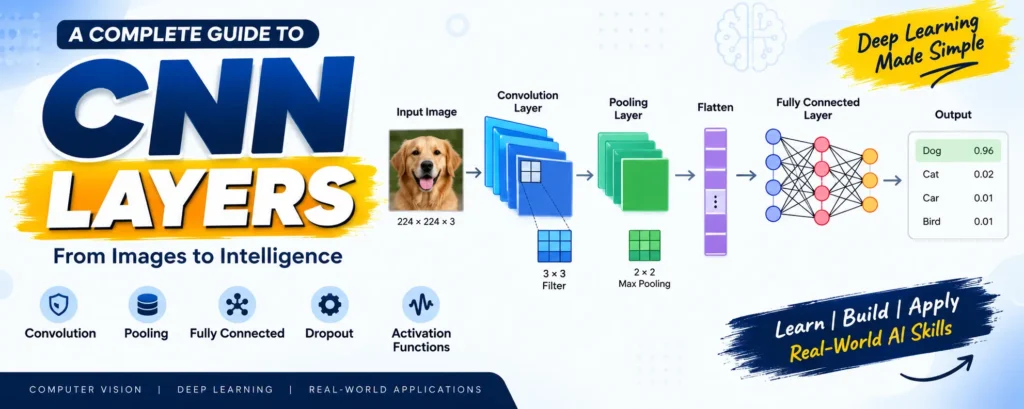
Input Image → Convolution → ReLU → Pooling → Convolution → ReLU → Pooling → Flatten/Global Pooling → Fully Connected Layer → Output
The exact architecture varies depending on the problem and model design. Modern CNNs may also include batch normalization, residual connections, normalization layers, attention mechanisms, and other components.
Benefits of Using CNNs
- Automatic Feature Extraction: CNNs learn useful features directly from training data instead of requiring all features to be manually designed.
- Parameter Efficiency: Local connectivity and parameter sharing reduce the number of parameters compared with fully connected networks operating directly on images.
- Strong Computer Vision Performance: CNNs are highly effective for many image-related tasks.
- Transfer Learning: Pre-trained CNN models can be adapted to new datasets and applications.
- Hierarchical Feature Learning: Deeper layers can learn increasingly complex representations.
Limitations of CNNs
- Training Cost: Large CNNs can require significant computational resources.
- Data Requirements: Complex models may require substantial amounts of labeled training data, although transfer learning can reduce this requirement.
- Overfitting: CNNs can overfit when the model is too complex relative to the available data.
- Interpretability: Understanding exactly why a deep CNN produces a particular prediction can be difficult.
- Architecture Design: Selecting an appropriate architecture, training strategy, and hyperparameters can require experimentation.
Applications of CNNs
Healthcare
CNNs can analyze medical images such as X-rays, CT scans, MRI images, and pathology slides to assist with detecting and classifying visual patterns.
Automotive
Computer vision systems use CNN-based models for tasks such as object detection, lane detection, traffic-sign recognition, and scene understanding.
Social Media
CNNs can support image classification, automatic tagging, visual search, and content moderation systems.
Retail
Retail platforms can use computer vision models for visual product search, product classification, image-based recommendations, and inventory-related applications.
Security and Surveillance
CNN-based computer vision systems can be used for object detection, image classification, and activity analysis in video streams.
Speech and Audio Processing
Although CNNs are strongly associated with images, they can also process representations such as spectrograms for certain speech and audio recognition tasks.
CNN Layers: Quick Summary
| Layer | Main Purpose |
|---|---|
| Convolution | Extracts local features such as edges, textures, and patterns. |
| Padding | Controls border handling and can help preserve spatial dimensions. |
| Stride | Controls how far the convolution filter moves at each step. |
| Pooling | Reduces spatial dimensions and computational requirements. |
| Fully Connected | Combines learned features for classification or prediction. |
| Dropout | Helps reduce overfitting during training. |
| Activation | Introduces non-linearity into the neural network. |
YT:- DecodeIT
Conclusion
Convolutional Neural Networks (CNNs) are a fundamental deep learning architecture for processing visual and other grid-structured data. Their ability to automatically learn hierarchical features makes them particularly effective for computer vision applications.
Convolutional layers extract features, pooling layers reduce spatial dimensions, activation functions introduce non-linearity, dropout can improve generalization, and classification layers transform learned features into predictions.
From medical image analysis and autonomous vehicles to visual search and image classification, CNNs continue to play an important role in modern artificial intelligence and computer vision systems.
Keywords
CNN Layers, Convolutional Neural Network, CNN Architecture, Convolutional Layer, Pooling Layer, Fully Connected Layer, Dropout Layer, ReLU, Sigmoid, Tanh, Softmax, Padding and Stride, Deep Learning, Machine Learning, Computer Vision, Image Classification, CNN Tutorial, Deep Learning Tutorial