
Data Ingestion Tutorial
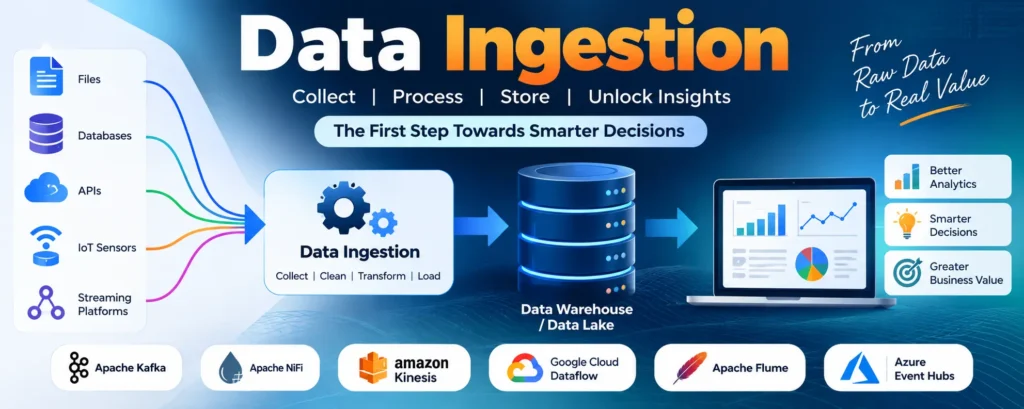
In today’s data-driven world, data ingestion is one of the most important steps in turning raw information into useful insights. It refers to the process of collecting and moving data from different sources into a centralized processing or storage system, such as a database, data warehouse, or data lake.
Organizations work with data from many sources, including files, APIs, databases, IoT sensors, and streaming platforms. Before this information can be analyzed, it often needs to be cleaned, transformed, and structured properly. Data ingestion can happen in batches or in real time, and the quality of this process directly affects the reliability and usefulness of downstream analytics.
Complete Advance AI Topics: Click Here
SQL Tutorial: Click Here
The Significance of Data Ingestion in Data Management
Efficient data ingestion forms the foundation of effective data management. By providing a reliable way to bring information into a system, organizations can improve data accuracy, completeness, and timeliness.
Without a proper ingestion process, businesses may end up making decisions using outdated, incomplete, or inconsistent information. A well-designed ingestion pipeline also supports important downstream activities such as data integration, transformation, and analysis.
Types of Data Ingestion
1. Batch Data Ingestion
Batch data ingestion collects and processes data at scheduled intervals, such as hourly, daily, or weekly. It is suitable for applications that do not require continuously updated information.
Use Cases: Business intelligence dashboards, ETL pipelines, reporting systems, and historical analysis.
2. Real-Time Data Ingestion
Real-time data ingestion, also known as streaming ingestion, processes information as soon as it is generated. This approach is useful for systems where decisions need to be made quickly based on continuously changing data.
Use Cases: Fraud detection, IoT monitoring, live analytics, and recommendation engines.
3. Incremental Data Ingestion
Incremental ingestion transfers only new or updated records instead of processing the complete dataset every time. This can significantly reduce processing time, storage requirements, and resource consumption.
Use Cases: CRM synchronization, versioned databases, and large-scale analytics systems where only a portion of the data changes regularly.
4. Full Data Ingestion
Full data ingestion imports the entire dataset during each ingestion cycle. Although it can require more resources, it is straightforward to implement and can work well with smaller or relatively static datasets.
Use Cases: Initial data loads, backup recovery, and small static datasets.
5. Hybrid Data Ingestion
Hybrid data ingestion combines batch and real-time ingestion approaches. It provides organizations with the flexibility to process historical data while also handling continuously generated information.
Use Cases: E-commerce platforms, financial analytics, and healthcare monitoring systems.
Popular Tools & Platforms for Data Ingestion
Apache Kafka
Apache Kafka is a high-throughput, distributed platform commonly used for building real-time data pipelines. It provides scalability and fault tolerance, making it suitable for event-driven architectures and streaming workloads.
Apache NiFi
Apache NiFi is a user-friendly data flow automation platform. Its visual interface makes it easier to route, transform, and move data between different systems. It can support both batch-oriented and streaming data workflows.
Amazon Kinesis
Amazon Kinesis is an AWS service designed for collecting and processing streaming data at scale. It can simplify the ingestion and processing of continuously generated data for real-time applications.
Google Cloud Dataflow
Google Cloud Dataflow is a fully managed data processing service based on Apache Beam. It supports both batch and streaming workloads and can be used to build data processing pipelines on Google Cloud.
Apache Flume
Apache Flume is designed primarily for collecting and transporting large amounts of log and event data. It can move data from different sources to storage systems such as Hadoop HDFS.
Azure Event Hubs
Azure Event Hubs is a managed data streaming platform from Microsoft. It is designed to handle high-throughput event ingestion and is commonly used for collecting telemetry and application data for real-time analytics.
Download New Real Time Projects :- Click here
Final Thoughts
Data ingestion may operate behind the scenes, but it is a critical component of modern data ecosystems. Whether an organization is monitoring IoT devices in real time or preparing data for monthly reports, an effective ingestion strategy helps ensure that information is accurate, timely, and reliable.
As organizations continue to increase the number and variety of their data sources, selecting the right ingestion approach and tools becomes increasingly important. Platforms such as Apache Kafka, Apache NiFi, and Google Cloud Dataflow provide different capabilities for handling modern data ingestion requirements.
With a well-designed ingestion process, data ingestion becomes more than a backend operation. It becomes an important part of building reliable analytics, improving decision-making, and creating value from organizational data.
Keywords
Data Ingestion, Data Ingestion Types, Batch Data Ingestion, Real-Time Data Ingestion, Incremental Data Ingestion, Full Data Ingestion, Hybrid Data Ingestion, Apache Kafka, Apache NiFi, Amazon Kinesis, Google Cloud Dataflow, Apache Flume, Azure Event Hubs, Data Pipeline, Data Management Data Ingestion, Data Ingestion Types, Data Ingestion Tools, Batch Data Ingestion, Real-Time Data Ingestion, Incremental Data Ingestion, Full Data Ingestion, Hybrid Data Ingestion, Data Pipeline, Data Management, Apache Kafka, Apache NiFi, Amazon Kinesis, Google Cloud Dataflow, Apache Flume, Azure Event Hubs, Streaming Data, Data Warehouse, Data Lake, Data Processing