
Machine Learning for Data Science
We live in a time when machines can learn from data, identify patterns, and make decisions with remarkable speed and accuracy. Welcome to the world of Machine Learning (ML), an important subset of Artificial Intelligence (AI). While AI represents the broader concept of intelligent machines, Machine Learning focuses specifically on the ability of computers to learn from data.
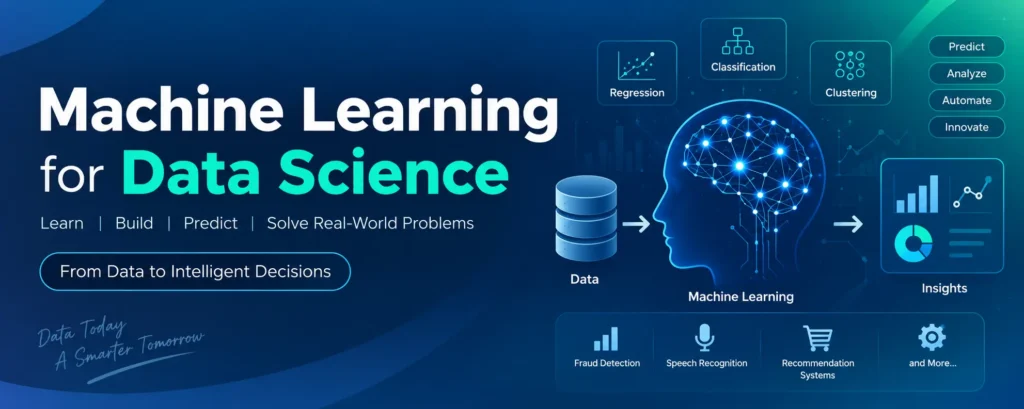
Machine Learning enables computers to discover patterns, generate insights, and make predictions with minimal human intervention. With the right dataset and suitable algorithms, ML can solve complex problems across different industries. Data Science provides the foundation for many machine learning applications, from fraud detection and speech recognition to recommendation systems.
Table of Contents
Complete Advance AI Topics: Click Here
SQL Tutorial: Click Here
Let’s explore how Machine Learning supports Data Science and how the complete process works.
Machine Learning Tutorial
The Role of Machine Learning in Data Science
Machine Learning acts as an important engine of modern Data Science. It helps automate the analysis of large datasets and enables organizations to build models that can identify patterns, make predictions, and improve their performance over time.
Traditional programming generally depends on explicitly defined rules. Machine Learning takes a different approach by using data to discover patterns and relationships.
Within the Data Science lifecycle, Machine Learning becomes particularly important after data has been collected, cleaned, and transformed into useful features. ML algorithms are then used to train models that learn from historical data. These models are evaluated and eventually deployed to generate predictions and support data-driven decisions.
Key Stages of Machine Learning in Data Science
The Machine Learning process in Data Science can be divided into several important stages.
1. Data Collection
Every Machine Learning project begins with data. The quality and relevance of the collected data have a direct impact on the performance of the final model.
The dataset serves as the training ground from which the machine learning algorithm learns patterns and relationships.
2. Data Preparation
Raw data usually contains missing values, duplicate records, errors, or inconsistent formats. Data preparation involves cleaning and transforming the dataset so that it can be effectively used by a machine learning model.
The prepared dataset is generally divided into different portions, including data used for training and data reserved for testing the model.
3. Model Training
This is where the actual learning process begins. The model uses the training dataset to learn relationships between input features and expected outputs.
Initially, the model may produce inaccurate results. During training, it adjusts its internal parameters to reduce errors and improve its predictions. This process can be compared to learning through trial and error.
4. Model Evaluation
After training, the model needs to be tested using data it has not previously seen. This helps determine whether the model has learned useful patterns that can be applied to new data.
The main objective is to measure how well the model generalizes to real-world situations rather than simply memorizing the training data.
5. Prediction and Deployment
Once the model performs satisfactorily, it can be deployed for practical use. The deployed model can process new data and generate predictions or insights in real time.
Depending on the application, models may continue to require monitoring, improvement, and tuning after deployment.
Popular Machine Learning Algorithms in Data Science
Different Data Science problems require different Machine Learning approaches. Some of the commonly used approaches include regression, classification, and clustering.
Regression
Regression is used to predict continuous numerical values such as prices, temperatures, sales, or revenue.
Linear Regression is a well-known example in which the algorithm attempts to establish a relationship between variables and use that relationship to predict an outcome.
Classification
Classification is used when the expected output belongs to a category or class.
Examples include:
- Spam vs. non-spam
- Positive vs. negative sentiment
- Fraudulent vs. legitimate transactions
Common classification algorithms include Decision Trees and Logistic Regression.
Clustering
Clustering is an unsupervised learning technique where the algorithm attempts to discover natural groups or patterns in data without predefined labels.
A common application is customer segmentation, where customers can be grouped according to similarities in their behavior, preferences, or purchasing patterns.
Challenges of Machine Learning in Data Science
Although Machine Learning is powerful, implementing it successfully can involve several challenges.
1. Lack of Quality Training Data
Machine Learning models require sufficient, relevant, and high-quality data. Collecting and labeling large datasets can be expensive and time-consuming.
Transfer Learning can help address this problem by allowing knowledge learned by an existing model to be reused for another related task.
2. Difference Between Training Data and Real-World Data
A model may perform well on training and testing datasets but behave differently when exposed to real-world data. Differences caused by regions, seasons, devices, user behavior, or other environmental factors can affect model performance.
Regular model updates and collecting data that accurately represents the target environment are important for maintaining reliable performance.
3. Model Scalability
As applications and businesses grow, machine learning models may need to process larger amounts of data while remaining efficient.
Techniques such as Post-Training Quantization can reduce model size and computational requirements while attempting to preserve acceptable accuracy. This can make models easier to deploy across different devices and environments.
YT:- DecodeIT
Real-World Applications of Machine Learning in Data Science
Machine Learning is widely used in practical applications across industries. Some common examples include fraud detection, speech recognition, and recommendation systems.
Fraud Detection
Banks and financial technology companies use Machine Learning to identify unusual transaction patterns. Models can learn what normal customer behavior looks like and flag transactions that appear suspicious.
Speech Recognition
Voice assistants such as Siri and Google Assistant use Machine Learning to process and interpret spoken language. Models can be trained using large datasets containing different languages, voices, accents, and speech patterns.
Recommendation Systems
Recommendation systems are widely used by online platforms to provide personalized suggestions. Services such as Amazon and Netflix analyze user behavior and preferences to recommend products, movies, shows, or other content.
Conclusion
Machine Learning is a fundamental part of modern Data Science. It enables computers to learn from data, identify patterns, adapt to new information, and make predictions.
Whether it is supervised learning using labeled datasets or unsupervised learning for discovering hidden patterns, Machine Learning provides powerful techniques for solving real-world problems.
As you learn Machine Learning, explore different programming languages, tools, and platforms used for model development, including Python, R, TensorFlow, and PyTorch. The most effective way to improve your skills is to practice by building projects, testing different approaches, learning from errors, and continuously improving your models.
Machine Learning continues to play a major role in the evolution of Data Science. Start experimenting with data, build practical models, and let the data guide your decisions.
Keywords
machine learning for data science, machine learning for data science pdf, machine learning for data science course, machine learning for data science book, machine learning for data science notes, machine learning for data science syllabus, machine learning for data science free, machine learning for data science RGPV notes, machine learning for data science IISc, DSCI 552 machine learning for data science, introduction to machine learning for data science, do you need machine learning for data science, statistics and machine learning for data science, how important is machine learning for data science, Python machine learning for data science, machine learning for data science Columbia, master machine learning for data science, learn machine learning for data science, machine learning for data science and analytics, machine learning for data science and analytics by ColumbiaX