What is Data Mesh
In today’s digital world, self-service business intelligence is becoming increasingly important as organizations work toward becoming more data-driven. Businesses rely on data to make informed decisions, deliver personalized services, and optimize costs.
However, moving toward a data-driven strategy comes with several challenges. Organizations need to move beyond legacy systems, respond to changing business requirements, and overcome limitations in their existing data architecture.
Traditional data warehouses and data lakes can struggle with real-time data requirements, scalability, and data democratization. This is where Data Mesh provides an alternative approach by decentralizing data ownership, improving collaboration, and enabling self-service analytics.
Let’s explore Data Mesh and understand how it can reshape modern enterprise data architecture.
Table of Contents
Complete Advance AI Topics: Click Here
SQL Tutorial: Click Here
What is Data Mesh?
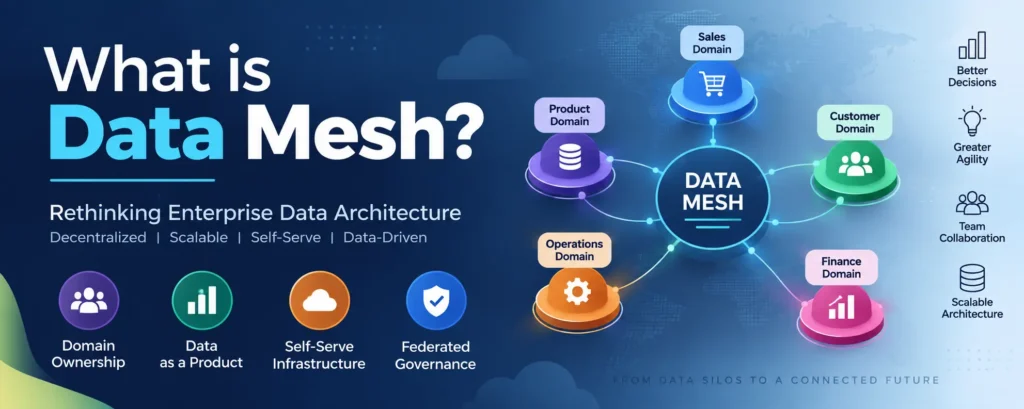
Data Mesh is a modern approach to data architecture that moves away from a completely centralized data platform toward a decentralized, domain-oriented model. Similar to how microservices changed software architecture, Data Mesh aims to change how organizations manage and use data at scale.
The concept was coined by Zhamak Dehghani at ThoughtWorks. Data Mesh allows organizations to organize data around business domains rather than relying entirely on a central data team.
In a Data Mesh architecture, domain teams take responsibility for the data they understand best and treat that data as a product. This approach improves data ownership, accessibility, and usability while reducing dependency on a centralized team.
Successful Data Mesh implementation also requires federated governance so that individual domains can maintain autonomy while following common standards for security, interoperability, and data management.
Problems Data Mesh Solves
Traditional data architectures can create several challenges as organizations grow.
1. Monolithic Data Platforms Can Become Bottlenecks
- Traditional data lakes and data warehouses may struggle to support diverse data sources and domain-specific requirements.
- Centralized platforms can make it difficult to preserve important domain-specific knowledge.
- Data teams can become overloaded as more departments depend on the same centralized infrastructure.
2. Data Pipelines Can Create Bottlenecks
- Data transformation, processing, and delivery may depend heavily on a central data engineering team.
- Multiple processing layers can increase delays and make data less accessible.
- Growing numbers of data requests can create backlogs and slow down analytics projects.
3. Lack of Collaboration Between Data Teams
- Data engineers, analysts, and domain experts may work independently.
- Limited communication can lead to misalignment between technical and business requirements.
- Valuable data may remain underutilized because the teams responsible for producing it are separated from its users.
Three Key Components of Data Mesh
A successful Data Mesh implementation depends on several important capabilities.
1. Domain-Oriented Data Ownership and Pipelines
- Data ownership is distributed across business domains.
- Domain teams are responsible for managing and maintaining their data.
- Each domain can build and operate the pipelines needed to provide reliable data to consumers.
2. Self-Serve Data Infrastructure
- A domain-neutral infrastructure platform provides common tools and capabilities.
- Domain teams can use shared services for data ingestion, transformation, storage, and processing.
- Self-service capabilities reduce dependency on a central team for routine data operations.
3. Interoperability and Standardization
- Common data governance rules help maintain consistency across domains.
- Shared standards make it easier for different domains to exchange and consume data.
- Metadata management improves data discovery and cross-domain collaboration.
Four Core Principles of Data Mesh
Data Mesh is based on four fundamental principles.
1. Domain-Oriented Decentralized Data Ownership
Data ownership is distributed among the teams that have the greatest understanding of their respective business domains.
This approach allows domain teams to make changes more quickly while reducing the workload placed on a centralized data team.
2. Data as a Product
Under Data Mesh, data is treated as a product rather than simply an output of an operational system.
Data products should be accessible, trustworthy, understandable, and useful to their intended consumers.
3. Self-Serve Data Infrastructure as a Platform
A shared data platform provides common infrastructure and tools that can be used by multiple domains.
This allows domain teams to maintain autonomy while benefiting from reusable platform capabilities and reduces the need to build everything independently.
4. Federated Computational Governance
Federated governance establishes organization-wide rules and standards while allowing individual domains to retain ownership of their data products.
The goal is to balance domain autonomy with consistency, security, interoperability, and regulatory requirements.
Why Use Data Mesh?
Traditional data architectures often depend on a centralized data team to manage data ingestion, transformation, governance, and access. As the organization grows, this model can lead to increasing pressure on the central team.
A Data Mesh approach can provide several benefits:
- Greater flexibility in data management.
- Improved collaboration between business and data teams.
- Scalable data infrastructure for growing organizations.
- Faster access to data for analytics and decision-making.
- Better domain ownership and accountability for data quality.
Is Data Mesh Right for Your Business?
Data Mesh is not automatically the right architecture for every organization. Before adopting it, businesses should evaluate their existing data environment and organizational structure.
Important factors include:
- Complexity of the data infrastructure.
- Number of business domains and data teams.
- Existing data engineering bottlenecks.
- Data governance and compliance requirements.
- Need for scalability and self-service analytics.
Organizations with many independent business domains, growing data requirements, and significant bottlenecks in centralized data teams may benefit more from a Data Mesh approach.
YT:- DecodeIT
Conclusion
Adopting Data Mesh requires a strategic change in how an organization approaches data architecture, governance, and ownership.
Organizations looking to implement Data Mesh should focus on:
- Redefining data platforms around domain requirements.
- Empowering domain teams to own and manage their data.
- Treating data as a product that serves consumers.
- Implementing federated governance and shared standards.
- Enabling self-service analytics through a common platform.
With the right organizational structure and technical foundation, Data Mesh can help enterprises build a more scalable, flexible, and collaborative data environment.
Keywords
Data Mesh, Data Mesh Architecture, What is Data Mesh, Data Mesh Strategy, Data Mesh Governance, Data Mesh Principles, Data Product, Data Mesh Example, Data Mesh vs Data Lake, Data Mesh vs Data Fabric, Data Fabric, Data Lake, Enterprise Data Architecture data mesh rethinking enterprise data architecture example
mesh data
what is data product and data mesh
what is data mesh strategy
data mesh ppt
data mesh governance
data mesh roles and responsibilities
advantages of data mesh architecture
what is data mesh vs data fabric
what is data mesh book
what is data mesh vs data lake
what is data mesh principles
what is data mesh example
what is data mesh gcp
data mesh smartsheet