
Data Science Process
Introduction
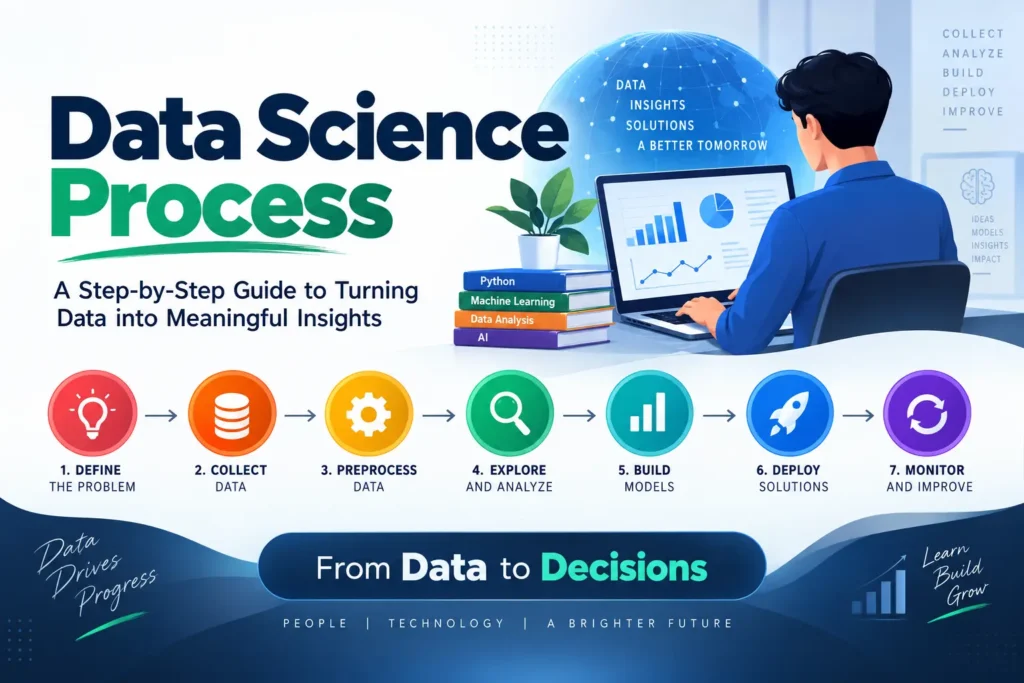
In today’s data-driven world, organizations rely on data to make better decisions, improve products, understand customers, and solve complex problems. From powering artificial intelligence systems to predicting market trends and improving healthcare, the data science process provides a structured approach for turning raw data into useful insights.
The data science process is not simply about building machine learning models. It involves several stages, including defining the problem, collecting and preparing data, exploring patterns, developing models, evaluating results, deploying solutions, and continuously improving them.
In this article, we will explore the complete data science process step by step and understand how each stage contributes to a successful data science project.
Complete Advance AI Topics: Click Here
SQL Tutorial: Click Here
Step 1: Problem Definition
Every data science project begins by clearly identifying the problem that needs to be solved. A well-defined problem gives the team a clear direction and helps determine what data, techniques, and evaluation metrics will be required.
Example: A telecom company wants to reduce customer churn. This objective helps the data science team identify the relevant customer information, choose an appropriate machine learning approach, and define how success will be measured.
Step 2: Data Collection
Once the problem has been defined, the next step is to collect the data required for analysis. Data can come from multiple sources, depending on the project.
- Databases
- APIs
- Web scraping
- IoT devices and sensors
- Business applications
- Existing datasets
Data quality is extremely important at this stage. Incorrect, incomplete, or inconsistent data can negatively affect every stage that follows. This is why data validation, duplicate detection, and missing-value analysis are essential.
Step 3: Data Preprocessing
Raw data is rarely ready to be used directly for analysis or machine learning. Data preprocessing transforms raw information into a cleaner and more useful format.
Common preprocessing activities include:
- Handling missing values
- Removing duplicate records
- Detecting and handling outliers
- Encoding categorical variables
- Scaling numerical features
- Correcting inconsistent data
A properly prepared dataset helps improve the reliability of analysis and machine learning models.
Step 4: Exploratory Data Analysis (EDA)
Exploratory Data Analysis (EDA) is the stage where data scientists investigate the dataset to understand its structure, patterns, relationships, and unusual observations.
During EDA, data scientists may ask questions such as:
- What trends are present in the data?
- Are there relationships between different variables?
- Are there unusual values or outliers?
- Which variables appear to be important?
Statistical methods and visualizations such as histograms, scatter plots, heatmaps, and boxplots are commonly used to understand the data.
Step 5: Feature Engineering
Feature engineering involves creating, transforming, or selecting variables that can help a machine learning model learn more effectively.
Examples of feature engineering techniques include:
- One-hot encoding
- Creating interaction features
- Extracting useful information from text
- Creating sentiment-related features
- Aggregating time-based data
- Transforming numerical variables
Good feature engineering can significantly improve model performance by providing the algorithm with more meaningful information.
Step 6: Model Selection
After understanding and preparing the data, the next step is to select an appropriate machine learning algorithm. The choice depends on the type of problem, the available data, and the desired outcome.
| Problem Type | Example Algorithms |
|---|---|
| Classification | Logistic Regression, Decision Trees |
| Regression | Linear Regression, Random Forest |
| Clustering | K-Means, DBSCAN |
Choosing the right model is important because different algorithms perform differently depending on the structure and characteristics of the dataset.
Step 7: Model Training
Once a suitable algorithm has been selected, the model is trained using a portion of the available data. During training, the model learns patterns and relationships from the dataset.
This stage may include:
- Training the selected algorithm
- Tuning model parameters
- Using cross-validation
- Reducing the risk of overfitting
- Comparing different model configurations
The objective is to create a model that performs well not only on training data but also on previously unseen data.
Step 8: Model Evaluation
After training, the model must be evaluated to determine how effectively it solves the original problem.
Depending on the type of machine learning problem, different evaluation metrics can be used, including:
- Accuracy
- Precision
- Recall
- F1 Score
- Mean Squared Error
- Mean Absolute Error
If the model does not produce satisfactory results, the data science team may return to earlier stages such as preprocessing, feature engineering, or model selection.
Step 9: Model Interpretability
Model performance is important, but understanding why a model produces a particular prediction can be equally valuable. This is especially important when models are used in areas where decisions need to be explained to users or stakeholders.
Some commonly used interpretability techniques include:
- Feature Importance
- SHAP Values
- Partial Dependence Plots
These techniques can help data scientists understand which features influence predictions and communicate model behavior more effectively.
Step 10: Deployment
After a model has been tested and approved, it can be deployed into a production environment where it can be used with real-world data.
Important deployment considerations include:
- Scalability for handling increasing amounts of data
- System integration with existing applications
- Monitoring model performance and stability
- Versioning models and supporting rollback when required
A successful deployment makes the model available as part of a real business or application workflow.
Step 11: Monitoring and Maintenance
Deploying a model is not the end of the data science process. Real-world data and user behavior can change over time, which may cause model performance to decline.
Data science teams should monitor factors such as:
- Data drift
- Model performance
- Changes in user behavior
- Prediction quality
When necessary, models can be retrained using newer data so that they remain useful and accurate.
Step 12: Communication and Reporting
A data scientist’s work is only valuable when the results can be understood and used by others. Effective communication helps connect technical findings with business objectives.
Data scientists commonly use:
- Visualizations to communicate patterns and trends
- Narratives to explain important findings
- Reports to document results and recommendations
- Feedback loops to improve future analysis
Clear communication helps stakeholders understand what the data means and how the results can support decision-making.
Step 13: Feedback Loop
Feedback from users, business teams, and other stakeholders can help improve a data science solution. This makes the process iterative rather than a one-time activity.
- Listening to user concerns
- Improving models based on feedback
- Adapting solutions to changing business requirements
Continuous feedback helps ensure that the solution remains useful as requirements and circumstances change.
Step 14: Ethical Considerations
Data science involves working with information that can directly or indirectly affect people. Therefore, responsible and ethical practices are an important part of the process.
Important areas include:
- Bias mitigation
- User privacy
- Transparency
- Regulatory compliance
Following ethical principles helps organizations build trustworthy data-driven systems and reduce the risk of harmful outcomes.
Step 15: Documentation
Good documentation makes a data science project easier to understand, reproduce, maintain, and improve. It is particularly useful when multiple people work on the same project.
Important information to document includes:
- Data sources
- Data preprocessing steps
- Feature engineering techniques
- Model parameters
- Evaluation metrics
- Deployment information
Clear documentation also makes it easier for future team members to understand how the solution was developed.
Step 16: Knowledge Sharing and Collaboration
Data science projects often involve collaboration between data scientists, developers, business analysts, domain experts, and other stakeholders.
Knowledge sharing can include:
- Peer code reviews
- Team discussions
- Sharing analytical findings
- Working with domain experts
- Cross-functional collaboration
Collaboration helps teams identify problems earlier and develop more practical solutions.
Step 17: Scaling and Automation
As a data science solution grows, repetitive processes can be automated and data pipelines can be designed to handle larger workloads.
Common approaches include:
- Automated ETL workflows
- Batch processing
- Real-time data processing
- Cloud-based infrastructure
- Automated model pipelines
Automation reduces manual work and can make data science systems more reliable and scalable.
YT:- DecodeIT
Step 18: Continuous Learning
Data science is a rapidly changing field. New algorithms, tools, frameworks, and research are introduced regularly. Continuous learning is therefore important for anyone working in this field.
Data scientists can continue developing their skills by:
- Attending conferences and technical events
- Reading research papers and academic journals
- Experimenting with new tools and technologies
- Taking online courses
- Working on practical projects
Continuous learning helps data professionals stay current and adapt to the changing data science landscape.
Conclusion
The data science process is not a simple linear checklist. It is an iterative and continuous journey that starts with defining a problem and continues through data collection, preprocessing, exploration, modeling, evaluation, deployment, monitoring, and improvement.
Each stage plays an important role in transforming raw data into meaningful insights and practical solutions. Understanding this process can help beginners build a strong foundation in data science while helping experienced professionals approach projects in a more structured way.
Whether you are working on machine learning, business analytics, artificial intelligence, or predictive modeling, understanding the data science life cycle is an important step toward becoming a successful data-driven professional.
Keywords
data science process, data science process 6 steps, data science process PDF, data science process life cycle, data science process with example, data science process PPT, data science process PDF notes, data science process with diagram, retrieving data in data science process, what is data science, data exploration in data science, data science process step by step, data science process in Python