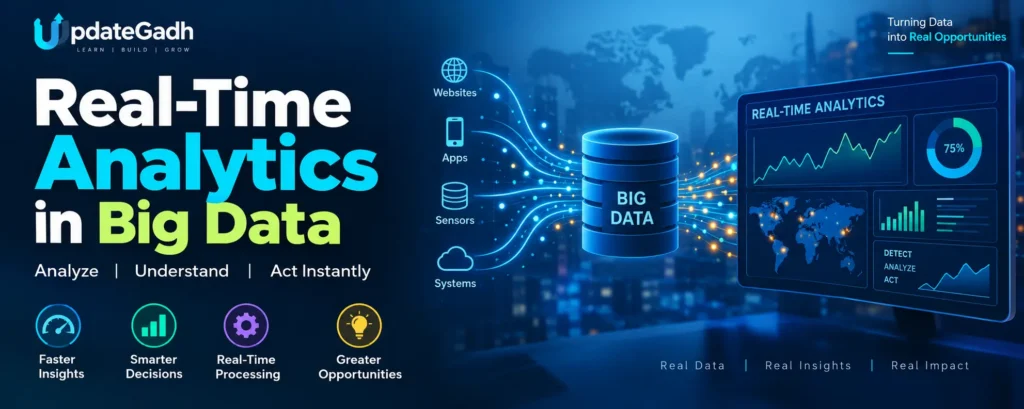
Real-Time Analytics in Big Data
In today’s fast-moving digital world, data is generated continuously from websites, mobile applications, sensors, transactions, and business systems. The ability to analyze this data as soon as it is generated can help organizations respond quickly and make better decisions. This is where Real-Time Analytics in Big Data becomes important.
In this tutorial, we’ll explore what real-time analytics is, how it works, its major components, real-world examples, and the key benefits it provides to businesses and users.
Table of Contents
Complete Advance AI Topics: Click Here
SQL Tutorial: Click Here
What is Real-Time Analytics?
Real-time analytics is the process of analyzing data immediately after it is created or received. Unlike traditional analytics, where data is usually stored first and analyzed later, real-time analytics processes incoming information with very low latency.
Depending on the system, insights can be generated within seconds or minutes. This allows organizations to understand what is happening right now and take appropriate action without waiting for a scheduled report.
For example, financial institutions can analyze transactions in real time to identify potentially fraudulent activity, while e-commerce platforms can monitor customer behavior and respond to changing shopping patterns.
Overview of Real-Time Big Data Analytics
Real-time big data analytics systems are designed to handle large volumes of high-velocity data while keeping processing delays to a minimum.
Real-time analytics can generally operate in three ways:
- On-demand: Analysis is performed when a user or application requests it.
- Continuously: Results are continuously updated as new data arrives.
- Automatically: The system performs an action when predefined conditions are detected.
For example, traders can use real-time analytics to monitor changing stock prices and make quick decisions. Similarly, an e-commerce platform can monitor sudden changes in website traffic and dynamically adjust product placement or other business strategies.
Real-time analytics helps organizations:
- React quickly to changing conditions.
- Maintain situational awareness using current information.
- Optimize performance dynamically based on live data.
Real-Life Examples of Real-Time Analytics
Real-time analytics is used across many industries. Some common examples include:
- Order Monitoring: Businesses can track orders as they are placed and monitor delivery and logistics operations.
- Customer Interaction: Websites can analyze page views, cart additions, and other user activities to understand customer behavior.
- Behavioral Targeting: E-commerce platforms can identify high-intent shoppers and provide relevant offers or recommendations.
- Web Performance: Applications can monitor website performance and respond when load times or traffic levels exceed predefined thresholds.
Download New Real-Time Projects: Click here
How Does Real-Time Analytics Work?
A typical real-time analytics architecture contains several components that work together to collect, transport, process, and analyze streaming data.
- Aggregator: Collects and organizes raw data from different sources.
- Broker: Acts as an intermediate layer that manages the movement of data between producers and consumers.
- Stream Processor: Continuously processes incoming data and applies filters, transformations, and business logic.
- Analytics Engine: Performs calculations, applies analytical models, or uses machine learning techniques to generate insights.
Push vs Pull
Real-time data can be delivered using different approaches:
- Push-Based Streaming: Data is actively pushed to the receiving system as soon as it is generated.
- Pull-Based Streaming: The receiving system periodically requests or retrieves available data.
The main goal is to maintain a suitable balance between processing speed, system performance, and resource usage. Processing every event immediately can require significant computing resources, so systems need to be designed according to their specific requirements.
Benefits of Real-Time Analytics
Real-time analytics provides businesses with the ability to understand and respond to changing situations quickly. This is especially valuable in environments where decisions need to be made immediately, such as:
- Product launches
- Live marketing campaigns
- Stock and cryptocurrency trading
- Fraud detection
Key Advantages
- Create dynamic and interactive analytics dashboards.
- Share up-to-date information through transparent dashboards.
- Monitor customer behavior and personalize user experiences.
- Adjust systems and business strategies based on live information.
- Use machine learning to support intelligent automation and faster decision-making.
Other Noteworthy Benefits
Beyond speed and responsiveness, real-time big data analytics can provide several additional benefits:
- Data Localization: Helps organizations analyze data based on specific regions, locations, or customer segments.
- Anomaly Detection: Identifies unusual patterns, unexpected events, or potential problems as they occur.
- Sales and Marketing Insights: Enables businesses to modify campaigns and strategies according to current user behavior.
- Operational Efficiency: Automates responses to certain events, reducing manual work and improving efficiency.
Final Thoughts
Real-time analytics in big data has become an important part of modern data-driven systems. Instead of waiting for data to be collected and analyzed later, organizations can process information as it arrives and respond to changing conditions much faster.
Whether it is an e-commerce platform, financial system, marketing campaign, or large-scale operational environment, the ability to see, understand, and act on data in real time can provide a significant advantage.
As businesses continue to generate increasing amounts of data, real-time analytics will remain an important technology for turning continuously generated information into useful and timely insights.
Want more tutorials and project-based learning on big data and analytics? Stay tuned for more technology tutorials and practical learning resources.
Keywords
Real-Time Analytics in Big Data, real-time analytics, real-time big data analytics, real-time analytics platform, RTAP applications in big data, real-time analytics examples, real-time data analytics, real-time sentiment analysis, real-time analytics platform applications, real-time analytics in data analytics, big data analytics, real-time data processing, streaming analytics, big data real-time analytics Real-Time Analytics in Big Data
real-time analytics in big data platform
real-time sentiment analysis in big data
real time analytics platform(rtap) applications in big data ppt
real-time analytics examples
real-time analytics platform rtap applications in data analytics
real-time analytics platform rtap applications pdf
real-time analytics in bib data platform applications
real-time analytics in big data platform in data analytics
real-time analytics in big data geeksforgeeks
real-time analytics in big data ppt
real-time analytics in big data examples