Data Analyst vs Data Scientist
In today’s data-driven world, organizations depend on professionals who can turn large amounts of data into useful information. Two important roles in this field are Data Analysts and Data Scientists.
Although both professionals work with data, their responsibilities, skills, tools, and objectives are different. So, what exactly is the difference between a Data Analyst and a Data Scientist? Let’s take a closer look.
Complete Advance AI Topics: Click Here
SQL Tutorial: Click Here
What is a Data Analyst?
A Data Analyst is a professional who collects, cleans, analyzes, and interprets data to help organizations make better decisions. Their work mainly focuses on historical and existing data to identify trends, patterns, and relationships.
Data Analysts transform raw information into meaningful insights that can be used by businesses and teams for planning and decision-making.
Key Responsibilities of a Data Analyst
- Data Preparation and Cleaning: Cleaning raw data, handling missing values, correcting errors, and preparing datasets for analysis.
- Data Analysis: Using statistical and analytical techniques to identify patterns and summarize important information.
- Reporting: Creating reports that communicate important findings to business teams and stakeholders.
- Data Visualization: Creating charts, dashboards, and other visualizations to make data easier to understand.
Educational Background and Skills
Data Analysts commonly have a bachelor’s degree in areas such as Computer Science, Statistics, Mathematics, Economics, or related fields. Certifications in tools such as Excel, SQL, Tableau, and Power BI can also help improve career opportunities.
Core skills of a Data Analyst include:
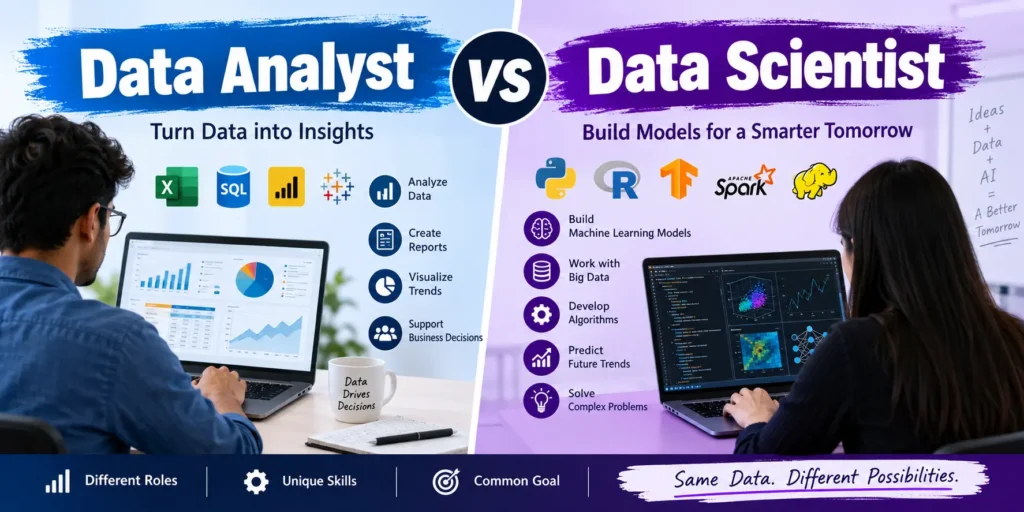
- Proficiency in data analysis tools such as SQL, Excel, and Tableau
- Good statistical and mathematical knowledge
- Analytical and critical thinking
- Strong communication and presentation skills
- Attention to detail
What is a Data Scientist?
A Data Scientist works with data at a more advanced level by using programming, statistics, machine learning, and artificial intelligence techniques to solve complex problems.
Unlike traditional data analysis, Data Science often focuses on predictive modeling, forecasting, and developing data-driven solutions. Data Scientists can work with both structured and unstructured data.
Key Responsibilities of a Data Scientist
- Data Exploration and Preprocessing: Cleaning, transforming, and organizing data, often involving large and complex datasets.
- Big Data Technologies: Using technologies such as Hadoop and Spark to process large amounts of data efficiently.
- Statistical Modeling: Applying statistical methods and machine learning models to discover deeper patterns and make predictions.
- Algorithm Development: Developing algorithms for applications such as recommendation systems, classification, and image recognition.
- Iterative Experimentation: Testing, evaluating, and improving models based on their performance and feedback.
- Domain Knowledge Collaboration: Working with stakeholders and domain experts to develop solutions that address business requirements.
- Advanced Visualization: Presenting complex findings through visualizations and data storytelling.
Educational Background and Skills
Many Data Scientists have master’s or Ph.D. degrees in Data Science, Computer Science, Statistics, Mathematics, or related fields. However, practical experience, strong technical skills, and relevant projects are also important for building a career in Data Science.
Essential skills of a Data Scientist include:
- Programming skills in Python and R
- Strong knowledge of machine learning and AI
- Experience with big data technologies such as Hadoop and Spark
- Advanced statistics and mathematics
- Creative and analytical problem-solving
- Effective communication and stakeholder collaboration
Data Analyst vs Data Scientist: Key Differences
Although Data Analysts and Data Scientists both work with data, their responsibilities and approaches are different. The following table highlights the major differences between the two roles.
| Aspect | Data Analyst | Data Scientist |
|---|---|---|
| Primary Focus | Descriptive analytics and analyzing past data | Predictive analytics and forecasting future trends |
| Data Type | Mostly structured data | Structured and unstructured data |
| Goal | Generate insights to support decision-making | Solve complex problems using data |
| Tools Used | Excel, SQL, Power BI, Tableau | Python, R, TensorFlow, Spark, Hadoop |
| Typical Education | Bachelor’s degree | Master’s degree or Ph.D. is common |
| Key Skills | Data cleaning, visualization, and reporting | Machine learning, algorithm design, and statistical modeling |
| Work Complexity | Moderate | High |
| Problem Approach | Outcome-driven | Discovery-driven |
Educational Paths: A Comparison
Data Analyst
- Degree: Bachelor’s degree in Statistics, Computer Science, Economics, or a related field.
- Certifications: Certifications in SQL, Excel, Tableau, and Power BI can be useful.
- Experience: Internships, data analysis projects, and business analytics courses can help build practical experience.
Data Scientist
- Degree: A master’s or Ph.D. in Data Science, Computer Science, Statistics, or a related field is common.
- Coursework: Machine learning, advanced statistics, programming, and related technical subjects.
- Research: Advanced academic programs may involve thesis or dissertation research.
- Experience: Internships, research projects, Kaggle competitions, and industry case studies can provide valuable practical experience.
Download New Real-Time Projects: Click here
Final Thoughts
Data Analysts primarily focus on understanding historical data, identifying trends, and providing insights that support business decisions. Data Scientists, on the other hand, use advanced statistics, machine learning, and programming to build predictive models and solve more complex problems.
Both roles are important in a data-driven organization. Data Analysts help businesses understand what has already happened, while Data Scientists can use data to predict what may happen next and develop advanced data-driven solutions.
The right role depends on an organization’s requirements as well as an individual’s interests and skills. In many modern organizations, Data Analysts and Data Scientists work together to turn data into meaningful business outcomes.
At Updategadh, we believe that understanding the difference between these roles is important for students, professionals, and businesses. Whether you are planning a career in data or building a data-focused team, knowing the responsibilities and skill requirements of each role can help you make better decisions.
Explore more career guides and technology comparisons at Updategadh. Stay curious and keep learning.
Keywords
Data Analyst vs Data Scientist, Data Analyst, Data Scientist, Data Analytics, Data Science, Data Analyst Skills, Data Scientist Skills, Data Analytics Career, Data Science Career, Machine Learning, Data Analysis