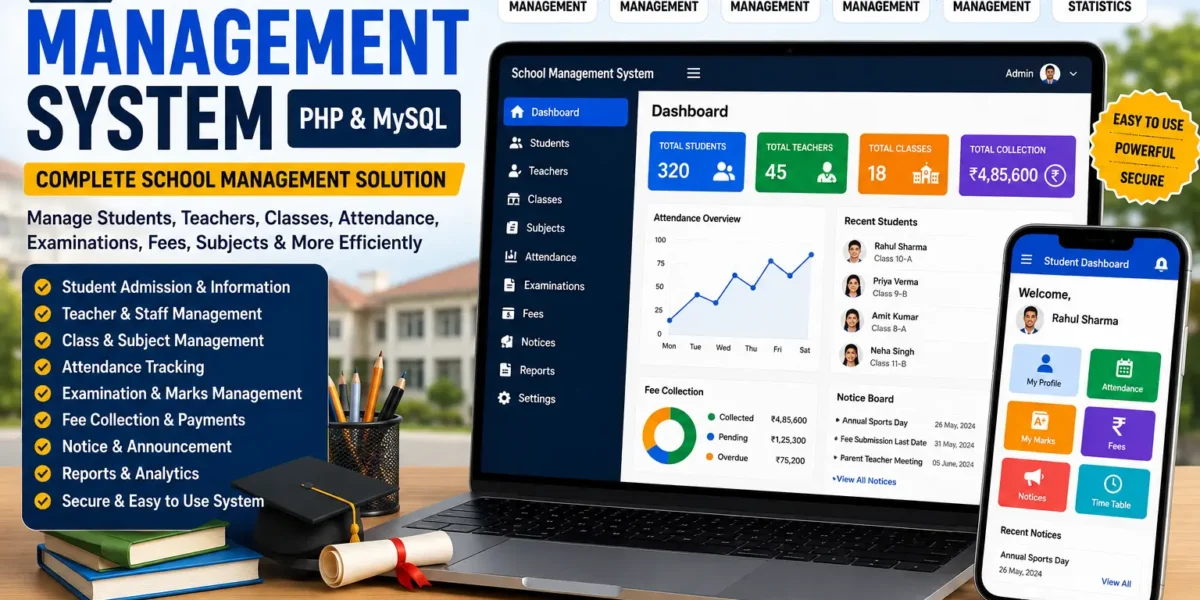
School Management System Using PHP
Running a school, coaching center, or small college today means juggling attendance registers, fee receipts, exam results, timetables, and a constant stream of notices — often across a mix of spreadsheets, WhatsApp groups, and paper files. A School Management System (SMS) brings all of that into one web application, giving administrators, teachers, students, and parents a single place to manage day-to-day academic operations.
This post walks through what a modern School Management System typically includes, the technology that usually powers it, and why institutions of almost any size benefit from adopting one.
Table of Contents
What Is a School Management System?
A School Management System is a web-based application that centralizes the administrative and academic workflows of an educational institution. Instead of maintaining separate registers for attendance, results, and staff leave, everything lives in a shared database that different user roles — admin, teacher, and student — can access through their own dashboards.
The goal isn’t just digitization for its own sake. It’s about cutting down repetitive manual work, reducing errors in records like attendance and grades, and making information (a notice, a timetable change, an exam result) instantly available to everyone who needs it.
Core Features to Expect
A well-built SMS typically covers the full academic cycle rather than just one piece of it. Common modules include:
- Student Record Management — enrollment details, class assignments, and academic history in one profile
- Teacher Record Management — staff profiles, subject assignments, and schedules
- Leave Management — a structured workflow for staff or student leave requests and approvals
- Notice Upload — a central board for circulars and announcements
- Exam Result Upload — uploading, storing, and publishing results securely
- Notes Upload — sharing study material digitally
- Bus Service Integration — tracking transport routes for students who commute by school bus
- Syllabus Upload / Update — keeping curriculum documents current and accessible
- Time Table Management — building and updating class schedules
- Attendance Management — daily attendance logging with reports by class or student
- Password Reset & Forgot Password — self-service account recovery
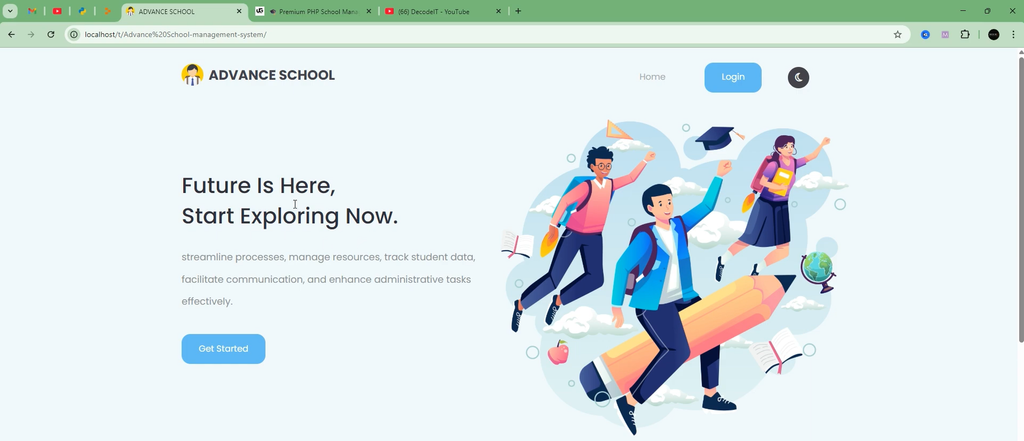
- Front-End Home Page — a public-facing page that gives parents or prospective students basic information without needing to log in
- Single Login System — one authentication flow across all user roles
- Dark Theme Support — a dark-mode interface option
- Multi-Language Support — interface available in more than one language
Each of these modules is generally built to work independently, so an institution can adopt only what it needs, or run all of them together as a single integrated platform.
Typical Technology Stack
Most School Management Systems built for small-to-mid-sized institutions rely on a straightforward, well-supported stack:
| Layer | Common Choice |
|---|---|
| Backend language | PHP |
| Database | MySQL |
| Frontend | HTML, CSS, JavaScript, jQuery |
| UI framework | Bootstrap (commonly Bootstrap 5) |
This combination is popular for a reason: it’s inexpensive to host, easy to find developers for, and flexible enough to run on almost any shared or cloud hosting environment. It also makes the system approachable for students and early-career developers who want to study or extend the codebase.
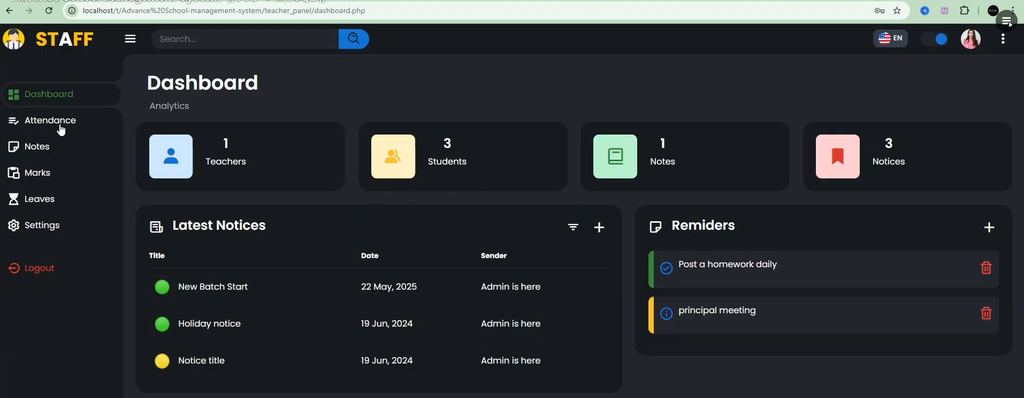
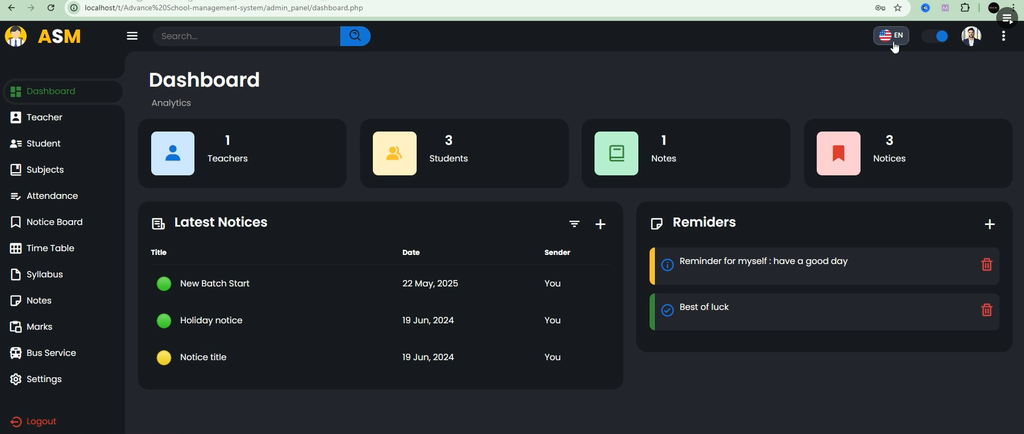
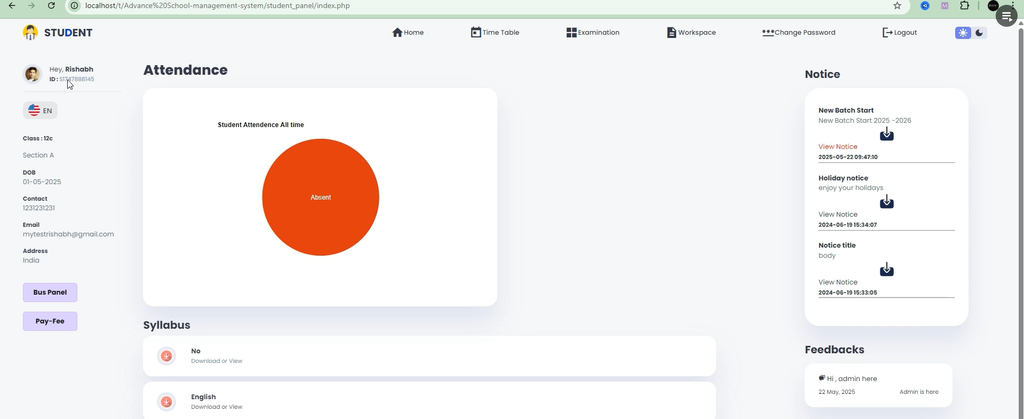
Screenshot:


How to Download
Get This Project
The complete package is available so you can run, study, and submit it with confidence. It includes:
- Full Source Code
- Project Report
- Synopsis
- PPT Presentation
For any queries or a quick response, reach out on WhatsApp: +91 79834 34684
Who Actually Uses It
A School Management System usually serves three main user groups, each with a different view of the same data:
Administrators get the widest access — managing student and teacher records, approving leave requests, publishing notices, and overseeing the system as a whole.
Teachers use their dashboard to mark attendance, upload results and notes, and check timetables or leave status.
Students (and often parents, depending on the implementation) get a read-focused view — checking attendance, results, notices, and class schedules without needing to contact the office for routine information.
Separating these roles isn’t just a security measure; it’s what makes the system actually reduce workload, since each user only interacts with the features relevant to them.
Why Institutions Are Moving to Systems Like This
- Fewer errors — attendance and grades entered once, directly into a database, instead of transcribed multiple times across registers and spreadsheets
- Faster communication — a notice posted once is instantly visible to everyone, instead of relying on printed circulars or group messages
- Better record-keeping — historical data (attendance trends, past results) is easy to retrieve instead of buried in old files
- Lower administrative overhead — routine questions (“What’s my attendance?”, “When’s the next exam?”) get answered by the system itself, freeing up staff time
Is It a Good Fit for Your Institution?
Because these systems are modular, they scale reasonably well — a small coaching center might only need attendance, notices, and results, while a larger school could use every module including bus tracking and multi-language support. If you’re evaluating one, it’s worth mapping your institution’s actual pain points (Is it attendance? Fee tracking? Communication?) to the modules on offer, rather than assuming you need every feature from day one.
Final Thoughts
A School Management System won’t replace good administration — but it removes a lot of the manual friction around record-keeping and communication that eats into staff time. Whether you’re running a single coaching center or a multi-branch school, a PHP/MySQL-based system remains one of the most accessible ways to get a functional, role-based platform up and running without a large development budget.
If you’re building or evaluating one for your own institution, start with the modules that solve your biggest day-to-day headache — attendance and communication are usually the highest-impact places to begin.
Keywords:
school management system using php with source code
school management system project in php github
school management system using php github
school management system using php pdf
school management system using php and mysql
school management system php mysql source code github
school management system project with source code pdf
localhost school management system php