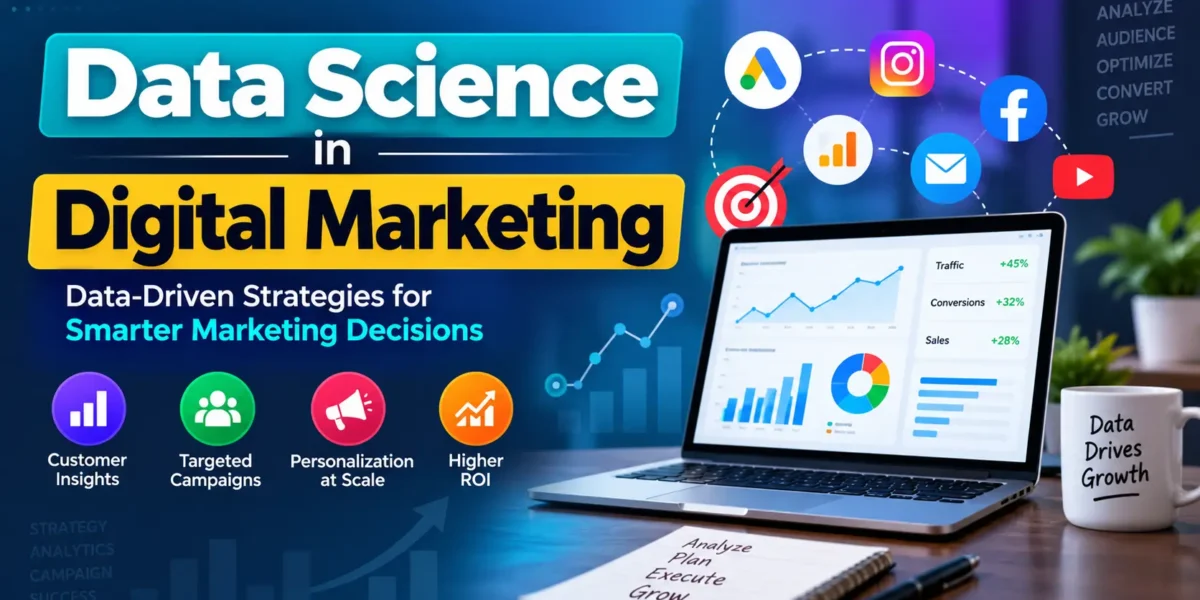
Data Science in Digital Marketing
The marketing landscape has changed dramatically in the digital age. Gone are the days when marketing decisions were based mainly on intuition. Today, successful digital marketing depends on data-driven strategies, where analytics and technology work together to help businesses understand their audiences and make better decisions.
At the center of this transformation is data science. It enables marketers to extract valuable insights, predict outcomes, understand customer behavior, and create campaigns that connect with audiences more effectively. In this article, we explore the key features, applications, challenges, tools, and future of data science in digital marketing.
Table of Contents
Complete Advance AI Topics: Click Here
SQL Tutorial: Click Here
Key Features
1. Data-Driven Decision Making
Marketers can rely on real-time data insights instead of assumptions. Data science helps teams test ideas, identify trends, monitor campaign performance, and make informed decisions based on measurable results.
2. Customer Segmentation and Profiling
Data science allows businesses to segment customers based on their demographics, preferences, interests, and behavior. This helps marketers create highly targeted campaigns that can improve engagement and conversion rates.
3. Personalization at Scale
By analyzing historical and real-time customer data, marketers can personalize product recommendations, emails, advertisements, and other experiences. This creates a more individualized marketing experience for customers.
4. Predictive Analytics
Predictive models use historical data and trends to forecast customer behavior, churn rates, and campaign performance. These insights allow marketers to take proactive actions rather than simply responding to past results.
5. A/B Testing and Optimization
Data science provides a structured and data-backed approach to A/B testing. Marketers can compare different versions of campaigns, content, landing pages, or advertisements and identify the option that produces the best results.
6. Marketing Automation
From automated email campaigns to intelligent advertising placements, data-driven automation reduces manual work and helps marketers improve efficiency while delivering relevant content to customers.
7. Multichannel Integration
Data science can combine information from websites, social media, advertising platforms, and email campaigns to provide a more complete view of customer interactions. This helps businesses create coordinated campaigns across multiple touchpoints.
8. Real-Time Insights
Real-time dashboards allow marketers to monitor campaign performance and important metrics as they change. This makes it easier to make quick adjustments and support agile decision-making.
9. Customer Journey Mapping
By analyzing customer interactions across different touchpoints, marketers can create detailed customer journey maps. These insights help businesses deliver personalized and timely experiences.
10. ROI Measurement
Analytics and attribution models help marketers measure the return on investment (ROI) of different campaigns and marketing channels. This makes it easier to understand which activities are delivering the greatest value.
11. Content Optimization
Data plays an important role in modern content strategies. By analyzing user interactions and engagement, marketers can identify the type of content that resonates with audiences and drives conversions.
12. Cross-Channel Insights
Combining data from different marketing channels helps businesses understand how each channel contributes to the customer journey and final conversion. These insights can improve marketing mix decisions.
13. Customer Retention Strategies
Data science can identify patterns associated with customer churn. Businesses can use these insights to develop customer retention strategies and improve long-term relationships.
14. Marketing Attribution
Attribution models help marketers understand which touchpoints have the greatest influence on conversions. This information can be used to improve future marketing strategies and allocate resources more effectively.
15. Dashboards and Real-Time Reporting
Custom dashboards provide marketers with an easy way to monitor KPIs, campaign results, and other important metrics. This keeps teams aligned and focused on marketing performance.
16. Ethical and Responsible Data Usage
Responsible data handling is essential in digital marketing. Following regulations such as GDPR and CCPA and using customer data ethically can help businesses build trust and maintain strong customer relationships.
17. Dynamic Pricing
E-commerce platforms can use algorithms to adjust prices based on factors such as customer behavior, competition, and demand. This allows businesses to respond quickly to changing market conditions.
18. Fraud Detection
Machine learning models can help identify click fraud, bot traffic, and unusual patterns. This protects digital advertising campaigns and helps maintain the accuracy of marketing data.
19. Scalability
Data-driven marketing systems can scale as a business grows. This allows organizations to process larger amounts of information while keeping their marketing strategies responsive and efficient.
Understanding Data Science in Digital Marketing
Data Science in Digital Marketing involves collecting, processing, analyzing, and interpreting large amounts of data to understand customer preferences, improve marketing performance, and predict future trends.
It combines several important areas, including:
- Data Mining
- Machine Learning
- Predictive Modeling
- Statistical Analysis
Together, these techniques help marketers move from reactive decision-making to more proactive and data-driven marketing.
Data Sources in Digital Marketing
Web Analytics
Platforms such as Google Analytics help businesses understand website traffic, user behavior, traffic sources, and conversion rates. These insights can support improvements in user experience and content strategies.
Social Media Platforms
Data science can analyze social sentiment, shares, likes, engagement, and trends to help businesses understand audience interests and preferences.
Email Marketing Data
Email marketing metrics such as open rates, click-through rates, and bounce rates provide useful information about campaign performance and customer engagement. Marketers can use these insights to improve personalization.
CRM Systems
Customer information stored in CRM platforms such as HubSpot and Salesforce can help businesses understand purchasing patterns, customer interactions, and relationships. This information can be used to improve customer nurturing strategies.
Challenges of Using Data Science in Digital Marketing
Data Privacy and Compliance
Businesses must handle customer information responsibly while complying with regulations such as GDPR and CCPA. Maintaining privacy and transparency is essential for building customer trust.
Data Quality and Integration
Combining information from multiple sources while maintaining accuracy and consistency can be a complex but important part of data-driven marketing.
Lack of Skilled Talent
There is increasing demand for professionals who understand data science, analytics, and marketing. Finding people with expertise across these areas can be challenging for businesses.
Bias in Algorithms
Poorly designed or trained models can contain biases that affect marketing decisions and outcomes. Transparency, proper model evaluation, and fairness are important when applying machine learning.
Data Overload
Having access to large amounts of information can sometimes overwhelm marketing teams. Businesses need to focus on meaningful metrics and actionable insights rather than trying to analyze every available data point.
Tools and Technologies Used
- Analytics Platforms: Google Analytics, Adobe Analytics
- CRM Tools: HubSpot, Zoho CRM, Salesforce
- Marketing Automation: Marketo, ActiveCampaign
- Machine Learning Libraries: Scikit-learn, TensorFlow
- Visualization Tools: Tableau, Power BI, Google Looker
These tools help marketers analyze customer data, visualize important metrics, automate workflows, and generate useful insights for better decision-making.
The Future of Data Science in Digital Marketing
AI-Powered Personalization
Artificial intelligence will continue to drive hyper-personalization, allowing businesses to create marketing messages and experiences based on individual customer needs, interests, and behavior.
Voice and Visual Search Optimization
As voice assistants and visual search continue to grow, marketers will increasingly use data science to understand and optimize content for these new search formats.
Ethical Focus
Customers are becoming increasingly aware of how their personal information is collected and used. Responsible and transparent data practices will therefore become an important competitive advantage.
Cross-Channel Cohesion
Businesses will continue working toward better integration between marketing channels. The goal will be to create consistent and unified customer experiences across different touchpoints.
Automation and Real-Time Adaptation
Real-time data will support dynamic content delivery and automated marketing decisions. This will allow campaigns to adapt more quickly to customer behavior and changing market conditions.
Real-World Applications
- Amazon uses data science to provide personalized product recommendations.
- News platforms analyze content engagement to improve traffic and customer retention.
- Retailers use customer data to send personalized emails based on previous purchases.
- Programmatic advertising uses data to deliver targeted advertisements based on audience behavior and browsing activity.
Download New Real Time Projects:- Click here
Conclusion
Data science is not simply improving digital marketing; it is redefining how modern marketing works. Its ability to personalize customer experiences, predict behavior, measure performance, and optimize campaigns gives businesses powerful ways to connect with their audiences.
As technology continues to evolve and customer expectations increase, businesses need to adopt data-driven marketing strategies to remain competitive. Organizations that effectively understand and apply data science will be better positioned to improve customer experiences and lead the future of digital marketing.
Keywords
data science in digital marketing, digital data science in digital marketing salary, data science in digital marketing salary, data science in marketing, data science in digital marketing which is better, marketing data science course, digital marketing course, data science for marketing book, use of data science in digital marketing, what do you understand by data science in digital marketing