What is DALL-E
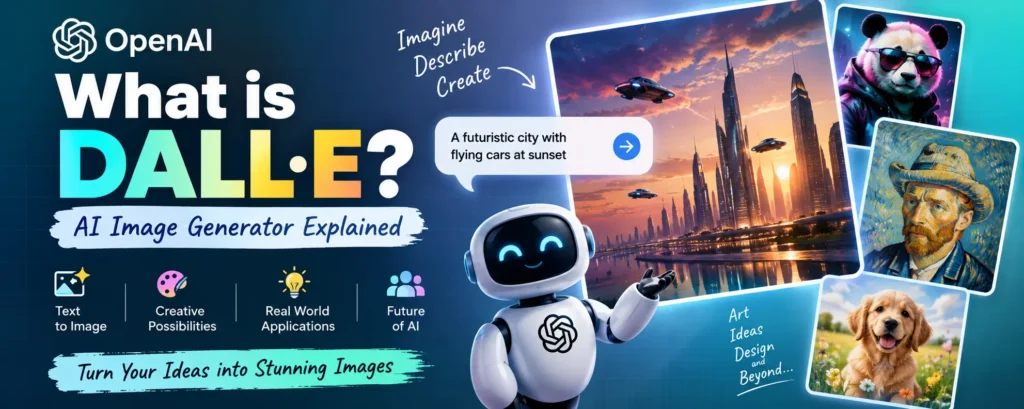
In the rapidly evolving world of artificial intelligence, DALL·E has become a well-known name among artists, designers, educators, marketers, and technology enthusiasts. Developed by OpenAI, DALL·E is an AI-powered image generation system that can turn written descriptions into visual content.
Instead of manually creating an image from scratch, users can describe what they want in natural language, and DALL·E can generate an image based on that description. From realistic scenes to imaginative and surreal concepts, the technology demonstrates how AI can connect language with visual creativity.
Table of Contents
Complete Advance AI Topics: Click Here
SQL Tutorial: Click Here
What is DALL·E?
DALL·E is an artificial intelligence model developed by OpenAI for generating images from text prompts. The name combines Salvador Dalí, the famous surrealist artist, with WALL·E, the Pixar character.
Early versions of DALL·E were closely related to OpenAI’s GPT research and demonstrated how transformer-based models could learn relationships between text and images. Later versions significantly improved image quality, prompt understanding, editing, and the ability to create more detailed visual compositions.
The basic idea is simple: you provide a description such as “a rabbit riding a bicycle through a busy city street”, and the AI interprets the words and produces a corresponding image.
The Birth of DALL·E: Where Imagination Meets Technology
OpenAI introduced the original DALL·E in January 2021. It attracted considerable attention because it showed that AI could generate visual concepts from ordinary language.
Users could describe unusual combinations of objects, characters, environments, and artistic concepts, and the model could create visual interpretations of those ideas. Examples included imaginary products, animals combined with objects, futuristic environments, and surreal scenes.
This early work helped demonstrate the potential of text-to-image AI and contributed to the rapid development of generative AI tools.
How Does DALL·E Work?
DALL·E uses machine learning techniques to understand relationships between language and visual information. Different generations of the system have used different architectures and training approaches, but the overall workflow can be understood in a few simple steps.
1. Text Input
The process begins when a user enters a text prompt. For example:
“A cozy wooden cabin surrounded by pine trees under a sky filled with northern lights.”
2. Understanding the Prompt
The AI analyzes the words and their relationships. It attempts to understand the objects, environment, visual style, positions, actions, and other details described in the prompt.
3. Image Generation
After interpreting the prompt, the model generates an image that attempts to match the requested description. Depending on the version and interface being used, users may also be able to create variations or modify an existing image.
4. Creative Synthesis
One of DALL·E’s interesting capabilities is its ability to combine different concepts. For example, a prompt could request a steampunk frog drinking coffee in a futuristic café. The model attempts to combine these elements into a single visual composition.
DALL·E’s Unique Features
DALL·E became popular because of its ability to transform relatively simple text instructions into detailed visual concepts.
- Text-to-Image Generation: Create images by describing the desired scene in natural language.
- Creative Image Generation: Generate imaginative, artistic, realistic, or surreal visual concepts.
- Style Flexibility: Prompts can specify different visual styles, such as digital art, illustration, photography, or cartoon-like artwork.
- Concept Combination: Combine multiple objects, ideas, environments, and characteristics in a single prompt.
- Practical Applications: Useful for designers, educators, marketers, content creators, and other professionals.
DALL·E in the Real World
AI image generation has applications across many industries. DALL·E can help people create visual concepts without requiring advanced graphic-design skills.
Education
Teachers and students can use AI-generated images to make learning materials more engaging. For example, an educator could generate an illustrated representation of the solar system or create visual examples for a classroom presentation.
Design
Designers can use AI image generation during the early stages of creative work. It can help with concept art, visual brainstorming, illustrations, product ideas, and other forms of creative exploration.
Marketing
Marketers can generate custom visual concepts for campaigns, social media content, advertisements, presentations, and other promotional materials. AI-generated visuals can help teams quickly explore different creative directions.
Tips for Using DALL·E Effectively
The quality of an AI-generated image often depends on how clearly the prompt communicates the desired result. Here are some useful practices:
- Be Descriptive: Include important details such as the subject, environment, lighting, composition, and mood.
- Use Clear Language: Write prompts that clearly describe what you want the AI to generate.
- Experiment with Prompts: Try different descriptions and wording to explore alternative results.
- Specify the Visual Style: Mention whether you want photography, digital art, illustration, 3D artwork, or another visual approach.
- Refine Your Ideas: If the first result is not suitable, modify the prompt and try again.
Challenges and Ethical Considerations
Although AI image generators provide powerful creative capabilities, they also raise several technical and ethical questions.
- Unpredictable Results: The generated image may not always match the user’s exact expectations.
- Copyright Questions: AI-generated artwork can raise questions about copyrighted material, artistic styles, and ownership.
- Content Safety: AI image systems require safeguards to reduce the generation of harmful or inappropriate content.
- Impact on Creative Jobs: AI may change how some creative tasks are performed, while also creating new opportunities involving AI-assisted design and creative direction.
- Bias: AI systems can reproduce biases found in their training data, making fairness and representation important considerations.
- Environmental Costs: Training and operating large AI models requires significant computing resources and energy.
- Privacy: Generating images involving real people can raise concerns about consent, identity, and misuse.
Responsible development and responsible use are therefore important as AI-generated visual content becomes more common.
YT:- DecodeIT
Final Thoughts: A Future Painted by AI
DALL·E represents an important step in the development of generative AI. By allowing users to describe visual ideas using natural language, it makes image creation more accessible to people with different levels of technical and artistic experience.
From education and design to marketing and content creation, AI image generation can support creative workflows and help people turn ideas into visual concepts more quickly.
While challenges involving copyright, privacy, bias, and responsible use still need careful consideration, DALL·E has played an important role in showing how artificial intelligence can connect language, imagination, and visual creation.
Keywords
DALL-E, what is DALL-E, what is DALL-E AI, DALL-E image generator, DALL-E AI image generator, what is DALL-E used for, how does DALL-E work, DALL-E 3 image generator, DALL-E online free, DALL-E in ChatGPT, DALL-E app, DALL-E image generation, DALL-E 2, generative AI, AI image generator, OpenAI DALL-E, AI image generation