AI Transformers
Artificial Intelligence (AI) has evolved rapidly, and one of the most important technologies behind this progress is the Transformer architecture. Introduced in 2017 through the research paper “Attention Is All You Need”, Transformers changed the way machines process and understand sequential data.
Unlike traditional models that process information step by step, Transformers use a mechanism called self-attention to analyze relationships between different parts of an input simultaneously. This allows them to capture context and long-range dependencies more effectively.
Today, Transformers are the foundation of many modern AI systems, including large language models (LLMs), machine translation systems, chatbots, code-generation tools, and multimodal AI applications.
Complete Advance AI Topics: Click Here
SQL Tutorial: Click Here
What Are Transformers in AI?
A Transformer is a neural network architecture designed to process and transform sequences of data. It learns relationships between different elements of the input and uses those relationships to generate meaningful outputs.
For example, consider the sentence:
“What colour is the sky?”
A Transformer can analyze the relationship between words such as “colour” and “sky” and use the surrounding context to determine that an appropriate answer is “The sky is blue.”
Transformers are widely used in Natural Language Processing (NLP), speech processing, computer vision, bioinformatics, and other AI applications involving complex data relationships.
Why Are Transformers So Important?
Before Transformers became popular, many NLP applications relied on models such as Recurrent Neural Networks (RNNs) and their variants. These models processed sequences one element at a time, which made training slower and made it difficult to capture relationships across very long sequences.
Transformers introduced a more efficient approach by allowing many parts of a sequence to be processed in parallel during training. Their attention mechanism also helps models identify which parts of the input are most relevant to the current task.
Key Advantages of Transformers
- Parallel processing: Multiple tokens can be processed simultaneously during training.
- Better contextual understanding: Attention allows the model to identify relationships between distant parts of a sequence.
- Scalability: Transformer architectures can be scaled to create very large AI models.
- Versatility: They can be adapted for text, images, audio, video, biological sequences, and multimodal data.
- Foundation for LLMs: Many modern large language models are based on Transformer architectures.
How Do Transformers Work?
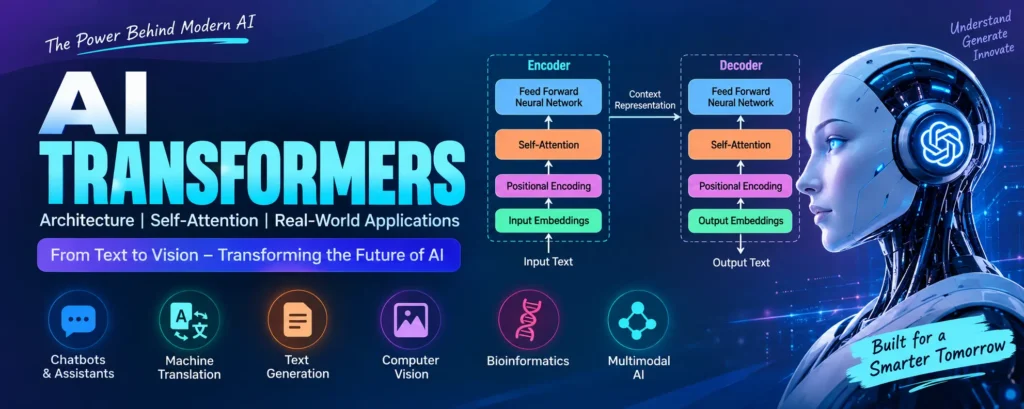
The original Transformer architecture consists of two major components: an encoder and a decoder. The encoder processes the input sequence and creates contextual representations, while the decoder uses those representations to generate the output sequence.
Modern Transformer models do not always use both components. For example, encoder-only architectures such as BERT are commonly used for understanding tasks, while decoder-only architectures such as GPT-style models are commonly used for text generation.
The most important idea behind Transformers is the self-attention mechanism. Self-attention allows every token to consider other relevant tokens in the input when creating its representation.
Imagine listening to someone speaking in a noisy room. Instead of treating every sound equally, you focus on the voice that matters. Self-attention works in a similar way by assigning greater importance to relevant pieces of information.
Core Elements of Transformer Architecture
- Input Embeddings: Convert tokens such as words or subwords into numerical vectors.
- Positional Information: Provides information about the order or position of tokens in a sequence.
- Self-Attention: Determines how strongly different tokens should influence one another.
- Feed-Forward Networks: Further process the representations produced by the attention layers.
- Normalization and Residual Connections: Help stabilize and improve the training of deep Transformer networks.
- Linear and Softmax Layers: Often used at the output stage to convert representations into predictions or probabilities.
Understanding Self-Attention
Self-attention is the key mechanism that makes Transformers powerful. For every token, the model evaluates other tokens in the sequence and determines which ones are important for understanding its meaning.
For example, consider:
“The animal didn’t cross the road because it was tired.”
To understand what “it” refers to, a model needs to examine the surrounding context. Self-attention helps the Transformer establish relationships between these words.
Technically, self-attention uses three representations called Query (Q), Key (K), and Value (V). The attention scores determine how much information each token should receive from other tokens.
Transformers vs. Other Neural Networks
Transformers vs. RNNs
Recurrent Neural Networks (RNNs) process sequence elements sequentially. This makes them naturally suited to sequential data but can make training difficult to parallelize and can create challenges when learning very long-range dependencies.
Transformers use attention to connect tokens directly and can process sequences much more efficiently during training. This has made them the dominant architecture for many modern NLP applications.
Transformers vs. CNNs
Convolutional Neural Networks (CNNs) are particularly effective for grid-like data such as images. They use convolutional filters to identify local patterns such as edges, textures, and shapes.
Transformers can also process visual information. Vision Transformers (ViTs), for example, divide images into patches and process those patches similarly to tokens in a sequence.
Use Cases of Transformers
Transformers are used across a wide range of industries and AI applications.
- Natural Language Processing: Chatbots, virtual assistants, text classification, summarization, and question answering.
- Machine Translation: Translating text between multiple languages.
- Text Generation: Generating articles, conversations, code, summaries, and other forms of content.
- Speech Processing: Speech recognition and other audio-related applications.
- Computer Vision: Image classification, object detection, and image understanding.
- DNA Sequence Analysis: Analyzing biological sequences and identifying meaningful patterns.
- Protein Research: Supporting protein analysis and biological discovery.
- Multimodal AI: Combining information from text, images, audio, and other data types.
Types of Transformer Models
1. BERT
BERT (Bidirectional Encoder Representations from Transformers) is an encoder-based Transformer model designed primarily for understanding language. It considers contextual information from both directions and has been widely used for tasks such as text classification, question answering, and information extraction.
2. GPT
GPT (Generative Pre-trained Transformer) refers to a family of generative Transformer models designed to predict and generate sequences of tokens. GPT-style architectures have become widely used for conversational AI, content generation, coding assistance, and many other applications.
3. BART
BART (Bidirectional and Auto-Regressive Transformers) combines ideas from encoder-based and decoder-based Transformers. It is particularly useful for tasks such as text generation, summarization, and language transformation.
4. Vision Transformers
Vision Transformers (ViTs) apply Transformer concepts to images. An image is divided into smaller patches, which are converted into representations and processed as a sequence.
5. Multimodal Transformers
Multimodal Transformers work with more than one type of data, such as text and images. They are useful for applications including visual question answering, image captioning, document understanding, and multimodal assistants.
Real-World Examples of Transformer-Based AI
1. BERT
BERT demonstrated how Transformer-based language representations could significantly improve a wide range of natural-language understanding tasks. It became particularly influential in search and NLP applications.
2. LaMDA
LaMDA was a conversational language model developed by Google, designed to generate more natural and context-aware dialogue.
3. GPT
GPT-style models demonstrated the ability of Transformer architectures to generate coherent text at large scale. They have been applied to writing, programming, question answering, conversational AI, and many other tasks.
Download New Real-Time Projects:- Click here
Conclusion
Transformers have fundamentally changed modern Artificial Intelligence. Their attention-based architecture allows AI systems to process large amounts of information, identify relationships between different parts of the input, and generate highly contextual outputs.
From language models and machine translation to computer vision, biological research, and multimodal AI, Transformers are now used across a broad range of applications.
Understanding Transformers is therefore an important step for anyone interested in Artificial Intelligence, Machine Learning, Natural Language Processing, or Large Language Models. As AI continues to evolve, Transformer-based architectures will remain an important foundation for developing increasingly capable intelligent systems.
Keywords
AI Transformers, Transformer Architecture, Transformers in AI, Self Attention, Transformer Neural Network, BERT, GPT, BART, Vision Transformers, Multimodal Transformers, Large Language Models, LLM, Natural Language Processing, Machine Learning, Deep Learning, Artificial Intelligence AI Transformers, Transformer Architecture, Transformers in AI, AI Transformer, Transformer Model, Self-Attention, Attention Mechanism, Deep Learning, Machine Learning, Artificial Intelligence, Large Language Models, LLM, GPT, BERT, BART, Vision Transformers, Multimodal AI, Natural Language Processing, NLP,