Generative Adversarial Network
Introduction
In the rapidly evolving field of deep learning, Generative Adversarial Networks (GANs) are one of the most influential approaches to generative AI. Introduced in 2014 by Ian J. Goodfellow and his colleagues, GANs made it possible for neural networks to learn the patterns and distribution of existing data and use that knowledge to generate new, realistic-looking samples.
GANs have been used for applications such as generating realistic images, creating artwork, improving image resolution, generating synthetic training data, and many other creative and computer vision tasks.
Table of Contents
Complete Advance AI Topics: Click Here
SQL Tutorial: Click Here
What is a Generative Adversarial Network (GAN)?
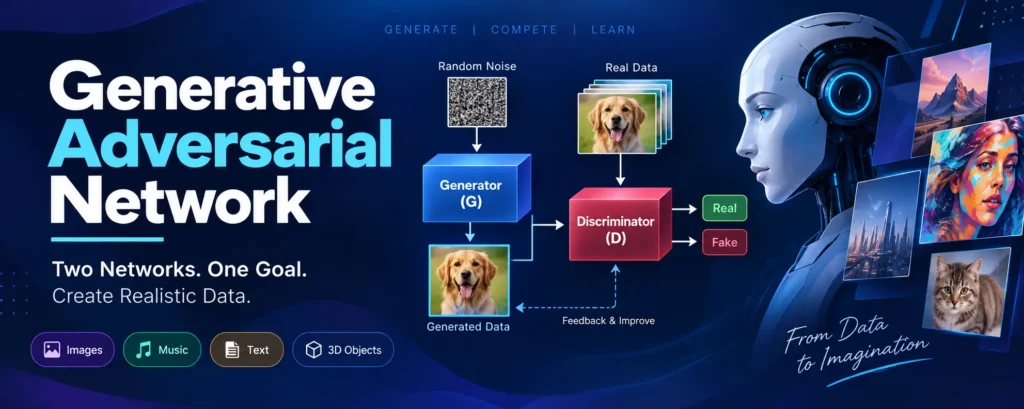
A Generative Adversarial Network is a deep learning architecture made up of two neural networks that compete with each other during training:
Generator (G)
The Generator creates new data samples from random noise. Its goal is to produce samples that look similar to the real training data.
Discriminator (D)
The Discriminator examines a sample and tries to determine whether it comes from the real training dataset or was generated by the Generator.
These two networks are trained together in an adversarial process. The Generator tries to fool the Discriminator, while the Discriminator learns to identify generated samples more accurately.
As training progresses, the Generator becomes better at producing realistic data, while the Discriminator becomes better at detecting generated samples.
Why Were GANs Invented?
GANs were introduced as a new way to train generative models by using competition between two neural networks. Instead of directly defining how a model should generate realistic data, GANs allow the Generator to learn through feedback from the Discriminator.
One important advantage of GANs is their ability to learn complex data distributions without requiring every training example to have a manually assigned label. This makes them particularly useful for generating synthetic data and working with large collections of unlabeled data.
How Do GANs Work?
The idea behind GANs can be understood through three concepts:
- Generative: The Generator learns patterns from the training data and creates new samples.
- Adversarial: The Generator and Discriminator compete with each other during training.
- Network: Neural networks are used to implement both the Generator and Discriminator.
Training Steps
- The Generator receives random noise and creates a synthetic sample.
- The Discriminator receives both real samples from the dataset and generated samples.
- The Discriminator learns to distinguish between real and generated data.
- The Generator receives feedback through the adversarial training process and learns to create more realistic samples.
- This process is repeated over many training iterations.
Ideally, the Generator eventually produces samples that are difficult for the Discriminator to distinguish from real data. At this point, the GAN has learned a useful approximation of the underlying data distribution.
Example: Generating Images of Dogs
Suppose we want to train a GAN to generate realistic images of dogs.
1. Discriminator Training
- Provide the Discriminator with real images of dogs from the training dataset.
- Provide it with fake dog images created by the Generator.
- The Discriminator learns to classify the images as real or generated.
- The errors from its predictions are used to update the Discriminator.
2. Generator Training
- Random noise is provided as input to the Generator.
- The Generator produces an image that is intended to resemble a dog.
- The Discriminator evaluates the generated image.
- The Generator is updated based on the feedback it receives through the adversarial objective.
After many iterations, the Generator can learn to create increasingly realistic dog images.
Mathematical Representation
The original GAN formulation can be represented as the following minimax objective:
minG maxD V(D,G) = Ex~pdata(x)[log D(x)] + Ez~pz(z)[log(1 – D(G(z)))]
Where:
- D(x): The probability assigned by the Discriminator that x is a real sample.
- G(z): The sample generated by the Generator from random input z.
- pdata(x): The distribution of real training data.
- pz(z): The distribution used to generate the Generator’s input noise.
The Discriminator attempts to maximize its ability to distinguish real samples from generated samples, while the Generator attempts to generate samples that can fool the Discriminator.
Types of GANs
Different GAN architectures have been developed for specific applications and improvements in training or image quality.
Vanilla GAN
The original GAN architecture uses relatively simple neural networks for the Generator and Discriminator.
Conditional GAN (CGAN)
A Conditional GAN provides additional information, such as class labels, to control what the Generator produces. For example, it can be trained to generate either dog or cat images based on a given label.
Laplacian Pyramid GAN (LAPGAN)
LAPGAN uses a multi-scale image generation approach based on a Laplacian pyramid to progressively generate detailed images at different resolutions.
Super-Resolution GAN (SRGAN)
SRGAN is designed for image super-resolution. It attempts to reconstruct high-resolution images from low-resolution inputs while producing visually realistic details.
Deep Convolutional GAN (DCGAN)
DCGAN uses convolutional neural network architectures for image generation and introduced architectural guidelines that helped make GAN training more stable and effective for image-related tasks.
YT:- DecodeIT
Advantages of GANs
High-Quality Output
GANs can generate highly realistic synthetic samples, particularly for image-related applications.
Learning Without Extensive Labels
GANs can learn from datasets without requiring traditional class labels for every example.
Synthetic Data Generation
GANs can create artificial samples that can be useful for research, experimentation, and some machine learning workflows where additional data is needed.
Creative and Versatile
GANs have been explored in areas such as computer vision, digital art, image enhancement, gaming, and synthetic data generation.
Conclusion
Generative Adversarial Networks introduced a powerful approach to generative deep learning by bringing together two competing neural networks: the Generator and the Discriminator.
Through this adversarial training process, the Generator learns to create increasingly realistic samples, while the Discriminator learns to distinguish generated data from real data. This simple but powerful idea has influenced many areas of generative AI and computer vision.
From image generation and super-resolution to synthetic data creation and creative applications, GANs have played an important role in the development of modern generative models.
Keywords
Generative Adversarial Network, gan ai generator, generative adversarial networks paper, gan image generation, gan full form, generative adversarial networks in deep learning, generative adversarial network upsc, gan architecture, gan model, variational autoencoder, reinforcement learning, generative adversarial network example, generative adversarial network python, generative adversarial network in machine learning