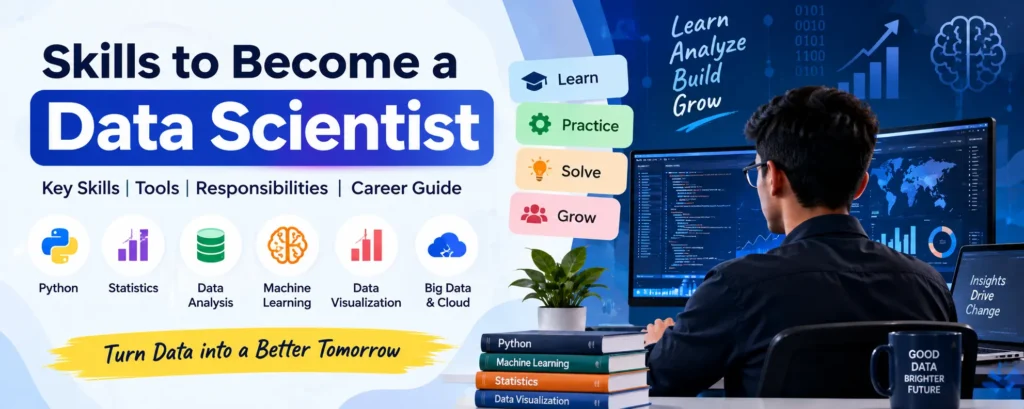
Skills to Become a Data Scientist
In a world driven by data, data scientists work at the intersection of statistics, computer science, and domain expertise, transforming raw information into actionable insights. Whether it is predicting future trends, personalizing customer experiences, or automating decision-making, data scientists play an important role in many modern innovations.
But what does it take to become a successful data scientist? Let’s explore the essential skills and responsibilities that define the role and understand how data scientists are making an impact across different industries.
Table of Contents
Complete Advance AI Topics: Click Here
SQL Tutorial: Click Here
What Do Data Scientists Actually Do?
Data scientists use data analysis, machine learning, and business knowledge to solve complex problems. Their work involves collecting, cleaning, and preparing data, developing models, analyzing results, and communicating insights to stakeholders in an understandable way.
Here are some of the fundamental responsibilities of a data scientist:
- Data Collection & Preparation: Gather data from APIs, databases, or web scraping tools. Clean and preprocess the data to handle missing values, duplicates, and inconsistencies.
- Exploratory Data Analysis (EDA): Use visualization and statistical techniques to understand data properties and identify important patterns.
- Feature Engineering: Transform raw data into meaningful features for machine learning models through techniques such as encoding, scaling, and dimensionality reduction.
- Modeling & Machine Learning: Build predictive and descriptive models using frameworks such as Scikit-learn, TensorFlow, or PyTorch.
- Statistical Analysis: Apply statistical methods to make inferences, test hypotheses, and validate models.
- Visualization: Present data and insights using tools such as Matplotlib, Seaborn, or Tableau so that non-technical stakeholders can understand the findings.
- A/B Testing: Design controlled experiments to evaluate business strategies, product changes, and user experiences.
- Deployment & Monitoring: Integrate machine learning models into production systems and monitor their performance.
- Domain Understanding: Translate technical findings into useful strategic recommendations based on the business context.
- Ethics & Privacy: Ensure responsible use of data by following privacy requirements and ethical data practices.
Core Skills to Master as a Data Scientist
1. Mathematics & Statistics
Data science is strongly based on mathematical and statistical thinking. A solid understanding of these concepts helps data scientists analyze data and build reliable models.
- Descriptive Statistics: Summarize data using measures such as mean, median, standard deviation, and visualizations including histograms and box plots.
- Inferential Statistics: Perform hypothesis testing and calculate confidence intervals to draw meaningful conclusions from data.
- Probability Theory: Understand randomness and uncertainty in data, which are important concepts behind many machine learning algorithms.
- Statistical Modeling: Apply techniques such as linear regression, logistic regression, and time-series models for prediction and forecasting.
- Optimization: Understand concepts such as gradient descent and cost functions used to optimize machine learning models.
- Anomaly Detection & Sampling: Identify unusual observations and select representative samples for analysis.
Download New Real-Time Projects:- Click here
2. Programming
Programming is an essential skill in a data scientist’s toolbox. It allows professionals to process data, build models, automate tasks, and develop scalable solutions.
- Python & R: Both languages are widely used for data analysis, machine learning, and visualization.
- Data Processing: Use libraries such as
Pandas,NumPy, anddplyrto manipulate and clean datasets. - Model Implementation: Work with tools and libraries such as
Scikit-learn,XGBoost, andKerasto train and evaluate machine learning models. - Visualization: Create charts and visual reports using
Matplotlib,Seaborn,Plotly, orggplot2. - Automation: Write scripts to automate repetitive activities such as ETL processes and reporting.
- Version Control: Use Git to manage code versions and collaborate effectively with other team members.
- Debugging & Scalability: Develop clean, efficient, and scalable programs capable of working with large datasets.
3. Data Manipulation & Analysis
Real-world data is often incomplete, inconsistent, and messy. Knowing how to clean, transform, and analyze such data is a critical skill for every data scientist.
- Data Cleaning: Handle missing values, correct inconsistencies, remove duplicates, and prepare organized datasets.
- Integration: Combine data from multiple sources such as databases, APIs, and spreadsheets.
- Feature Engineering: Create new variables or modify existing ones to improve the performance of machine learning models.
- Transformation: Normalize, standardize, or encode data so that it can be effectively used by machine learning algorithms.
- Dimensionality Reduction: Use techniques such as PCA or t-SNE to reduce data complexity while retaining important information.
- Profiling: Understand the structure, quality, and characteristics of datasets using summary statistics and data profiling techniques.
Soft Skills That Set You Apart
Technical knowledge alone is not enough to become a successful data scientist. Strong communication and problem-solving abilities are equally important.
- Communication: Explain complex data findings and technical concepts clearly to non-technical audiences.
- Collaboration: Work effectively with engineers, analysts, business teams, and domain experts.
- Problem-Solving: Break down complex business problems and develop practical, data-driven solutions.
- Adaptability: Keep learning new tools, techniques, and technologies as the field of data science evolves.
- Ethical Thinking: Understand the importance of responsible data collection, processing, analysis, and interpretation.
Where Are Data Scientists Making a Difference?
Data scientists are helping organizations solve problems and improve decision-making across many industries.
- Healthcare: Predict diseases, improve diagnostics, and support personalized treatment plans.
- Finance: Detect fraudulent transactions, assess risks, and support algorithmic trading.
- E-commerce & Retail: Personalize recommendations, understand customers, and optimize supply chains.
- Transportation: Improve traffic management and support autonomous driving technologies.
- Marketing: Improve campaigns through predictive analytics, customer insights, and A/B testing.
- Environmental Science: Model climate patterns and monitor ecosystems using data-driven techniques.
Trending Technologies in Data Science
Data scientists are increasingly using advanced technologies to solve more complex problems and work with larger datasets.
- AI & Machine Learning: Automate decision-making using neural networks, reinforcement learning, and other machine learning techniques.
- Natural Language Processing (NLP): Develop applications for chatbots, language translation, sentiment analysis, and text processing.
- Computer Vision: Build systems for image recognition, object detection, facial recognition, and object tracking.
- Big Data Tools: Work with technologies such as
Hadoop,Spark, andDaskto process large datasets. - Cloud Platforms: Build, deploy, and manage data science and machine learning solutions using platforms such as AWS, Azure, and Google Cloud.
The Path Forward: Lifelong Learning
Becoming a data scientist is not a one-time achievement; it is a continuous learning journey. Technologies evolve, datasets become larger, and industry requirements continue to change.
The most successful data scientists continuously improve their knowledge and skills. Enrolling in online courses, contributing to open-source projects, attending conferences, and staying curious can help you keep up with the rapidly changing field.
Final Thoughts
Being a data scientist is about much more than simply working with numbers. It involves storytelling with data, solving real-world problems, driving innovation, and helping organizations make better decisions.
With the right combination of technical skills, statistical knowledge, domain expertise, communication abilities, and a passion for problem-solving, you can build a successful career in data science and make a meaningful impact in today’s data-driven world.
Keywords
Skills to Become a Data Scientist, skills required for data scientist fresher, technical skills required for data scientist, skills to become a data scientist salary, skills to become a data scientist, essential skills to become a data scientist,