
Bias in Data Collection
In today’s data-driven world, information plays a critical role in decision-making. Organizations use data and artificial intelligence (AI) in areas such as marketing, healthcare, finance, education, hiring, and public policy.
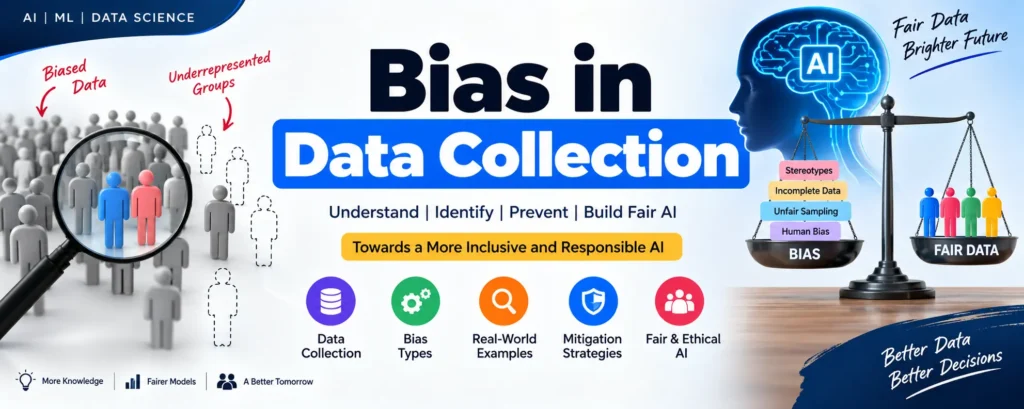
However, data is not always neutral. If the data collected is incomplete, unbalanced, inaccurate, or influenced by human assumptions, it can introduce data bias. When biased data is used to train machine learning models or support automated decisions, the resulting systems may produce unfair, inaccurate, or discriminatory outcomes.
Data bias can originate from human behavior, historical practices, sampling methods, measurement techniques, data processing, or even the algorithms used to analyze the information. Understanding where bias comes from is therefore an important part of responsible data science and AI development.
Complete Advance AI Topics: Click Here
SQL Tutorial: Click Here
What Is Data Bias?
Data bias refers to systematic errors or imbalances in a dataset that cause it to inaccurately represent the population, situation, or phenomenon being studied.
For example, suppose a machine learning model is designed to identify qualified job candidates but its training data primarily contains historical hiring decisions from a workforce that lacked diversity. The model may learn patterns from those historical decisions and unintentionally favor certain groups.
Data bias is especially important in sensitive applications such as:
- Hiring and recruitment
- Loan and credit decisions
- Healthcare and medical research
- Insurance
- Education
- Law enforcement
- Facial recognition
How Bias Manifests in Data
Bias can enter a dataset at almost any stage of the data lifecycle, from collecting information to analyzing and deploying a model.
1. Selection Bias
Selection bias occurs when some groups are more likely to be included in a dataset than others. As a result, the collected sample does not accurately represent the target population.
For example, an online survey about internet usage may underrepresent people who have limited internet access because they are less likely to participate in the survey.
2. Measurement Bias
Measurement bias occurs when the methods, tools, or questions used to collect information systematically produce inaccurate results.
Language differences, cultural differences, poorly designed surveys, inaccurate sensors, and inconsistent measurement procedures can all contribute to measurement bias.
3. Algorithmic Bias
Algorithmic bias occurs when an algorithm produces systematically unfair or unequal outcomes for particular groups.
This can happen because of biased training data, inappropriate features, flawed assumptions, optimization objectives, or decisions made during system design.
Bias in AI and Machine Learning Systems
AI and machine learning systems learn patterns from data. Therefore, if the underlying data contains systematic bias, a model can reproduce or sometimes amplify those patterns.
Cognitive Biases
Human decisions can introduce bias into datasets and AI systems in several ways.
- Unconscious Bias: Developers, researchers, or data collectors may unintentionally make assumptions that influence data collection or system design.
- Confirmation Bias: Analysts may focus more heavily on information that supports an existing assumption.
- Historical Bias: Data generated from past decisions may reflect unfair practices that existed at the time.
Incomplete or Unrepresentative Data
A dataset may fail to represent the population it is intended to describe. For example, a model trained primarily on data from urban populations may perform poorly when applied to rural communities.
This does not necessarily mean that the model was intentionally designed to discriminate. Instead, the lack of representative data can prevent the model from generalizing effectively across different populations.
Types of Data Bias
Some common forms of bias found in real-world datasets include:
- Response Bias: Participants may provide inaccurate, incomplete, or socially desirable answers.
- Activity Bias: Data from highly active users may dominate datasets, while less active users remain underrepresented.
- Societal Bias: Existing cultural stereotypes and social inequalities may be reflected in collected data.
- Omitted Variable Bias: Important variables are excluded from an analysis, potentially creating misleading relationships between the remaining variables.
- Feedback Loop Bias: A model’s decisions influence future data, which can reinforce the model’s original patterns.
- System Drift: Changes in the real-world environment or data-generation process can cause a model’s performance and behavior to change over time.
Where Does Bias Enter the Data Lifecycle?
1. During Data Collection
Bias can be introduced before the data even reaches a database or machine learning pipeline.
- Skewed Sampling: Some demographic or geographic groups may be overrepresented.
- Systematic Collection Errors: The same error may occur repeatedly during data gathering.
- Response Bias: Participants may intentionally or unintentionally provide inaccurate information.
- Non-Response: People who do not participate may differ significantly from those who respond.
2. During Data Preprocessing
Data preprocessing decisions can also affect the fairness and accuracy of a dataset.
- Poor Handling of Missing Values: Incorrect imputation techniques can distort the data.
- Over-Filtering: Removing too many records can eliminate important patterns or underrepresented groups.
- Feature Selection: Choosing inappropriate variables may cause a model to rely on misleading signals.
- Labeling Errors: Human annotators may apply inconsistent or subjective labels.
3. During Data Analysis
Even a well-collected dataset can be interpreted incorrectly.
- Confirmation Bias: Analysts may search for evidence supporting an existing hypothesis.
- Misleading Visualizations: Poorly designed charts can exaggerate or hide important differences.
- Incorrect Statistical Assumptions: Applying inappropriate statistical methods can produce misleading conclusions.
How to Reduce Bias in AI and Machine Learning
It is difficult to guarantee that a dataset or AI system will be completely free of bias. However, organizations can use systematic practices to identify, measure, and reduce harmful biases.
Acknowledge Human Bias
Bias is not simply a technical problem. Human decisions influence how data is collected, labeled, processed, and interpreted.
Recognizing this can help organizations design more careful data collection and model development processes.
Evaluate Datasets
Before training a model, examine whether the dataset adequately represents the intended population.
Important questions include:
- Which groups are represented?
- Which groups may be missing?
- Are some groups significantly overrepresented?
- Are labels consistent across groups?
- Does the data reflect current real-world conditions?
Evaluate Model Performance Across Groups
Overall model accuracy may hide problems affecting specific groups. Model performance should therefore be evaluated using relevant subgroup metrics where appropriate.
Depending on the application, teams may examine measures such as precision, recall, false-positive rates, false-negative rates, and calibration across different groups.
Improve Data Collection
Using diverse and representative data sources can reduce the risk of sampling bias.
Organizations should use appropriate sampling strategies, clearly defined collection procedures, and regular data-quality checks.
Establish a Debiasing Strategy
A comprehensive approach can include three major areas:
- Organizational: Encourage transparency, accountability, and diverse perspectives within development teams.
- Operational: Establish standardized and documented data collection and review procedures.
- Technical: Use appropriate fairness metrics, subgroup testing, data-quality checks, and model monitoring.
Regularly Audit AI Models
Bias should not be checked only once. AI systems can change as the underlying data and real-world environment change.
Regular audits can help identify performance differences, unexpected behavior, and changes in data distribution.
Use Multidisciplinary Teams
AI projects can benefit from perspectives beyond software engineering and data science. Depending on the application, teams may involve domain specialists, social scientists, ethicists, legal experts, and other stakeholders.
Tools for Detecting and Managing AI Bias
Several tools and frameworks can help developers investigate fairness and model behavior.
- AI Fairness 360: An open-source toolkit from IBM for examining and mitigating algorithmic bias.
- What-If Tool: A visual tool that helps users explore machine learning model behavior and performance.
- Model Evaluation Frameworks: Various machine learning libraries and platforms provide tools for analyzing model performance and data distributions.
The appropriate tool depends on the model, dataset, application, and fairness requirements of the project.
Real-World Examples of Data Bias
Amazon Recruitment Tool
Amazon developed an experimental recruitment system that used historical hiring data. Reports about the system showed that it learned patterns from historical resumes and produced outcomes that could disadvantage women. Amazon ultimately discontinued the project.
The example demonstrates why historical decisions should not automatically be treated as unbiased ground truth for machine learning systems.
Predictive Policing and Historical Crime Data
Predictive policing systems can face bias-related challenges when historical crime and enforcement data reflects unequal patterns of policing or reporting. If such data is used without careful analysis, a model may repeatedly direct resources toward the same communities, potentially creating a feedback loop.
These examples demonstrate why data quality, context, transparency, and continuous evaluation are important when deploying AI systems in high-impact areas.
Sources of Bias in Data Collection
- Historical and Social Factors: Existing inequalities and historical practices can become embedded in datasets.
- Data Collection Methods: Poor sampling, leading questions, and inadequate measurement procedures can distort information.
- Human Judgment: Decisions made by researchers, annotators, developers, and analysts can influence the resulting dataset.
- Technology Limitations: Sensors, software systems, and measurement tools can introduce systematic errors.
- Changing Environments: Data that was representative in the past may become less representative as user behavior and real-world conditions change.
Best Practices for Bias-Aware Data Collection
- Ensure Diversity: Include relevant demographic, geographic, and behavioral groups.
- Use Appropriate Sampling: Design sampling methods that match the target population.
- Document the Dataset: Record how, when, and why data was collected.
- Check Data Quality: Regularly identify missing values, errors, duplicates, and inconsistencies.
- Review Labels: Use clear labeling guidelines and quality-control processes.
- Test for Representation: Compare dataset characteristics with the intended population.
- Monitor Models After Deployment: Continue evaluating performance as new data becomes available.
- Be Transparent: Clearly communicate important limitations and assumptions.
Download New Real-Time Projects:- Click here
Conclusion
Bias in data collection is an important challenge in modern data science, artificial intelligence, and machine learning. Biased data can result from sampling methods, measurement errors, historical practices, human decisions, incomplete information, and changes in the environment.
Reducing bias requires more than simply changing an algorithm. Organizations need to examine the entire data lifecycle, from collection and preprocessing to model development, evaluation, deployment, and monitoring.
By using representative datasets, transparent processes, subgroup evaluation, regular audits, and multidisciplinary review, organizations can build AI and data-driven systems that are more reliable, responsible, and fair.
Keywords
Bias in Data Collection, Data Bias, AI Bias, Machine Learning Bias, Algorithmic Bias, Selection Bias, Measurement Bias, Response Bias, Societal Bias, Omitted Variable Bias, Feedback Loop Bias, Data Collection, AI Fairness, Machine Learning Ethics, Responsible AI, Data Science