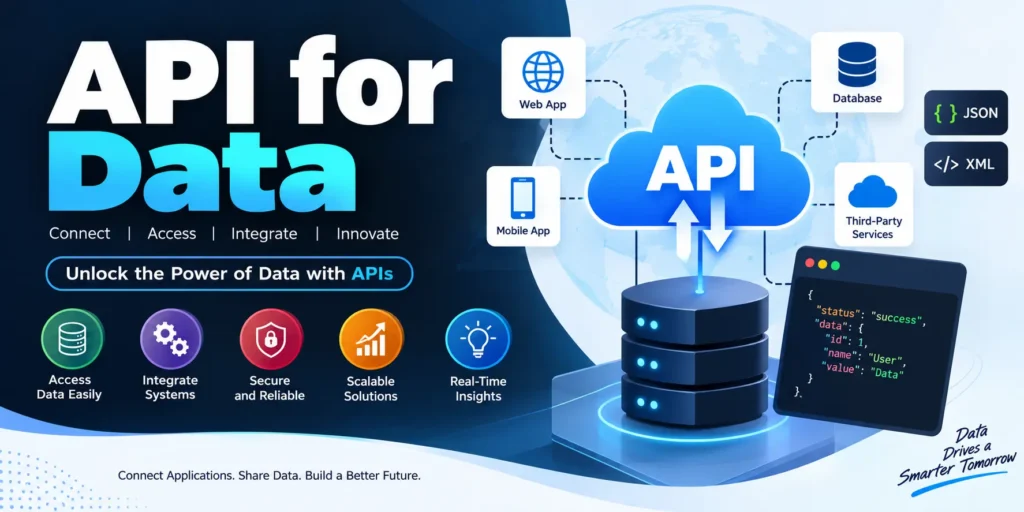
API for Data
In today’s connected digital world, applications need to exchange information quickly, securely, and efficiently. A Data API (Application Programming Interface) provides a standardized way for different software systems to communicate and share data.
Data APIs allow developers to retrieve, create, update, and manage information from databases, applications, online platforms, and third-party services without needing to understand the internal implementation of those systems.
Most modern Data APIs use web technologies such as HTTP and data formats such as JSON or XML. This abstraction makes APIs an essential part of modern application development, automation, system integration, and data-driven solutions.
Complete Advance AI Topics: Click Here
SQL Tutorial: Click Here
What is a Data API?
A Data API is an interface that allows an application to communicate with a data source through predefined requests and responses.
For example, a weather application does not need to maintain its own database containing weather information. Instead, it can send a request to a weather API and receive the required information in a structured format such as JSON.
{
  "city": "Delhi",
  "temperature": 32,
  "condition": "Sunny"
}
The application can then use this data to display weather information to its users.
How Does a Data API Work?
A typical Data API follows a request-response model:
- Client sends a request: An application sends a request to an API endpoint.
- API processes the request: The API validates the request and communicates with the required data source.
- Data source returns information: The database or external service provides the requested data.
- API sends a response: The API returns the information to the client, commonly in JSON format.
- Application uses the data: The client application processes and displays the received information.
Common Data API Operations
Many REST-based Data APIs use HTTP methods to perform different operations.
| HTTP Method | Purpose | Example |
|---|---|---|
| GET | Retrieve data | Get customer details |
| POST | Create new data | Add a new customer |
| PUT | Update existing data | Update customer information |
| PATCH | Partially update data | Update customer email |
| DELETE | Remove data | Delete a customer |
Key Benefits of Implementing a Data API
1. Streamlined Data Access
Data APIs simplify access to information from different sources. Developers can interact with a consistent API interface instead of directly managing complex database queries or understanding the internal structure of every data source.
This reduces development effort and allows teams to focus on application features rather than low-level data integration.
2. Interoperability
Data APIs allow applications built using different programming languages, frameworks, and platforms to communicate with one another.
For example, a Python application can consume data from an API created using Java, Node.js, PHP, or another technology. This makes APIs extremely useful for integrating different systems within an organization.
3. Enhanced Data Security
APIs can provide multiple security mechanisms to control access to data. Common techniques include:
- API keys
- Authentication tokens
- OAuth authentication
- Role-based access control
- HTTPS encryption
- Request validation
These mechanisms help ensure that only authorized applications and users can access protected information.
4. Scalability
Data APIs make it easier to build applications that can scale as data usage increases. API-based architectures can use techniques such as caching, load balancing, rate limiting, and horizontal scaling to handle large numbers of requests.
This is particularly important for applications that serve thousands or millions of users.
5. Flexibility and Adaptability
APIs separate the data layer from the application layer. This allows developers to use the same data source across websites, mobile applications, dashboards, internal tools, and other services.
As application requirements change, the API layer can evolve without requiring every client application to be completely redesigned.
6. Real-Time Data Updates
Many modern APIs provide access to frequently updated or real-time information. This is especially useful for applications that depend on current data.
Industries such as finance, logistics, communication, and e-commerce use APIs to deliver updated information to users and connected systems.
7. Data Monetization
Organizations can expose selected datasets and services through paid APIs. This creates opportunities to monetize proprietary data, software capabilities, and business services.
API-based products can also help organizations create partnerships and build developer ecosystems around their services.
Real-World Applications of Data APIs
Data APIs are used across a wide range of industries and applications.
- Finance: Financial APIs provide market information, exchange rates, account information, and transaction data to applications.
- E-Commerce: APIs help synchronize product information, prices, orders, inventory, payments, and shipping information across different platforms.
- Healthcare: APIs can facilitate secure exchange of healthcare information between authorized systems and applications.
- Logistics and Transportation: APIs provide shipment tracking, location information, delivery updates, and route-related data.
- Social Media and Analytics: APIs can provide engagement metrics and other authorized data for dashboards, analytics platforms, and reporting applications.
- Weather Applications: Weather APIs allow applications to retrieve current conditions, forecasts, temperature, humidity, and other weather-related information.
These examples demonstrate that Data APIs are not simply backend development tools. They play an important role in connecting services, automating workflows, and improving the overall user experience.
Data API Example
Suppose an application needs information about users. Instead of directly connecting to the database, the application can request data from an API endpoint:
GET /api/usersThe API may return a JSON response such as:
{
  "users": [
    {
      "id": 1,
      "name": "Rahul",
      "email": "rahul@example.com"
    },
    {
      "id": 2,
      "name": "Amit",
      "email": "amit@example.com"
    }
  ]
}
The frontend application can then process this response and display the user information.
Data API vs Direct Database Access
| Feature | Data API | Direct Database Access |
|---|---|---|
| Security | Centralized access control | Requires careful database-level management |
| Integration | Easy integration across applications | Usually tightly coupled to the database |
| Scalability | Can use API-level scaling techniques | Depends heavily on database architecture |
| Technology Independence | Clients can use different technologies | Often requires database-specific drivers |
| Maintenance | API provides an abstraction layer | Clients may depend directly on database structure |
Why Data APIs Are Important
Modern applications rarely operate as completely independent systems. Websites, mobile applications, cloud services, databases, analytics platforms, payment systems, and third-party services often need to communicate with each other.
Data APIs provide a standardized communication layer that makes this integration easier. They allow organizations to expose data and functionality while maintaining control over authentication, permissions, validation, and business logic.
For developers, learning how Data APIs work is an important skill for building modern applications, data pipelines, dashboards, automation systems, and distributed software.
Click here to explore new projects
Conclusion
Data APIs are an essential component of modern software development. They provide a reliable way for applications and services to exchange information without requiring direct access to internal data infrastructure.
From finance and e-commerce to healthcare, logistics, analytics, and weather applications, APIs make it possible to build connected, scalable, and flexible systems.
By combining standardized communication protocols, structured data formats, authentication, and access control, Data APIs help organizations securely expose and consume valuable information.
Whether you are developing a small application or a large enterprise platform, understanding Data APIs can help you create more maintainable, integrated, and future-ready software solutions.
Keywords
api for data, free api for developers, free api for testing, data.gov api key, api data gov, public apis, data.gov api documentation, weather api, google analytics data api, api for data example, rest api for data, best api for data, free api for data, tradingview api for data, jira rest api for data center, dummy api for data, binance api for data, api for database, data API, REST API, API integration, API development, API data access