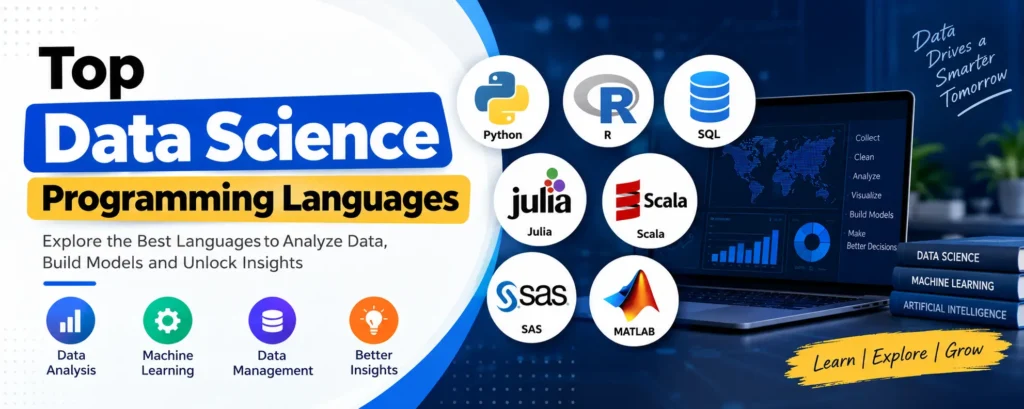
Top Data Science Programming Languages
Data science has become one of the most important fields in today’s digital world. Businesses use data science to make better decisions, solve complex problems, identify hidden patterns, and build intelligent applications.
Programming languages play a major role in this process. They help data scientists collect, clean, analyze, visualize, and model data. While no single language is perfect for every task, some programming languages have become especially popular in the data science community.
Table of Contents
Complete Advance AI Topics: Click Here
SQL Tutorial: Click Here
1. Python
Python is arguably the most popular programming language for data science. Its simple syntax, flexibility, and extensive ecosystem make it suitable for everyone from beginners to experienced AI and machine learning professionals.
Strengths of Python
- Beginner-Friendly: Python has clean and readable syntax, making it easy to learn and understand.
- Rich Libraries: Libraries such as
NumPy,pandas,scikit-learn,TensorFlow, andMatplotlibsupport data analysis, machine learning, and visualization. - Easy Integration: Python works well with databases, cloud platforms, and big data technologies.
- Large Community: A large global community provides extensive documentation, tutorials, and third-party packages.
- Visualization: Libraries such as
SeabornandPlotlymake it possible to create attractive and interactive visualizations.
Weaknesses of Python
- Performance: Python can be slower than compiled programming languages for certain computation-heavy tasks.
- Memory Usage: Python applications can require considerable memory when working with very large datasets.
- GIL Limitation: Python’s Global Interpreter Lock can limit CPU-bound multithreaded execution in standard CPython.
Conclusion: Despite these limitations, Python remains one of the leading choices for data science because of its flexibility, simplicity, and extensive ecosystem.
2. R
R was designed specifically for statistical computing and data visualization. It is particularly useful for statisticians, researchers, academics, and professionals who work extensively with statistical analysis.
Strengths of R
- Statistical Capabilities: R is excellent for regression, hypothesis testing, statistical modeling, and other analytical techniques.
- Powerful Visualization: Libraries such as
ggplot2and tools such asShinysupport effective data visualization and interactive applications. - Data Wrangling: Packages such as
dplyrandtidyrsimplify data transformation and preparation.
Weaknesses of R
- Learning Curve: R can be challenging for users who do not have a statistical background.
- Performance: Some workflows may require additional optimization when working with very large datasets.
- General-Purpose Limitations: R is primarily focused on statistical computing and data analysis rather than general software development.
Conclusion: R remains a valuable language for research, statistics, and data-intensive fields where advanced statistical analysis is important.
3. SQL (Structured Query Language)
SQL is not a general-purpose programming language like Python or R, but it is an essential skill for data professionals. SQL is primarily used to query, manage, filter, aggregate, and transform structured data stored in relational databases.
Strengths of SQL
- Data Retrieval: SQL can efficiently retrieve information from large relational databases.
- Data Transformation: Filtering, joining, grouping, sorting, and aggregating data can be performed efficiently.
- Industry Standard: SQL is widely used across organizations that work with relational and analytical databases.
Weaknesses of SQL
- Limited Machine Learning: SQL alone is not designed for advanced machine learning workflows.
- Structured Data Focus: Traditional relational SQL databases are primarily designed around structured data.
Conclusion: SQL is often used together with languages such as Python or R to retrieve and prepare data before performing deeper analysis or machine learning.
4. Julia
Julia is gaining attention in data science because of its high performance and ability to handle complex mathematical and scientific computations. It combines a relatively simple syntax with performance that can be suitable for computationally demanding workloads.
Strengths of Julia
- High Performance: Julia is designed for high-performance numerical and scientific computing.
- Parallel and Distributed Computing: Julia provides built-in capabilities for parallel and distributed workloads.
- Interoperability: Julia can interact with technologies and libraries from languages such as Python, R, and C.
Weaknesses of Julia
- Smaller Ecosystem: Its package ecosystem is not as extensive as Python’s or R’s.
- Adoption: Julia has a smaller user base and is less commonly taught compared with Python and R.
Conclusion: Julia is a strong option for high-performance data science, scientific computing, simulations, and mathematical workloads.
5. Scala
Scala combines object-oriented and functional programming and runs on the Java Virtual Machine (JVM). It is particularly useful for large-scale data processing and applications built with Apache Spark.
Strengths of Scala
- Big Data Integration: Scala is closely associated with Apache Spark and is widely used for distributed data processing.
- Concurrency: Scala provides features that support concurrent and parallel application development.
- Type Safety: Its strong type system can help identify certain errors during compilation.
Weaknesses of Scala
- Complex Syntax: Scala can be more difficult for beginners compared with Python.
- Smaller Data Science Community: It has fewer data science resources and libraries compared with Python.
Conclusion: Scala is a good choice for engineers and data professionals working with large-scale distributed systems and Spark-based applications.
Download New Real Time Projects: Click here
6. SAS (Statistical Analysis System)
SAS is a powerful analytics software platform widely used in enterprise and regulated environments. It is particularly common in industries such as finance, healthcare, pharmaceuticals, and government.
Strengths of SAS
- Enterprise Ready: SAS is widely used by organizations that require established analytics solutions.
- Advanced Analytics: It provides tools for statistical analysis, predictive modeling, and data management.
- Regulatory Support: SAS is well suited to environments where data governance, security, and compliance are important.
Weaknesses of SAS
- Cost: Commercial licensing can be expensive for individuals, startups, and small organizations.
- Less Flexible: Being a proprietary platform can provide less flexibility than open-source ecosystems.
Conclusion: SAS remains useful in enterprise and highly regulated environments, although open-source alternatives may be preferred for many modern development projects.
7. MATLAB
MATLAB is widely used in engineering, academia, scientific computing, simulations, and algorithm development. It is particularly strong in numerical computation and mathematical modeling.
Strengths of MATLAB
- Numerical Computing: MATLAB provides powerful capabilities for linear algebra, numerical analysis, and simulations.
- Specialized Toolboxes: A wide range of toolboxes support different engineering, scientific, and analytical applications.
- Visualization: MATLAB includes powerful tools for creating graphs and visualizing numerical data.
Weaknesses of MATLAB
- Licensing Cost: Commercial licensing can be expensive for some users and organizations.
- Not Open Source: MATLAB is proprietary, which can limit flexibility compared with open-source alternatives.
- Limited General-Purpose Use: It is less commonly used for modern web applications and general production software development.
Conclusion: MATLAB is an excellent choice for engineering, scientific computing, and academic applications, although Python and other open-source tools have broader adoption across modern data science.
Final Thoughts: Choosing the Right Data Science Programming Language
The data science landscape continues to evolve, but the languages discussed above remain useful for different types of tasks. The best choice depends on your project requirements, existing technology stack, and area of specialization.
- Choose Python for general data science, machine learning, AI, and data visualization.
- Choose R for statistical analysis, research, and advanced data visualization.
- Choose SQL for querying, managing, and transforming structured data.
- Choose Julia when high performance and scientific computing are important.
- Choose Scala for large-scale data processing and Apache Spark applications.
- Choose SAS for enterprise analytics and highly regulated industries.
- Choose MATLAB for engineering, simulations, numerical computing, and academic applications.
Pro Tip: Most data scientists do not rely on just one programming language. They often use different tools depending on the task, so learning multiple technologies can make you more versatile in your data science career.
Keep learning and exploring new technologies to build your skills in data science, machine learning, artificial intelligence, and analytics.
Keywords
top data science programming languages, data science languages and tools, best programming language for data analysis and visualization, data science libraries, data science tools, commonly used libraries in data science, Julia programming language, R programming language, Python for data science, SQL for data science, Scala for data science, SAS programming, MATLAB for data science, why is Python increasingly integral to data science, top 3 programming languages for data science, top 10 programming languages for data science, which programming language is used for data science, top data science languages, best data science programming languages, what is the best programming language for data science, most popular programming languages for data science