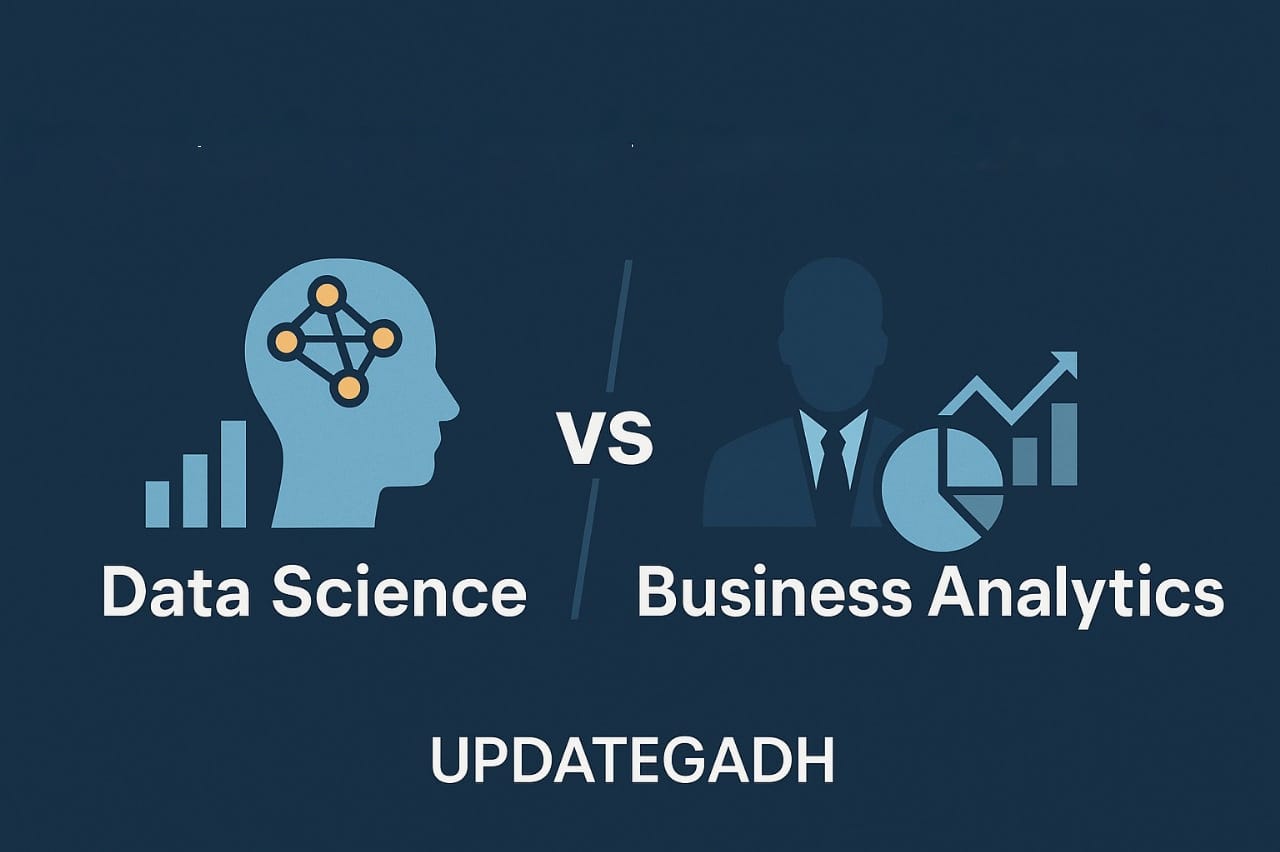
Data Science vs Business Analytics
Introduction
In today’s data-driven world, the way businesses manage and interpret data plays an important role in growth and innovation. Organizations increasingly rely on data analysis to understand customer behavior, identify market trends, improve internal processes, and make better decisions.
Two important career paths in this area are Data Science and Business Analytics. Although these fields can overlap, their skills, tools, responsibilities, and objectives are different.
Understanding the difference between Data Science and Business Analytics can help organizations choose the right professionals and help aspiring professionals select a career path that matches their interests and goals.
Complete Advance AI Topics: Click Here
SQL Tutorial: Click Here
Data Science vs Business Analytics: What’s the Difference?
At first glance, both Data Science and Business Analytics involve working with data. However, the approach, goals, and responsibilities of these fields are different.
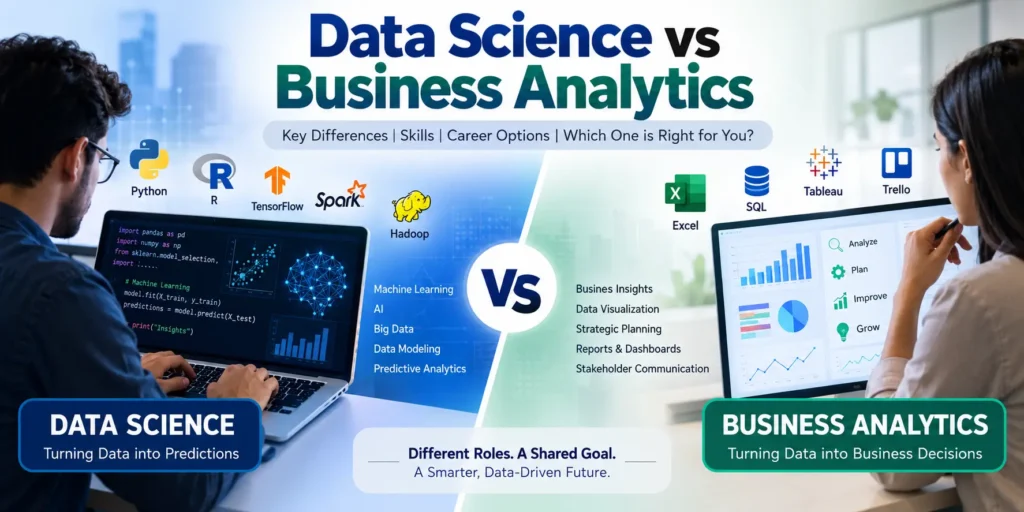
Data Scientists focus on complex data processing, predictive modeling, machine learning, and algorithm development. They work with structured as well as unstructured data to discover patterns and make predictions.
Business Analysts, on the other hand, focus primarily on understanding business problems, analyzing data, preparing reports, and recommending strategies based on business trends and requirements.
Despite these differences, Data Scientists and Business Analysts often work together to transform data into useful insights for stakeholders and business leaders.
What is Data Science?
Data Science is a multidisciplinary field that combines programming, statistics, mathematics, machine learning, and domain knowledge to extract useful information and value from data.
Data Scientists typically perform tasks such as:
- Collecting, cleaning, and organizing data.
- Working with tools such as Python, R, Hadoop, TensorFlow, and Spark.
- Developing and evaluating machine learning models.
- Analyzing large datasets to identify patterns and trends.
- Creating predictions and forecasts to support decision-making.
Data Science also extends into specialized areas such as Artificial Intelligence (AI), Natural Language Processing (NLP), and Big Data Engineering.
What is Business Analytics?
Business Analytics is the process of using data, statistical methods, and business knowledge to support better business decisions and improve organizational performance.
Business Analysts typically:
- Work with stakeholders to understand business requirements.
- Use tools such as Excel, SQL, Tableau, and project management platforms.
- Analyze structured business data to identify trends and patterns.
- Prepare reports and dashboards for decision-makers.
- Recommend solutions to improve operational efficiency and customer experience.
Business Analysts also help bridge the gap between business and technology teams. They interpret data, identify business needs, and support organizational transformation by aligning strategies with business objectives.
Data Science vs Business Analytics: Side-by-Side Comparison
| Aspect | Data Scientist | Business Analyst |
|---|---|---|
| Primary Focus | Predictive modeling and algorithm development | Business insights and strategic decisions |
| Data Type | Structured and unstructured data | Primarily structured data |
| Key Skills | Python, R, SQL, Spark, Hadoop, Machine Learning | Excel, SQL, Tableau, SWOT, PESTLE |
| Typical Output | Predictive models, algorithms, and advanced insights | Dashboards, reports, and business cases |
| Role in an Organization | Technical and analytical expert | Business and strategic consultant |
Required Skills
Skills of a Data Scientist
- Strong knowledge of mathematics and statistics.
- Proficiency in Python, R, and SQL.
- Experience with technologies such as Spark and Hadoop.
- Strong understanding of machine learning algorithms.
- Ability to process and extract insights from unstructured data.
Skills of a Business Analyst
- Strong communication and presentation skills.
- Understanding of business frameworks such as SWOT and PESTLE.
- Knowledge of data modeling and requirement analysis.
- Experience with project management and data visualization tools.
- Ability to understand business requirements and convert data into actionable recommendations.
Educational Path and Qualifications
For Data Scientists
- A Bachelor’s or Master’s degree in Statistics, Computer Science, Mathematics, or a related field.
- Certifications in Machine Learning or Artificial Intelligence can be advantageous.
- A strong programming, mathematical, and analytical background.
For Business Analysts
- A degree in Business Administration, Information Systems, or a related field.
- An MBA or a degree in Computer Applications can be beneficial.
- Hands-on experience in project management, data analysis, and stakeholder communication.
Top Career Options
Business Intelligence Analyst
Business Intelligence Analysts use organizational data to create reports, dashboards, and insights that support business decisions.
Average Salary: $85,635 per year
Data Scientist
Data Scientists develop algorithms, machine learning models, and analytical solutions to identify patterns and predict future trends.
Average Salary: $116,654 per year
Database Manager
Database Managers maintain organizational databases, troubleshoot database issues, and help ensure that business data remains accessible and reliable.
Average Salary: $61,236 per year
Data Architect
Data Architects design and maintain data frameworks and architectures used by large-scale systems and organizations.
Average Salary: $125,049 per year
Education at Updategadh: Your Path to Success
At Updategadh, aspiring professionals can pursue programs designed to build skills in data science and business analytics.
M.Sc. in Applied Mathematics and Data Science
This program is suitable for students interested in statistics, mathematical modeling, data analysis, and solving complex problems using technology.
M.Sc. in Business Analytics
This program is designed for individuals who want to understand business problems through data-driven strategies and quantitative methods.
Both programs can help students develop practical skills and prepare for career opportunities across different industries.
Which One Should You Choose?
There is no single “better” choice between Data Science and Business Analytics. The right option depends on your interests, educational background, and long-term career goals.
- Choose Data Science if you are interested in programming, algorithms, artificial intelligence, machine learning, and advanced predictive modeling.
- Choose Business Analytics if you enjoy solving business problems, communicating with stakeholders, analyzing business data, and supporting strategic planning.
Download New Real-Time Projects: Click here
Final Thoughts
The rapid growth of Big Data is changing the way businesses operate and make decisions. As organizations increasingly depend on data-driven strategies, the demand for professionals who can analyze, interpret, and use data effectively continues to grow.
Whether you choose a career in Data Science or Business Analytics, both fields offer opportunities to contribute to business innovation, improve customer experiences, and support better decision-making.
As businesses continue to become more data-driven, the ability to interpret, predict, and act on data insights will remain an important professional advantage. Start building your career path today with Updategadh.
Keywords
data science vs business analytics, data science vs business analytics salary, data science and business analytics course, masters in data science vs business analytics, data scientist vs business analyst salary in India, data science vs business analytics vs big data, data science and business analytics jobs, data science and business analytics certification, difference between data science and data analytics, data science, data analytics, data science vs business analytics Reddit, data science vs business analytics degree, data science vs business intelligence