Data Science and Predictive Analytics
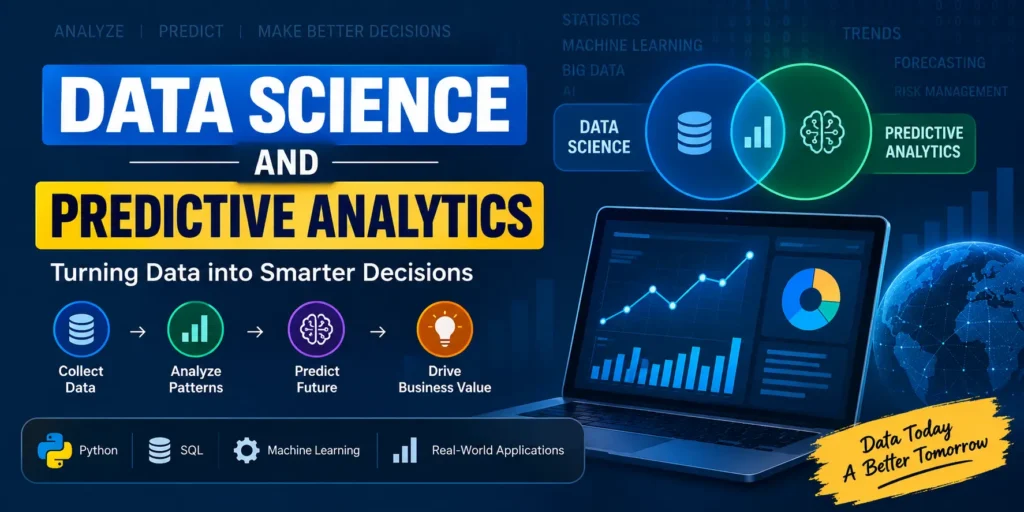
In today’s rapidly evolving digital world, data is more than just numbers—it is a powerful asset that businesses use to gain insights, improve decision-making, and anticipate future trends. Two important areas driving this transformation are data science and predictive analytics. Although they are closely connected, they serve different purposes in data-driven decision-making.
This article explains the difference between data science and predictive analytics, their core methodologies, and why both are important in modern business environments.
Complete Advance AI Topics: Click Here
SQL Tutorial: Click Here
What is Data Science?
Data science is an interdisciplinary field that combines programming, mathematics, statistics, and domain expertise to extract useful insights from structured and unstructured data. It covers a wide range of activities, including data collection, data cleaning, analysis, visualization, and the development of machine learning models.
At its core, data science helps answer complex business questions by transforming raw data into meaningful and actionable insights. Whether the goal is to understand customer behavior, evaluate sales performance, or identify operational inefficiencies, data science enables organizations to make informed decisions based on data.
Understanding Predictive Analytics
Predictive analytics is a specialized area of data science that focuses on using historical data to predict future outcomes. It involves analyzing existing data and developing models that can identify patterns, trends, and the likelihood of future events.
The primary goal of predictive analytics is to forecast possible outcomes, such as customer churn, credit risk, equipment failure, or the potential success of a marketing campaign.
Key Techniques in Predictive Modeling
Several techniques are commonly used in predictive analytics. Some of the most important ones include:
- Decision Trees: Decision trees are classification and prediction models that divide data into branches based on input variables. They provide an easy-to-understand representation of decision-making processes and are widely used in business applications.
- Regression Analysis: Regression is a statistical technique used to identify relationships between variables. It is commonly applied in finance, economics, and marketing to predict continuous outcomes such as prices, revenue, and sales.
- Neural Networks: Neural networks are advanced machine learning models inspired by the structure of the human brain. They can identify complex and nonlinear relationships in data and are frequently used for pattern recognition, image analysis, and artificial intelligence applications.
Why Predictive Analytics Matters in Risk Management
The demand for predictive analytics and risk management has increased across industries, particularly in finance, healthcare, and insurance. Organizations need professionals who can analyze large volumes of data and develop predictive models that improve operational efficiency while helping reduce potential risks.
Predictive analytics plays an important role in areas such as:
- Fraud detection and prevention
- Operational optimization
- Cost reduction strategies
- Gaining a competitive advantage
- Customer satisfaction and retention
- Strategic planning and forecasting
With the rapid growth of big data and advancements in cloud computing, traditional data analysis tools can struggle to handle the scale and complexity of modern datasets. Predictive analytics, supported by machine learning, helps organizations identify patterns and make smarter, faster decisions.
The Future of Predictive Analytics and Data Science
Several factors are contributing to the continued growth of data science and predictive analytics:
- Exponential Data Growth: Connected devices, IoT systems, and digital platforms are generating increasingly large amounts of data.
- Wider Adoption of Cloud Services: Cloud technologies make it easier for organizations to store, process, and access large datasets.
- Rapid Development of AI and Machine Learning: Advances in artificial intelligence and machine learning are making analytical tools more sophisticated and accessible.
- Growing Demand for Skilled Professionals: Organizations increasingly require professionals such as data scientists, data engineers, and Chief Data Officers (CDOs) to manage and use data effectively.
As more organizations recognize the value of predictive insights, the need for strong data management and analytical capabilities will continue to increase.
Data Science vs Predictive Analytics: Key Differences
| Criteria | Predictive Analytics | Data Science |
|---|---|---|
| Definition | Forecasts future events using current and historical data | Extracts knowledge and insights from data using interdisciplinary techniques |
| Purpose | Predict unknown or future outcomes | Understand data and extract actionable insights |
| Focus | Statistical modeling and forecasting | Data preparation, transformation, analysis, and machine learning |
| Applications | Risk management, fraud detection, and operational forecasting | Search engines, recommendation systems, and logistics |
| Tools & Techniques | Regression, decision trees, and AI | ETL, data visualization, modeling, and cloud computing |
| Industries | Finance, retail, healthcare, and manufacturing | Technology, e-commerce, transportation, and digital services |
| End Goal | Build models that predict future outcomes | Extract insights that support better decision-making |
Real-World Application Example
Consider a financial institution with thousands of customers. Predictive analytics can analyze historical customer behavior to forecast which customers are more likely to apply for a loan or close their accounts. The institution can then proactively engage with those customers.
At the same time, data science can help collect, organize, clean, structure, and analyze the organization’s large customer dataset. This broader process can reveal hidden patterns and trends that support business decisions.
Download New Real-Time Projects:- Click here
Final Thoughts
Although data science and predictive analytics overlap in their use of data, they have different strategic purposes. Predictive analytics primarily focuses on forecasting future outcomes using historical and current data, while data science takes a broader approach to understanding data and generating meaningful insights.
Together, these disciplines form an important foundation for intelligent, data-driven business strategies. As organizations continue to generate and rely on large amounts of data, understanding data science and predictive analytics is becoming increasingly valuable.
Keywords
data science and predictive analytics, predictive analytics, predictive analytics tools, predictive analytics techniques, predictive analytics models, AI predictive analytics examples, types of predictive analytics, steps involved in predictive analytics, data science, machine learning, data analytics