Introduction
Linear Programming (LP) is a powerful mathematical technique used for optimization. It helps in maximizing or minimizing a linear objective function while satisfying a set of linear constraints. Introduced in the 20th century, Linear Programming has become an important tool in areas such as operations research, economics, engineering, logistics, and finance.
At its core, Linear Programming helps decision-makers find the best possible solution when resources are limited. The term linear means that both the objective function and the constraints have linear relationships, where variables are combined proportionally and additively.
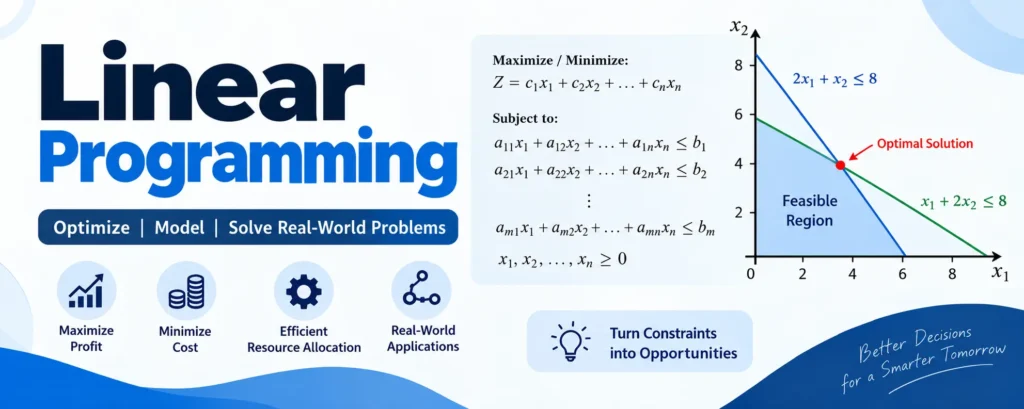
LP problems can often be represented visually using a feasible region created by the given constraints. In many cases, the optimal solution occurs at one of the extreme points of this region. Simple LP problems can be solved graphically, while more complex problems can be solved using algorithms such as the Simplex Method and Interior Point Methods.
Linear Programming is widely used for resource allocation, production scheduling, financial portfolio optimization, logistics planning, and many other strategic decision-making problems.
Table of Contents
Complete Advance AI Topics: Click Here
SQL Tutorial: Click Here
Definition of Linear Programming
Linear Programming is a quantitative optimization technique that aims to maximize or minimize a linear objective function while satisfying a set of linear constraints.
These constraints represent limitations or requirements involving resources such as time, money, labor, materials, or production capacity.
A general Linear Programming problem can be represented as follows:
Objective Function
Maximize or Minimize:
Z = c₁x₁ + c₂x₂ + ... + cₙxₙSubject to Constraints
a₁₁x₁ + a₁₂x₂ + ... + a₁ₙxₙ ≤ b₁
a₂₁x₁ + a₂₂x₂ + ... + a₂ₙxₙ ≤ b₂
...
aₘ₁x₁ + aₘ₂x₂ + ... + aₘₙxₙ ≤ bₘ

x₁, x₂, ..., xₙ ≥ 0
The symbols in the constraints can also be ≥ or =, depending on the type of Linear Programming problem.
Core Components of Linear Programming
Decision Variables
Decision variables are the unknown quantities that need to be determined. They represent values that a decision-maker can control, such as the number of products to manufacture or the amount of money to invest.
Objective Function
The objective function defines the main goal of the optimization problem. It can involve maximizing profit, production, or revenue, or minimizing cost, time, or resource usage.
Constraints
Constraints represent the limitations or requirements that a solution must satisfy. These may include restrictions related to budget, production capacity, available materials, labor, or time.
Non-Negativity Restriction
Decision variables are generally required to be non-negative:
x₁, x₂, ..., xₙ ≥ 0This restriction is useful because quantities such as production units, resources, and investments usually cannot have negative values.
Types of Linear Programming
1. Standard Linear Programming
Standard Linear Programming focuses on optimizing a linear objective function subject to linear constraints.
Use Case: Production planning, scheduling, and basic logistics.
2. Integer Linear Programming (ILP)
Integer Linear Programming requires some or all decision variables to have integer values.
Use Case: Network design and staff scheduling.
3. Binary Linear Programming
Binary Linear Programming restricts decision variables to either 0 or 1. These values are often used to represent yes/no or selected/not-selected decisions.
Use Case: Facility location, selection problems, and circuit design.
4. Mixed-Integer Linear Programming (MILP)
Mixed-Integer Linear Programming combines continuous variables with integer variables in the same optimization problem.
Use Case: Supply chain planning and energy systems.
5. Multi-Objective Linear Programming
Multi-Objective Linear Programming considers multiple objective functions simultaneously, particularly when the objectives may conflict with each other.
Use Case: Environmental planning and resource trade-offs.
6. Dynamic Linear Programming
Dynamic Linear Programming extends optimization to decision-making problems that involve multiple time periods.
Use Case: Inventory control and multi-period financial planning.
Applications of Linear Programming
Production Planning
Linear Programming can be used to determine the optimal product mix and allocation of resources to maximize profit.
Supply Chain and Logistics
LP helps organizations improve transportation planning, inventory levels, resource allocation, and delivery efficiency.
Financial Portfolio Optimization
Financial institutions and investors can use Linear Programming to allocate assets while considering return, risk, and budget constraints.
Marketing Campaigns
LP can help distribute marketing budgets across different channels to maximize reach, engagement, or other measurable objectives.
Agriculture
Farmers and agricultural planners can use Linear Programming to allocate land, labor, fertilizers, and other resources to maximize crop production or profit.
Project Scheduling
Linear Programming can help organizations allocate available time and resources efficiently while meeting project deadlines and controlling costs.
Common Linear Programming Problem Types
| Problem Type | Description | Example |
|---|---|---|
| Maximization Problem | Maximize a linear function under given constraints. | Maximize profit from a product mix. |
| Minimization Problem | Minimize a linear function while satisfying constraints. | Minimize transportation cost. |
| Standard Form Problem | Represents the problem using a standard mathematical structure. | Solve using the Simplex Method. |
| Canonical Form Problem | Uses equality constraints and can involve slack or surplus variables. | Convert inequalities into equalities. |
| Feasibility Problem | Determines whether a solution exists that satisfies all constraints. | Check whether resource requirements can be satisfied. |
| Unbounded Problem | A problem where the objective can increase or decrease without reaching a finite optimum. | Maximize profit when no effective limiting constraint exists. |
Methods for Solving Linear Programming Problems
Graphical Method
The Graphical Method is generally used for Linear Programming problems involving two decision variables. The constraints are plotted on a graph, creating a feasible region, and the optimal point is identified.
Best For: Simple problems with two variables and visual analysis.
Simplex Method
The Simplex Method is an iterative optimization technique that moves between vertices of the feasible region to find an optimal solution.
Best For: Medium- to large-scale Linear Programming problems.
Dual Simplex Method
The Dual Simplex Method is a variation of the Simplex Method that can be useful when the initial solution is infeasible but certain optimality conditions are satisfied.
Best For: Problems where maintaining feasibility during the standard Simplex process is difficult.
Interior Point Methods
Interior Point Methods search through the interior of the feasible region rather than moving only along its edges. These methods are particularly useful for large-scale optimization problems.
Best For: High-dimensional Linear Programming problems.
Branch and Bound
Branch and Bound divides an optimization problem into smaller subproblems and eliminates branches that cannot produce a better solution.
Best For: Integer and Mixed-Integer Linear Programming problems.
Genetic Algorithms
Genetic Algorithms are optimization techniques inspired by natural selection. They generate and evolve candidate solutions over multiple generations.
Best For: Complex optimization problems where traditional methods may be difficult to apply.
Gradient Descent
Gradient Descent is an iterative optimization technique that updates variables based on the gradient of an objective function. It is widely used in machine learning and convex optimization.
Best For: Convex optimization and machine learning applications.
Karmarkar’s Algorithm
Karmarkar’s Algorithm is an interior-point algorithm developed for Linear Programming. It provides a polynomial-time approach to solving large optimization problems.
Best For: Large and computationally intensive Linear Programming problems.
Download New Real-Time Projects: Click here
Conclusion
Linear Programming remains an important and powerful technique in modern optimization. It helps organizations make better decisions by efficiently allocating limited resources and optimizing objectives such as profit, cost, production, and time.
From business and finance to logistics, agriculture, engineering, and project planning, Linear Programming can be applied to a wide range of real-world problems.
Whether you are a student, researcher, or professional, understanding Linear Programming can help you develop the analytical and problem-solving skills needed to approach complex decision-making problems with greater precision.
Keywords
Linear Programming, Linear Programming Tutorial, Linear Programming Problems, Linear Programming Methods, Linear Programming Applications, Simplex Method, Graphical Method, Integer Linear Programming, Mixed Integer Linear Programming, Binary Linear Programming, Optimization Techniques