
Derivation of Cross Entropy Function
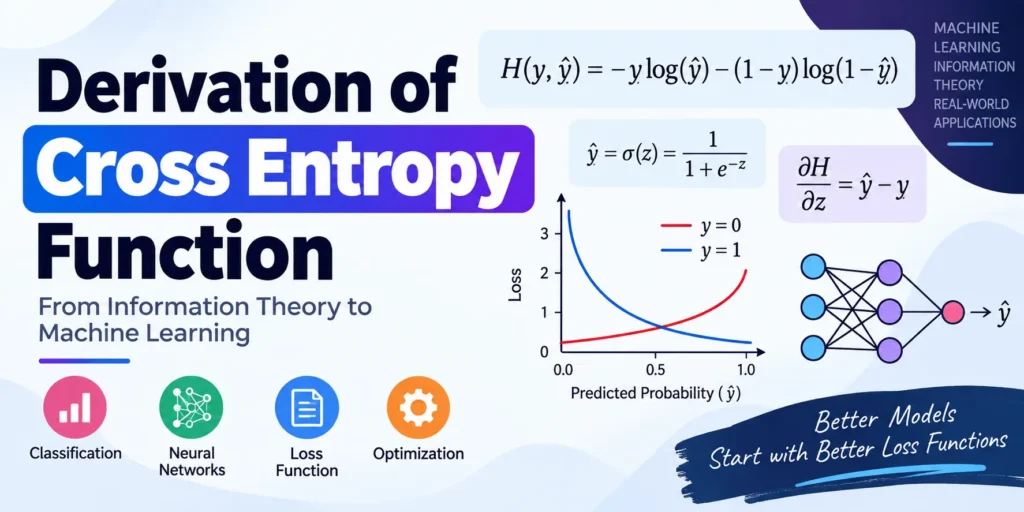
Cross Entropy is an important concept in information theory and machine learning, especially for classification problems. It measures the difference between two probability distributions, typically the actual class labels and the probabilities predicted by a model.
In information theory, cross entropy represents the average number of bits required to encode data from one probability distribution when using a coding scheme optimized for another distribution. In machine learning, it is commonly used as a loss function to measure how far predicted probabilities are from the actual labels.
Cross Entropy is particularly important in binary and multiclass classification. When a model makes predictions that differ significantly from the actual labels, the loss increases, encouraging the model to improve its predictions during training.
Table of Contents
Complete Advance AI Topics: Click Here
SQL Tutorial: Click Here
Why the Cross Entropy Function Was Derived
1. Model Performance Evaluation
In classification problems, it is important to measure how closely the predicted probabilities match the actual class labels. Cross Entropy provides a mathematical method for evaluating the quality of probabilistic predictions.
2. Information-Theoretic Foundation
Cross Entropy originates from information theory. It measures the number of bits required to represent outcomes from one probability distribution when using a coding scheme based on another distribution. This provides a theoretical foundation for evaluating how well a machine learning model represents the underlying data.
3. Optimization in Learning
Cross Entropy is differentiable and works effectively with optimization algorithms such as gradient descent. Its derivative provides the information required to update model parameters and reduce prediction errors during training.
4. Emphasis on Confident Accuracy
Cross Entropy strongly penalizes predictions that are confidently incorrect. For example, if the correct class has a probability close to zero, the resulting loss can become very large. This encourages models to assign higher probabilities to the correct classes.
Mathematical Derivation
Derivative of Cross Entropy with Respect to Logits
Let’s begin with binary classification.
Step 1: Define the Loss Function
The binary cross entropy loss is defined as:
H(y, ŷ) = -y log(ŷ) - (1 - y) log(1 - ŷ)Where:
- y ∈ {0, 1} is the true class label.
- ŷ is the predicted probability of class 1.
Step 2: Use the Sigmoid Activation
The predicted probability ŷ is obtained from the logit z using the sigmoid function:
ŷ = σ(z) = 1 / (1 + e-z)The derivative of the sigmoid function is:
dŷ/dz = ŷ(1 - ŷ)Step 3: Substitute into the Loss
Substituting the sigmoid output into the binary cross entropy function gives:
H(y, z) = -y log(1 / (1 + e-z))
         - (1 - y) log(1 - 1 / (1 + e-z))
Step 4: Apply the Chain Rule
To calculate the gradient of the loss with respect to the logit z, we apply the chain rule:
∂H/∂z = (∂H/∂ŷ)(∂ŷ/∂z)Step 5: Compute the Partial Derivatives
The derivative of the cross entropy loss with respect to the predicted probability is:
∂H/∂ŷ = -y/ŷ + (1 - y)/(1 - ŷ)From the sigmoid function, we have:
∂ŷ/∂z = ŷ(1 - ŷ)Step 6: Combine the Derivatives
Substituting both derivatives into the chain rule gives:
∂H/∂z =
(-y/ŷ + (1 - y)/(1 - ŷ)) × ŷ(1 - ŷ)
Step 7: Simplify
After simplifying the expression, we obtain:
∂H/∂z = ŷ - yThis is one of the most useful results when working with binary classification. The gradient of binary cross entropy with a sigmoid activation is simply the predicted probability minus the actual label.
Derivative of Cross Entropy with Respect to Predicted Probability
We can return to the original binary cross entropy function:
H(y, ŷ) = -y log(ŷ) - (1 - y) log(1 - ŷ)Step 1: Take the Derivative
Differentiating with respect to the predicted probability ŷ gives:
∂H/∂ŷ = -y/ŷ + (1 - y)/(1 - ŷ)This derivative is important during backpropagation because it helps determine how the model parameters should be updated to reduce the prediction error.
Practical Applications
1. Neural Network Training
Cross Entropy is one of the most commonly used loss functions for classification problems in neural networks. During backpropagation, its gradient helps the network adjust its parameters and minimize prediction errors.
2. Binary and Multiclass Classification
Cross Entropy can be used for both binary and multiclass classification. For example, it can help train a model to distinguish between spam and non-spam messages or classify handwritten digits into multiple categories.
3. Softmax + Cross Entropy Combination
For multiclass classification, the Softmax activation function is commonly used to convert logits into class probabilities. When Softmax is combined with Cross Entropy, the resulting gradient has a simple and efficient form, which makes optimization easier.
For a multiclass problem, the derivative with respect to a logit can be expressed as:
∂L/∂zi = pi - yiwhere pi is the predicted probability for class i and yi represents the actual class label.
4. Natural Language Processing (NLP)
Cross Entropy is widely used in NLP applications such as language modeling, machine translation, and sentiment analysis. It helps models learn to assign higher probabilities to the correct words or tokens.
5. Reinforcement Learning
Cross Entropy can also be used in reinforcement learning, particularly in methods that work with probability distributions over possible actions. It can help update action probabilities during the learning process.
6. Anomaly Detection
Cross Entropy can be useful in anomaly detection when a model predicts probability distributions for expected observations. Significant differences between predicted and actual distributions can indicate unusual or anomalous behavior.
Download New Real Time Projects :- Click here
Conclusion
The Cross Entropy function is more than just a loss metric. It provides an important connection between information theory and practical machine learning. Understanding its mathematical derivation helps developers and data scientists understand how classification models measure errors and update their parameters during training.
In particular, the result ŷ – y for sigmoid-based binary classification demonstrates why Cross Entropy works so effectively with neural networks. By understanding these derivatives and their applications, machine learning practitioners can build and train classification models more effectively.
For more in-depth guides on machine learning, stay tuned to your learning partner in tech.
Keywords
cross entropy loss, derivative of cross entropy loss, derivative of cross entropy loss with softmax, cross entropy loss formula, derivative of cross entropy loss with sigmoid, categorical cross entropy, binary cross entropy, cross entropy loss python, shannon entropy, entropy function formula, entropy in machine learning, entropy function, binary entropy function, cross entropy function, binary cross entropy function, categorical cross entropy function, binary entropy function calculator, negative entropy function, q ary entropy function, cross entropy function pytorch, torch entropy function, shannon entropy function