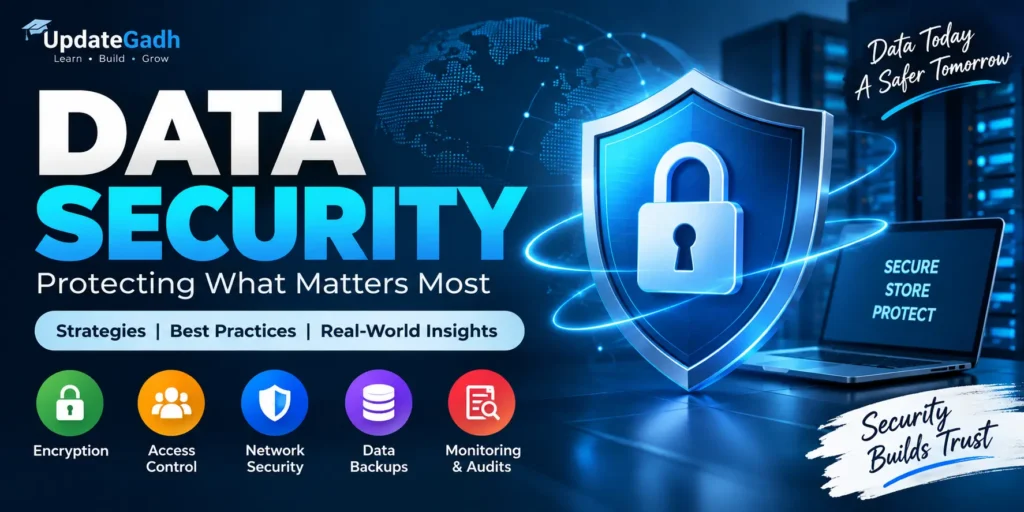
Data Security
In today’s digital world, data has become one of the most valuable assets for individuals and organizations. As businesses collect, process, and store increasing amounts of information, protecting that data from cyber threats has become essential.
Threats such as ransomware, phishing attacks, unauthorized access, and data breaches can lead to financial losses, privacy violations, and reputational damage. Data security involves using technologies, processes, and security practices to protect information from unauthorized access, modification, corruption, or theft.
Table of Contents
Complete Advance AI Topics: Click Here
SQL Tutorial: Click Here
Understanding Data Security
Data security is the practice of protecting digital information throughout its lifecycle. It includes securing personal information, financial records, business data, intellectual property, databases, and other sensitive information.
A strong data security strategy uses multiple layers of protection so that if one security mechanism fails, other controls can help protect the data.
Encryption: The First Line of Defense
Encryption converts readable data into an encoded format that cannot be easily understood without the appropriate decryption key. Only authorized users or systems with the required key can access the original information.
Encryption is widely used to protect data both while it is stored and while it is being transmitted. It can help secure emails, files, databases, cloud applications, and communication between distributed systems.
Access Controls: Managing Who Can See What
Controlling access to sensitive information is an important part of data security. Users should only have access to the data and systems required for their roles.
Common access control techniques include:
- Multi-Factor Authentication (MFA): Requires additional verification beyond a password.
- Role-Based Access Control (RBAC): Provides permissions according to a user’s role and responsibilities.
- Strong Password Policies: Encourage secure and difficult-to-guess passwords.
Proper access controls help reduce unauthorized access, accidental exposure, and potential insider threats.
Network Security and Firewalls
Network infrastructure is often a major target for attackers. Organizations can use multiple security technologies to monitor network traffic and identify suspicious activity.
Important network security tools include:
- Firewalls to filter and control network traffic.
- Intrusion Detection Systems (IDS) to identify suspicious activities.
- Intrusion Prevention Systems (IPS) to detect and block potentially harmful activity.
A strong network security framework helps protect information as it moves between systems, devices, applications, and users.
Regular Backups: Prepare for the Unexpected
Data can be lost because of cyberattacks, hardware failures, accidental deletion, or other unexpected events. Maintaining regular and automated backups provides an important layer of protection.
Backups should ideally be stored securely in separate locations, including suitable offsite or cloud-based environments. Organizations should also test their backups regularly to make sure that data can be successfully restored when required.
Educating Users and Enforcing Security Policies
Technology alone cannot completely prevent data breaches. Human behavior is also an important part of an organization’s security posture.
Regular security awareness training can help employees recognize common threats and follow safer practices. Training may include:
- Phishing awareness
- Safe browsing practices
- Password security
- Recognizing suspicious links and attachments
- Following organizational security policies
A security-aware workforce can significantly reduce vulnerabilities caused by human error.
Physical Security
Data security is not limited to software and networks. Physical access to servers, data centers, computers, storage devices, and backup systems must also be protected.
Organizations can use controlled facility access, surveillance systems, secure server rooms, and hardware security procedures to reduce the risk of unauthorized physical access, tampering, or theft.
Security Audits, Monitoring, and Continuous Improvement
Security audits and continuous monitoring help organizations identify vulnerabilities and suspicious activities before they cause significant damage.
Regular security assessments can help organizations improve their security controls and adapt to new threats. Real-time monitoring, automated alerts, and log analysis can also help security teams respond more quickly to potential incidents.
Data Classification: Not All Data Is Equal
Different types of data require different levels of protection. Data classification allows organizations to categorize information according to its sensitivity and importance.
Common classifications may include:
- Public: Information that can be freely shared.
- Internal: Information intended for use within an organization.
- Confidential: Sensitive information that requires restricted access.
- Restricted: Highly sensitive information requiring the strongest security controls.
Classifying data helps organizations apply appropriate security measures and focus resources on their most critical information.
Incident Response Planning
Even with strong security controls, security incidents can still occur. An effective incident response plan helps organizations respond quickly and systematically when a security event takes place.
A typical incident response process may include:
- Detection and containment
- Root cause analysis
- Data and system recovery
- Communication and reporting
- Post-incident review
- Updating security controls and procedures
A well-prepared response plan can reduce downtime, limit damage, and help an organization recover more effectively after a security incident.
YT:- DecodeIT
Conclusion
In a digital-first environment, data security is a necessity rather than an option. Organizations need a multi-layered approach that combines encryption, access controls, network security, backups, employee awareness, monitoring, and incident response planning.
Protecting data is not only about preventing cyberattacks. It also helps organizations maintain trust, protect sensitive information, improve resilience, and support long-term digital growth.
Keywords
what are the three pillars of cyber security, data pillar, data security implementation, data security research papers pdf, data security using cryptography, data security in analytics, data security examples, data security pdf, types of data security, what is data security in computer, data security in DBMS, 5 importance of data security, data security course, data security and privacy, data integrity, in cloud computing, data security issues in data science, data security issues in data science GeeksforGeeks