PySpark MLlib: Machine Learning at Big Data Scale
PySpark MLlib is Apache Spark’s machine learning library designed for working with large-scale data. It provides a range of machine learning algorithms and utilities that can operate across distributed computing environments.
MLlib supports important machine learning tasks such as classification, regression, clustering, collaborative filtering, feature extraction, and feature transformation. This makes it useful for machine learning workflows where datasets are too large for traditional single-machine approaches.
Core ML Concepts in PySpark MLlib
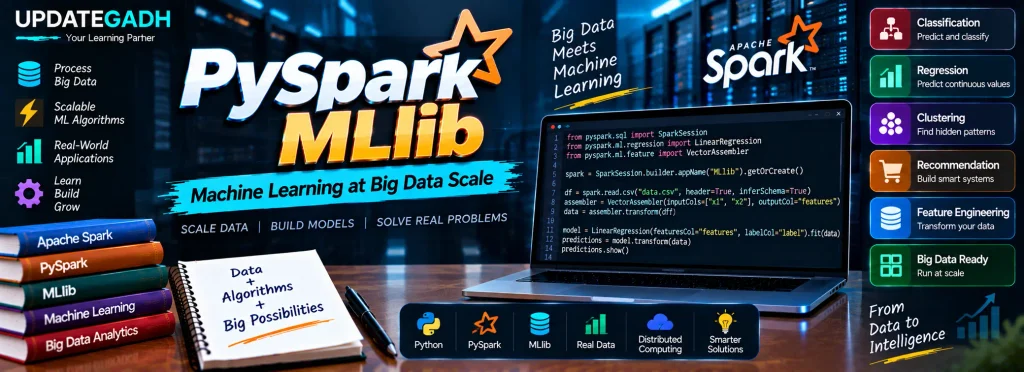
PySpark MLlib provides tools for several major machine learning tasks:
- Classification: Supports binary and multiclass classification using algorithms such as Decision Trees, Random Forest, and Naive Bayes.
- Clustering: Includes techniques such as K-Means, Gaussian Mixture, and hierarchical clustering.
- Frequent Pattern Mining: Supports itemset analysis and market basket-related tasks.
- Linear Algebra Utilities: The
mllib.linalgpackage provides utilities for matrix and vector operations. - Recommendation Systems: Collaborative filtering can be implemented using the Alternating Least Squares (ALS) algorithm.
- Regression: Regression algorithms can be used to predict continuous outcomes, including linear regression and logistic regression.
Features of PySpark MLlib
MLlib includes several features that help prepare data and build machine learning models:
- Feature Extraction: Converts raw input data into useful features for machine learning models.
- Feature Transformation: Supports operations such as scaling and encoding.
- Feature Selection: Helps select relevant features for machine learning models.
- Locality Sensitive Hashing (LSH): Provides tools for similarity-based operations on large datasets.
Example 1: Linear Regression with PySpark
Linear regression can be used to predict a continuous value from a set of input features. In this example, VectorAssembler combines selected columns into a single feature vector.
from pyspark.sql import SparkSession
from pyspark.ml.regression import LinearRegression
from pyspark.ml.feature import VectorAssembler

spark = SparkSession.builder.appName("LinReg").getOrCreate()

df = spark.read.csv(
    "Ecommerce-Customers.csv",
    header=True,
    inferSchema=True
)

assembler = VectorAssembler(
    inputCols=[
        "Avg Session Length",
        "Time on App",
        "Time on Website"
    ],
    outputCol="features"
)

data = assembler.transform(df).select(
    "features",
    "Yearly Amount Spent"
)

regressor = LinearRegression(
    featuresCol="features",
    labelCol="Yearly Amount Spent"
)

model = regressor.fit(data)

print("Coefficients:", model.coefficients)
print("Intercept:", model.intercept)
The model is trained using the selected features, and the coefficients and intercept are then displayed.
Example 2: K-Means Clustering
K-Means is an unsupervised learning algorithm used to divide data into a specified number of clusters. The following example creates three clusters and evaluates the resulting predictions using a silhouette score.
from pyspark.ml.clustering import KMeans
from pyspark.ml.evaluation import ClusteringEvaluator

dataset = spark.read.format("libsvm").load("Iris.csv")

kmeans = KMeans().setK(3).setSeed(1)

model = kmeans.fit(dataset)

predictions = model.transform(dataset)

evaluator = ClusteringEvaluator()

silhouette = evaluator.evaluate(predictions)

print(f"Silhouette Score: {silhouette}")
Here, setK(3) specifies three clusters. After training, the model generates predictions and the ClusteringEvaluator calculates the silhouette score.
Example 3: Collaborative Filtering with ALS
Collaborative filtering is commonly used for recommendation systems. PySpark provides the ALS (Alternating Least Squares) algorithm for building recommendation models from user-item rating data.
from pyspark.ml.recommendation import ALS
from pyspark.ml.evaluation import RegressionEvaluator

ratings = spark.read.csv(
    "MovieLens.csv",
    header=True,
    inferSchema=True
)

training, test = ratings.randomSplit([0.8, 0.2])

als = ALS(
    maxIter=5,
    regParam=0.01,
    userCol="userId",
    itemCol="movieId",
    ratingCol="rating",
    coldStartStrategy="drop"
)

model = als.fit(training)

predictions = model.transform(test)

evaluator = RegressionEvaluator(
    metricName="rmse",
    labelCol="rating",
    predictionCol="prediction"
)

print("RMSE:", evaluator.evaluate(predictions))

# Top 10 recommendations per user
model.recommendForAllUsers(10).show()
The ratings dataset is divided into training and testing data. The ALS model is trained using the training set, while the test set is used to evaluate predictions using RMSE. The final statement generates the top 10 recommendations for each user.
Complete Advance AI Topics: Click Here
SQL Tutorial: Click Here
YT:- DecodeIT
Frequently Asked Questions
1. What is PySpark MLlib?
PySpark MLlib is Apache Spark’s machine learning library for building machine learning applications that can work with large-scale data.
2. What algorithms are available in PySpark MLlib?
MLlib supports machine learning tasks including classification, regression, clustering, frequent pattern mining, and collaborative filtering.
3. What is VectorAssembler in PySpark?
VectorAssembler combines multiple input columns into a single feature vector that can be used by machine learning algorithms.
4. What is K-Means used for?
K-Means is a clustering algorithm that divides data into a specified number of groups or clusters.
5. What is ALS in PySpark?
ALS, or Alternating Least Squares, is used for collaborative filtering and can be applied to recommendation systems.
6. What is the purpose of ClusteringEvaluator?
ClusteringEvaluator can be used to evaluate clustering results, including calculating a silhouette score.
Conclusion
PySpark MLlib brings machine learning capabilities to Apache Spark’s distributed data-processing environment. It provides tools for tasks ranging from linear regression and clustering to recommendation systems using ALS.
With support for feature extraction, transformation, selection, and distributed machine learning workflows, PySpark MLlib can be used when working with large datasets that require scalable processing.
Keywords: PySpark MLlib, pyspark mllib example, pyspark mllib tutorial, pyspark ml vs mllib, pyspark ml pipeline, pyspark ml models, pyspark ml transformer, pyspark deep learning, pyspark mllib W3Schools, PySpark machine learning, PySpark regression, PySpark K-Means clustering, PySpark ALS recommendation system