Advanced Python Tutorial
Python is a general-purpose programming language that is used in many areas of software development and technology. Basic Python knowledge is enough for simple programs and everyday scripting, but advanced domains such as Data Science, Artificial Intelligence, and Robotics require a stronger understanding of Python’s programming features.
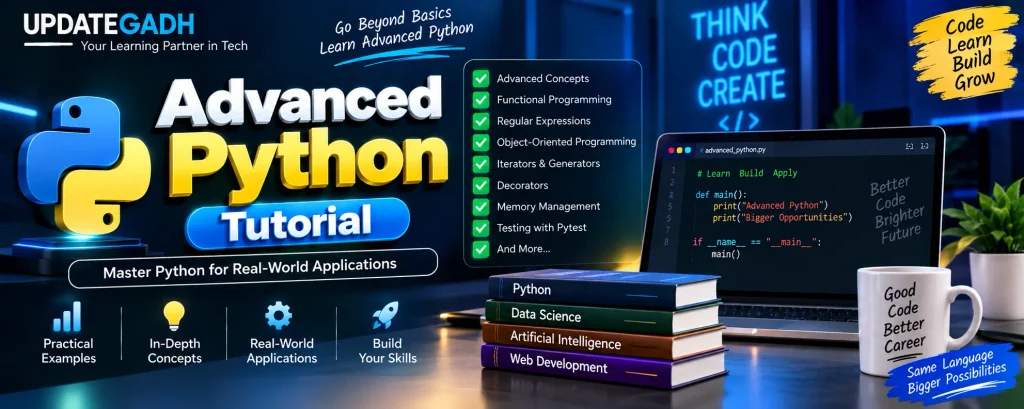
This Advanced Python Tutorial covers important concepts that help developers move beyond basic syntax and understand more powerful programming techniques. The topics include comprehensions, functional programming, recursion, regular expressions, object-oriented programming, iterators, generators, decorators, memory management, optimization, and testing.
Pre-requisites
Before starting advanced Python concepts, you should already be comfortable with the fundamentals of Python programming. A good understanding of basic syntax and programming concepts will make it easier to follow the advanced topics covered in this tutorial.
Advanced Python Topics
1. Advanced Conditional Statements
Learn how more complex conditional structures can be designed to handle situations where simple decision-making statements are not sufficient.
2. List Comprehension
Explore list comprehensions as a compact way to construct lists while keeping the code concise and readable.
3. Python Dictionary Comprehension
Learn how dictionary comprehensions can be used to generate dictionaries dynamically from existing data or expressions.
Functional Programming Concepts
4. Lambda Operator
Understand anonymous functions and how they can be used when a small function is required for a particular operation.
5. Filter
Learn how the filter() function can select elements from an iterable according to a specified condition.
6. Reduce
Understand how reduce() can perform cumulative processing on the elements of an iterable.
7. Map
Explore the map() function for applying a function to each element of an iterable and producing transformed results.
8. Recursive Functions
Study recursion and learn how a function can repeatedly call itself to solve a problem. Common examples include calculating factorials and generating Fibonacci series.
Regular Expressions
9. Basics of Regular Expressions
Learn the fundamentals of regular expressions and how patterns can be used to search, match, and manipulate text.
10. Advanced Regular Expressions
Move beyond basic patterns and work with regular expressions for more specialized validation and text-processing requirements, including:
- Checking whether a string starts and ends with the same character.
- Password validation.
- Extracting email addresses.
- Validating UPI IDs.
Object-Oriented Programming (OOP)
11. Core Concepts of OOP
Object-oriented programming provides a way to organize programs around classes and objects. Important OOP concepts include:
- Classes and Objects: Create reusable structures for organizing program data and behavior.
- Inheritance: Allow one class to reuse and extend functionality provided by another class.
- Encapsulation: Combine data and related methods within a class to manage access to information.
- Polymorphism: Allow the same method or interface to represent different behaviors.
- Data Abstraction: Hide unnecessary implementation details while exposing the required functionality.
12. Operator Overloading
Learn how operators can be given customized behavior when they are used with objects created from user-defined classes.
Iterables, Iterators, and Generators
13. Difference Between Iterable and Iterator
Understand what separates an iterable from an iterator and learn how both concepts are used when processing collections of data.
14. Python __iter__() and __next__()
Explore the iterator protocol in Python and understand the roles of __iter__() and __next__() when creating iterator-based objects.
15. Generators in Python
Learn how generator functions can produce values progressively instead of creating the complete sequence at once. This makes generators useful for creating efficient iterable structures.
Closures and Decorators
16. Closures
Understand how a closure can preserve access to variables from the environment in which a function was created, allowing function logic and its surrounding state to work together.
17. Decorators
Learn different approaches to creating decorators in Python, including:
- Creating simple decorators.
- Creating decorators that accept arguments.
- Using classes as decorators.
18. Monkey Patching
Study monkey patching, a technique that allows existing behavior to be modified or extended dynamically while a program is running.
Special Methods
19. @staticmethod and @classmethod
- @staticmethod: Defines a method that does not rely on instance-specific or class-specific state.
- @classmethod: Defines a method that can work with class-level data.
Memory Management
20. Garbage Collection and Reference Counting
Learn about the mechanisms Python uses to manage memory, including garbage collection and reference counting.
21. Mutable vs Immutable Objects
Understand how mutable and immutable objects differ and why this distinction matters when working with Python objects and memory.
22. Memory Profiling
Learn how memory usage can be examined to identify opportunities for improving and optimizing Python programs.
23. Deep Copy vs Shallow Copy
Understand the difference between shallow and deep copying and why choosing the appropriate copying technique is important when working with nested or referenced objects.
Optimization Tips
24. How Python Stores Integers
Explore how Python handles integer objects and how memory allocation is involved when integers are represented internally.
Testing
25. Testing with Pytest
Learn how Pytest can be used to create structured, reusable, and reliable test cases for Python programs.
26. DocTests and UnitTests
Understand how DocTests can validate examples written inside documentation and how UnitTests can be used to test individual parts of a program.
Complete Advance AI Topics: Click Here
SQL Tutorial: Click Here
YT:- DecodeIT
FAQs
1. What is Advanced Python?
Advanced Python covers programming concepts beyond basic syntax, including comprehensions, functional programming, OOP, generators, decorators, memory management, and testing.
2. What should I know before learning Advanced Python?
You should have a good understanding of basic Python programming concepts before moving to advanced topics.
3. What are Python comprehensions?
Comprehensions provide a concise way to create collections such as lists and dictionaries dynamically.
4. What is the difference between an iterable and an iterator?
An iterable is an object that can provide its elements one at a time, while an iterator follows Python’s iterator protocol using methods such as __iter__() and __next__().
5. What are generators in Python?
Generators are used to create iterable sequences that produce values progressively, making them useful for efficient data processing.
6. What are decorators in Python?
Decorators are used to extend or modify the behavior of functions or classes without directly changing their original implementation.
Conclusion
Advanced Python programming covers a wide range of concepts that become important as applications grow more complex. Topics such as comprehensions, functional programming, recursion, regular expressions, OOP, iterators, generators, decorators, and memory management help developers understand Python beyond its basic syntax.
Testing and optimization concepts also play an important role in building reliable and maintainable Python programs. By studying these advanced topics step by step, Python developers can strengthen their programming knowledge and prepare themselves for more demanding areas such as Data Science, Artificial Intelligence, and Robotics.
Keywords: Advanced Python Tutorial, advanced python topics, advanced python tutorial topics w3schools, advanced python tutorial programming examples, advanced python syllabus, advanced python notes, advanced python course, advance python notes pdf, advanced python projects, python tutorial, advanced python tutorial w3schools,Advanced Python Tutorial