Python OOPs Concepts
Python is a powerful general-purpose programming language that supports the Object-Oriented Programming (OOP) paradigm. OOP allows developers to organize applications around classes and objects, making programs easier to structure, reuse, maintain, and extend.
In object-oriented programming, real-world entities such as a car, book, employee, or bank account can be represented as objects. Classes define the structure and behavior of these objects, while OOP principles describe how they interact with each other.
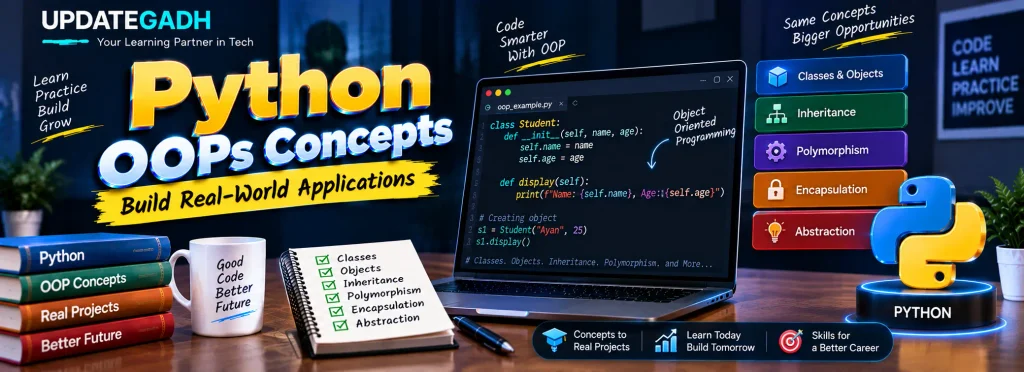
Python provides several important OOP concepts, including classes, objects, methods, inheritance, polymorphism, encapsulation, and abstraction. Understanding these concepts provides a strong foundation for developing structured Python applications.
Core Principles of Python Object-Oriented Programming
1. Class
A class in Python works as a blueprint for creating objects. It defines the data through attributes and the behavior or functionality through methods.
The class establishes the common structure for its objects. Whenever an object is created from that class, it maintains its own instance data while following the structure defined by the class.
Example
class Employee:
    def __init__(self, name, age, salary):
        self.name = name
        self.age = age
        self.salary = salary

    def show_details(self):
        print(f"Name: {self.name}, Age: {self.age}, Salary: {self.salary}")
Here, Employee is a class containing the attributes name, age, and salary, along with the show_details() method.
2. Object
An object is an instance of a class. Objects represent individual entities and contain their own state while using the behavior defined by their class.
Example
emp1 = Employee("John", 28, 50000)

emp1.show_details()
Output
Name: John, Age: 28, Salary: 50000In this example, emp1 is an object created from the Employee class. The values supplied during object creation are stored in the object’s attributes.
3. Method
Method is function defined inside class. Methods are used to perform operations related to objects and can access or modify their attributes.
For example, the show_details() method in the Employee class displays information belonging to an employee object.
emp1.show_details()Methods help combine data and the operations performed on that data within a class.
4. Inheritance
Inheritance allows child class to acquire attributes and methods from parent class. It promotes code reuse and provides a hierarchical structure between related classes.
Example
class Vehicle:
    def __init__(self, brand):
        self.brand = brand

    def show_brand(self):
        print(f"Brand: {self.brand}")


class Car(Vehicle):
    def __init__(self, brand, model):
        super().__init__(brand)
        self.model = model

    def show_model(self):
        print(f"Model: {self.model}")


car1 = Car("Toyota", "Corolla")

car1.show_brand()
car1.show_model()
Output
Brand: Toyota
Model: Corolla
Here, Car inherits from Vehicle. The show_brand() method is inherited from the parent class, while show_model() is defined in the child class.
The super() function is used to call the constructor of the parent class and initialize the inherited brand attribute.
5. Polymorphism
Polymorphism means that a common interface can be used with objects having different implementations. Different classes can provide their own behavior for a method with the same name.
Example
class Animal:
    def speak(self):
        pass


class Dog(Animal):
    def speak(self):
        print("Woof!")


class Cat(Animal):
    def speak(self):
        print("Meow!")


animals = [Dog(), Cat()]

for animal in animals:
    animal.speak()
Output
Woof!
Meow!
Both Dog and Cat provide their own implementation of the speak() method. The same method call, animal.speak(), produces different results depending on the object.
6. Encapsulation
Encapsulation combines data and methods within a class and provides a way to control access to internal data. It helps protect an object’s internal state from direct manipulation.
In Python, a double underscore prefix can be used with an attribute to indicate that it should not be accessed directly using its original name from outside the class.
Example
class BankAccount:
    def __init__(self, balance):
        self.__balance = balance

    def deposit(self, amount):
        self.__balance += amount

    def get_balance(self):
        return self.__balance


account = BankAccount(1000)

account.deposit(500)

print(account.get_balance())
Output
1500Here, __balance is used as an internal attribute. The deposit() and get_balance() methods provide controlled ways to modify and retrieve the balance.
7. Abstraction
Abstraction focuses on exposing the essential functionality while hiding unnecessary implementation details. It allows users to work with an interface without needing to understand every internal operation.
In Python, abstraction can be implemented using abstract classes or abstract methods. These concepts are particularly useful when designing larger applications where multiple classes need to follow a common structure.
Object-Oriented Programming vs Procedural Programming
| Feature | Object-Oriented Programming | Procedural Programming |
|---|---|---|
| Approach | Uses objects and classes to organize programs | Uses step-by-step procedures and instructions |
| Real-world Modeling | Can represent real-world entities through objects | Primarily focuses on procedures and functions |
| Reusability | Supports reuse through classes, inheritance, and other OOP features | Generally provides less structure for object-based reuse |
| Data Protection | Supports data hiding and controlled access through encapsulation | Provides a different, procedure-oriented approach to data management |
| Examples | Python, Java, C++ | C, Fortran, Pascal |
Benefits of Python OOP
Complete Advance AI Topics: Click Here
SQL Tutorial: Click Here
YT:- DecodeIT
1. Code Reusability
Inheritance and polymorphism can help developers reuse existing code across related classes and application components.
2. Scalability
Organizing applications into classes and objects can make larger programs easier to expand and manage.
3. Real-World Modeling
Classes and objects provide a convenient way to represent real-world entities and their behavior in a program.
4. Ease of Maintenance
Encapsulation and modular class structures can help isolate functionality, making changes easier to manage within larger applications.
Frequently Asked Questions
1. What are OOP concepts in Python?
The major OOP concepts discussed in Python include classes, objects, methods, inheritance, polymorphism, encapsulation, and abstraction.
2. What is a class in Python?
A class is a blueprint used to define the attributes and methods that objects created from it can use.
3. What is an object in Python?
An object is an instance of a class that contains its own data and can use the methods defined by that class.
4. What is inheritance in Python?
Inheritance allows a child class to acquire functionality from a parent class and extend or customize that functionality.
5. What is polymorphism in Python?
Polymorphism allows different classes to provide different implementations of a common method or interface.
6. What is encapsulation in Python?
Encapsulation combines data and methods within a class and helps control access to the object’s internal data.
7. What is abstraction in Python?
Abstraction hides unnecessary implementation details and exposes the essential functionality required by the user.
8. Why is OOP useful in Python?
OOP can improve code organization, reusability, scalability, and maintainability by structuring applications around classes and objects.
Conclusion
Python OOP concepts provide a structured approach to developing reusable and maintainable applications. Classes define the structure of objects, while objects represent individual instances containing their own data and behavior.
Inheritance promotes reuse between related classes, polymorphism allows different implementations through a common interface, encapsulation helps organize and protect internal data, and abstraction hides unnecessary implementation details.
Understanding these concepts provides a strong foundation for working with Python’s object-oriented programming model and building larger applications with a clear and modular structure.
Keywords: Python OOPs Concepts, OOPs concepts in Python with examples, Python OOP concepts, Python OOPs interview questions, Python OOP cheat sheet, polymorphism in Python, inheritance in Python, encapsulation in Python, abstraction in Python, Python classes and objects, object-oriented programming in Python, Python OOP concepts advanced, Python OOP concepts questions, Python OOP concepts PDF, OOP concepts in Python and Java