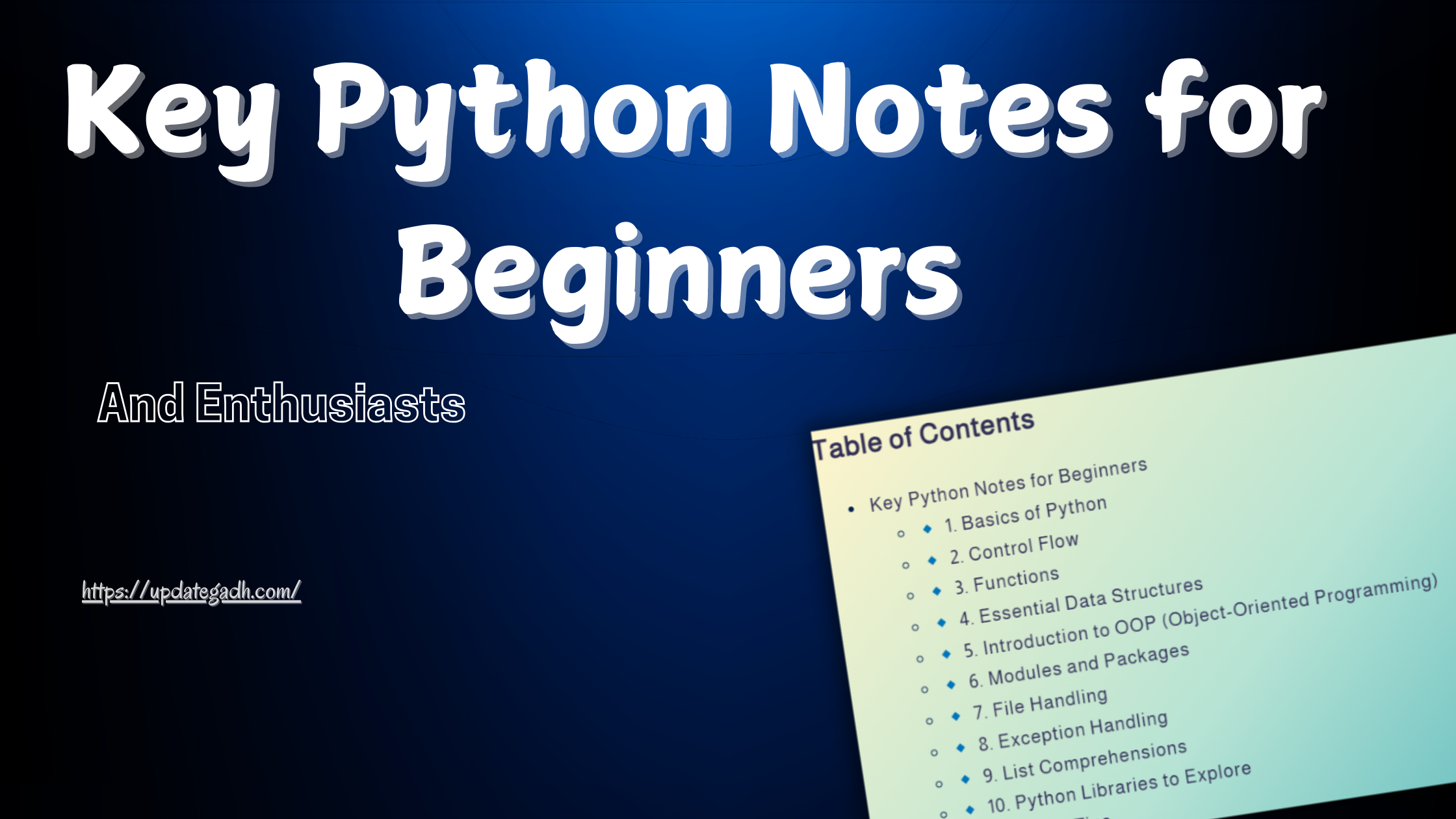
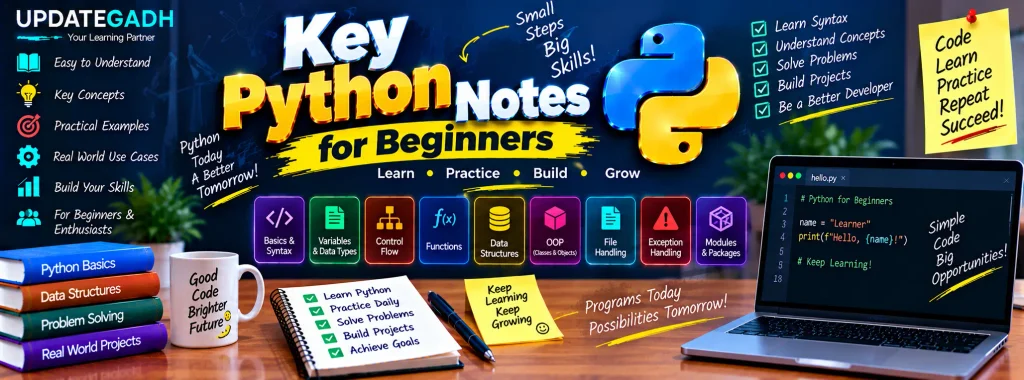
Key Python Notes for Beginners
Python is one of the most popular programming languages for beginners because of its readable syntax, flexible features, and wide range of applications. Learning Python becomes much easier when the basic concepts are understood step by step. Important topics include variables, data types, control flow, functions, data structures, object-oriented programming, modules, file handling, exception handling, and list comprehensions.
These key Python notes provide a practical overview of the concepts that beginners and Python enthusiasts should understand while building their programming foundation. By becoming familiar with these topics and practicing them regularly, learners can develop the skills needed to write clearer and more effective Python programs.
1. Basics of Python
The first step in learning Python is understanding its basic building blocks. Variables, data types, and comments are fundamental concepts that appear throughout Python programming.
Variables
Variables are used to store values so that they can be accessed and used later in a program. Python allows variables to store different kinds of information without requiring an explicit type declaration.
x = 5
name = "Alice"
pi = 3.14
In this example, x stores an integer, name stores a string, and pi stores a floating-point value.
Data Types
Python provides several commonly used data types. Some important examples include:
intfor integer values.floatfor decimal numbers.strfor text.listfor ordered and changeable collections.tuplefor ordered and immutable collections.dictfor key-value data.setfor collections of unique items.
Comments
Comments help make Python code easier to understand. A single-line comment can be written using the # symbol. Multi-line comments can be represented using triple quotes when appropriate.
# This is a single-line comment

'''
This is a
multi-line comment
'''
2. Control Flow
Control flow determines how a Python program executes different instructions. Conditional statements allow programs to make decisions, while loops allow tasks to be repeated.
If-Else Statements
An if-else statement allows a program to choose between different outcomes depending on whether a condition is true or false.
age = 20

if age >= 18:
    print("Adult")
else:
    print("Minor")
Here, Python checks whether the value stored in age is at least 18. If the condition is true, the first message is displayed. Otherwise, the else block is executed.
Loops
Loops are useful when the same operation needs to be performed repeatedly. Python mainly provides for and while loops for this purpose.
For Loop
A for loop is commonly used when iterating over a sequence or when a task needs to be repeated for a known range of values.
for i in range(5):
    print(i)
This example prints values from 0 through 4.
While Loop
A while loop continues executing while its condition remains true.
count = 0

while count < 5:
    print(count)
    count += 1
The value of count increases during every iteration, allowing the condition to eventually become false.
3. Functions
A function is a reusable block of Python code designed to perform a specific task. Functions help organize programs into smaller sections and reduce unnecessary repetition.
Functions are created using the def keyword. They can receive parameters and can return a result.
def greet(name):
    return f"Hello, {name}!"

print(greet("Alice"))
In this example, greet() accepts a name as an argument and returns a formatted greeting. Functions make programs easier to structure and allow the same logic to be reused whenever required.
4. Essential Data Structures
Data structures provide ways to organize and store multiple values. Python includes several built-in structures that are useful for different programming requirements.
Lists
A list is an ordered and mutable collection. Because lists can be changed after creation, elements can be added, removed, or modified.
fruits = ["apple", "banana"]Dictionaries
A dictionary stores information as key-value pairs. It is useful when values need to be associated with meaningful keys.
person = {
    "name": "Alice",
    "age": 25
}
Sets
A set is used to store unique items. It is useful when duplicate values are not required.
Tuples
A tuple is an ordered collection that cannot normally be modified after it has been created. Tuples are useful when a fixed collection of values needs to be represented.
5. Introduction to OOP in Python
Object-Oriented Programming, commonly called OOP, is a programming approach based around classes and objects. Python supports OOP concepts that help developers organize larger programs into reusable and structured components.
A class can be considered a blueprint for creating objects. Python OOP includes concepts such as encapsulation, inheritance, polymorphism, and abstraction. These principles can help organize complex applications and make code more modular and maintainable.
A simple Python class example is shown below:
class Dog:
    def __init__(self, name):
        self.name = name

    def bark(self):
        print(f"{self.name} says Woof!")

my_dog = Dog("Buddy")
my_dog.bark()
In this example, Dog is a class and my_dog is an object created from that class. The constructor initializes the dog’s name, while the bark() method performs an action.
6. Modules and Packages
Python allows developers to reuse existing functionality through modules and packages. The import statement is used to access modules, libraries, and functions that provide additional capabilities.
For example, Python’s math module provides mathematical functionality:
import math

print(math.sqrt(16))
The sqrt() function from the math module calculates the square root of a number. Modules help keep programs organized and allow developers to use existing functionality instead of implementing everything from scratch.
7. File Handling
Python provides simple tools for working with files. Programs can open files, read their contents, write new information, and manage file-based data.
The with open() approach is commonly used because it handles the file resource appropriately after the operation is completed.
with open("file.txt", "w") as file:
    file.write("Hello, Python!")
In this example, the file is opened in write mode using "w". The write() method places the specified text into the file.
8. Exception Handling
Errors can occur while a Python program is running. Exception handling allows developers to manage certain errors and prevent the program from ending unexpectedly.
Python commonly uses try, except, and finally blocks for handling exceptions.
try:
    result = 10 / 0

except ZeroDivisionError:
    print("Cannot divide by zero.")

finally:
    print("Finished.")
Here, dividing by zero raises a ZeroDivisionError. The except block handles that specific exception, while the finally block executes after the operation.
9. List Comprehensions
List comprehensions provide a concise way to create lists from existing sequences or ranges. They can often express list-building operations in a single line while keeping the code readable.
squares = [x**2 for x in range(10)]This example creates a list containing the square of each value generated by range(10). List comprehensions are particularly useful when a new list needs to be generated from an existing sequence using a straightforward expression.
10. Python Libraries to Explore
Python has a large ecosystem of libraries that can be used for different types of development and programming tasks. After learning the fundamentals, beginners can explore libraries based on their interests and project requirements.
- NumPy: Used for mathematical and numerical operations.
- Pandas: Used for data analysis and data manipulation.
- Matplotlib: Used for creating data visualizations.
- Flask/Django: Used for web development.
- Requests: Used for making HTTP requests.
- Tkinter: Used for creating graphical user interfaces.
Learning Tips
Learning Python effectively requires regular practice rather than only reading theoretical concepts. Beginners should practice the syntax and concepts they learn by writing small programs and gradually applying them to practical tasks.
- Practice Python consistently.
- Solve coding challenges to improve problem-solving skills.
- Build small projects while learning new concepts.
- Use tutorials and community resources when additional guidance is needed.
Keeping a concise set of Python notes can also make revision easier. As you learn new concepts, adding important syntax, examples, and explanations to your notes can help you quickly review previously studied topics.
Complete Advance AI Topics: Click Here
SQL Tutorial: Click Here
YT:- DecodeIT
Conclusion
These key Python notes cover several of the fundamental concepts that beginners should understand while learning Python. Starting with variables and data types provides the foundation for working with information, while conditional statements and loops introduce program control.
Functions help create reusable code, and data structures such as lists, dictionaries, sets, and tuples provide different ways to organize information. OOP introduces classes and objects for structured programming, while modules and packages make it possible to reuse existing functionality.
File handling and exception handling are also important for practical applications, while list comprehensions provide a concise way to create lists. Once these fundamentals become familiar, learners can explore libraries such as NumPy, Pandas, Matplotlib, Flask, Django, Requests, and Tkinter according to their interests.
Regular practice, coding challenges, small projects, and continuous learning can help beginners become more comfortable with Python and gradually develop stronger programming skills.
Frequently Asked Questions
1. What are the basic Python concepts beginners should learn?
Beginners should start with variables, data types, comments, conditional statements, loops, functions, and basic data structures such as lists, dictionaries, sets, and tuples.
2. What are variables in Python?
Variables are names used to store values in a Python program. They can hold different types of data, such as integers, strings, and floating-point numbers.
3. What is the difference between a list and a tuple?
A list is an ordered and mutable collection, while a tuple is an ordered collection that is immutable.
4. What is a Python function?
A function is a reusable block of code designed to perform a particular task. Functions are defined using the def keyword.
5. Why is exception handling important in Python?
Exception handling allows a program to catch and manage certain runtime errors using constructs such as try, except, and finally.
6. What is Object-Oriented Programming in Python?
OOP is a programming approach that organizes code around classes and objects. Python supports concepts including encapsulation, inheritance, polymorphism, and abstraction.
7. What is a list comprehension?
A list comprehension is a concise Python technique for creating a new list from an iterable or range using a compact expression.
8. Which Python libraries should beginners explore?
Beginners can explore libraries such as NumPy, Pandas, Matplotlib, Flask, Django, Requests, and Tkinter based on their learning goals.
Keywords: Key Python Notes for Beginners,Key Python Notes for Beginners,Key Python Notes for Beginners,Key Python Notes for Beginners python notes for beginners pdf download, python notes pdf, python notes pdf for BCA, python notes for beginners download, python basics pdf, key python notes for beginners pdf, key python notes for beginners free, Python basics notes, Python programming notes for beginnersKey Python Notes for Beginners,Key Python Notes ,Key Python Notes for Beginners