
Python Classes and Objects
Python is a versatile object-oriented programming language that provides powerful features for creating reusable and organized applications. Among the most important concepts in Python OOP are classes and objects.
A class provides a structure for defining data and behavior, while an object represents an individual instance created from that class. By combining classes and objects, developers can organize related attributes and methods into reusable components.
In this tutorial, we will explore what classes and objects are, how to create them, how the self parameter and __init__() method work, the difference between class and instance variables, and the major advantages of using classes and objects in Python.
Table of Contents
What Are Classes in Python?
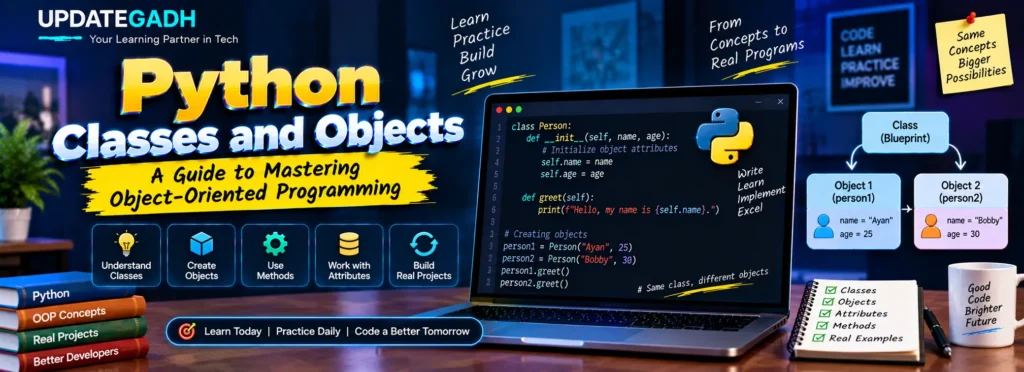
A class in Python is a user-defined structure that combines data and behavior. It can contain attributes that represent data and methods that define the operations that objects created from the class can perform.
A simple way to understand a class is to compare it with a blueprint. For example, a building blueprint can describe the arrangement of rooms, doors, windows, and floors. The same blueprint can then be used to create multiple buildings.
Similarly, a Python class defines the structure that can be used to create multiple objects with their own individual data while sharing the same methods.
Creating Classes in Python
The class keyword is used to define a class in Python. The general syntax is:
class ClassName:
    # Body of the class
A class can contain attributes, constructors, methods, and documentation strings. The documentation string of a class can be accessed using <class-name>.__doc__.
Example: Defining a Simple Class
class Person:
    def __init__(self, name, age):
        # Constructor initializes the object attributes
        self.name = name
        self.age = age

    def greet(self):
        # A method to print a greeting
        print(f"Hello, my name is {self.name}.")
In this example, Person is the class. It contains two instance attributes, name and age, and one method named greet().
What Are Objects in Python?
An object is an instance of a class. Once a class has been defined, objects can be created from it. Each object can contain its own values for the attributes defined by the class.
The __init__() method is used to initialize the attributes of an object when the object is created.
Syntax to Create an Object
object_name = ClassName(arguments)Example: Creating and Using Objects
class Person:
    def __init__(self, name, age):
        self.name = name
        self.age = age

    def greet(self):
        print(f"Hello, my name is {self.name}.")


# Creating an object of the Person class
person1 = Person("Ayan", 25)

person1.greet()
Output
Hello, my name is Ayan.Here, person1 is an object of the Person class. During object creation, the values "Ayan" and 25 are passed to the constructor and stored in the object’s attributes.
Key Concepts in Python Classes
1. The self Parameter
The self parameter refers to the current instance of a class. It is used to access instance attributes and methods from inside the class.
For example, in the following statement:
self.name = nameself.name represents the name attribute belonging to the current object, while name represents the value received by the method.
self is the conventional name used for the current instance. Although another valid identifier can technically be used, self is the standard and recommended convention for Python instance methods.
2. The __init__() Method
The __init__() method is automatically called when an object is created. It is commonly used to initialize the object’s instance attributes.
For example:
class Person:
    def __init__(self, name, age):
        self.name = name
        self.age = age
When an object is created, the constructor receives the provided values and stores them in the corresponding instance attributes.
3. Class Variables vs. Instance Variables
Python classes can contain both class variables and instance variables. Understanding the difference is important when working with multiple objects.
Class Variables
Class variables belong to the class and are shared among its instances. They are normally defined directly inside the class but outside instance methods.
Instance Variables
Instance variables belong to individual objects. They are commonly initialized inside the __init__() method using self.
Example: Class and Instance Variables
class Person:
    count = 0  # Class variable

    def __init__(self, name, age):
        self.name = name  # Instance variable
        self.age = age
        Person.count += 1


person1 = Person("Ayan", 25)
person2 = Person("Bobby", 30)

# Accessing class variable
print(Person.count)

# Accessing instance variables
print(person1.name)
print(person2.age)
Output
2
Ayan
30
Here, count is a class variable shared by the class, while name and age are instance variables belonging to individual objects.
Classes and Objects in Python
Classes and objects work together to implement object-oriented programming. The class defines the structure and behavior, while objects contain individual data based on that structure.
For example, a single Person class can be used to create multiple objects:
person1 = Person("Ayan", 25)
person2 = Person("Bobby", 30)
Both objects use the same class methods, but their instance attributes can contain different values.
Complete Advance AI Topics: Click Here
SQL Tutorial: Click Here
YT:- DecodeIT
Advantages of Using Classes and Objects
1. Reusability
Classes allow developers to define functionality once and reuse it through multiple objects. This reduces the need to duplicate similar code.
2. Modularity
Classes group related data and functions together. This makes large programs easier to organize and manage.
3. Encapsulation
Classes provide a structure for combining data and the methods that operate on that data. This helps organize how information is accessed and manipulated.
4. Scalability
Object-oriented design can make applications easier to expand because new classes and objects can be added while keeping related functionality organized.
Frequently Asked Questions
1. What is a class in Python?
A class is a user-defined structure that combines attributes and methods and provides a blueprint for creating objects.
2. What is an object in Python?
An object is an instance of a class that contains its own data and can use the methods defined by that class.
3. What is the purpose of the self parameter?
The self parameter refers to the current object and is used to access its instance attributes and methods.
4. What is the __init__() method?
The __init__() method is automatically called when an object is created and is commonly used to initialize instance attributes.
5. What is the difference between a class variable and an instance variable?
A class variable is associated with the class and can be shared among its objects, while an instance variable belongs to a particular object.
6. How do you create an object in Python?
An object can be created by calling the class with the required arguments, such as person1 = Person("Ayan", 25).
7. Why are classes useful in Python?
Classes help organize related data and functionality while supporting code reuse, modularity, encapsulation, and scalable application design.
8. Can one class create multiple objects?
Yes. A single class can be used to create multiple objects, and each object can contain its own instance data.
Conclusion
Python classes and objects are fundamental concepts of object-oriented programming. A class provides a reusable structure for defining attributes and methods, while an object represents an individual instance of that class.
The self parameter provides access to the current instance, and the __init__() method is commonly used to initialize object attributes. Understanding the difference between class variables and instance variables is also important when working with multiple objects.
By using classes and objects, Python developers can create applications that are more organized, reusable, modular, and easier to expand. These concepts form an important foundation for learning other Python OOP topics such as inheritance, abstraction, encapsulation, and polymorphism.
Keywords: Python Classes and Objects: A Guide to Mastering Object-Oriented Programming, Python classes and objects, Python class example, what is object in Python, what is class in Python, Python classes and objects examples, Python classes and objects explained, Python classes and objects exercises, Python class and object attributes, Python object-oriented programming, Python class function, Python classes and objects practice, Python class inheritance, Python OOP concepts

Can you be more specific about the content of your article? After reading it, I still have some doubts. Hope you can help me.