Exploring Python itertools
Python’s itertools module is one of the most useful tools available in the Python standard library for working with iterators. It provides a collection of efficient functions that can simplify repetitive iteration tasks while keeping programs clean and memory-friendly.
Whether you are learning Python or already working with large datasets, understanding itertools can help you replace complicated loops with concise and readable code. The module is especially useful when working with combinations, permutations, sequences, and other iteration patterns.
What is itertools in Python?
The itertools module provides a collection of iterator-building functions. These functions can be combined to create efficient iteration workflows, often without storing an entire sequence in memory.
The main advantage of itertools is its lazy approach. Values are generally produced only when they are requested, which can make it useful when processing large amounts of data.
Why Use itertools?
- Memory Efficiency: Iterators can process values as needed instead of creating large collections immediately.
- Simplified Code: Many complicated iteration patterns can be expressed with short and readable functions.
- Versatility: itertools works with lists, tuples, strings, dictionaries, generators, and other iterable objects.
- Reusable Patterns: Common operations such as combinations, permutations, filtering, and chaining are already available.
Prerequisites
Before working with itertools, it is helpful to understand the basics of Python iterators and generators.
- Iterators: Objects that provide values through
__iter__()and__next__(). - Generators: Functions that produce values one at a time using the
yieldstatement.
Categories of itertools Functions
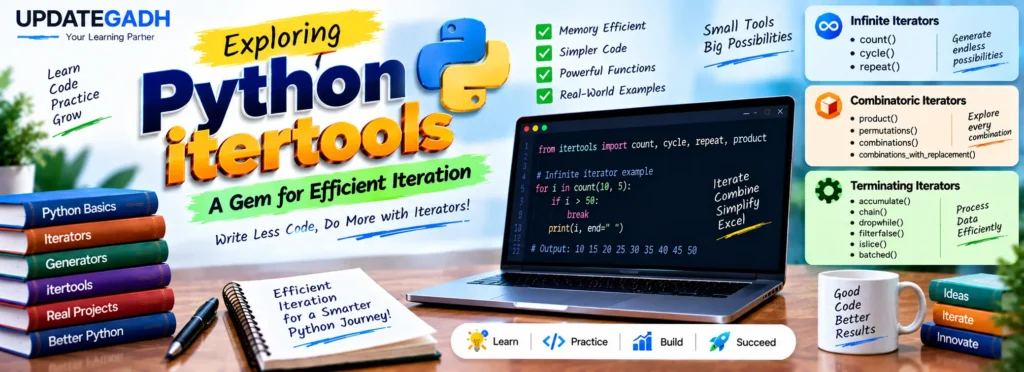
The commonly used itertools functions can be grouped into three major categories:
- Infinite Iterators: Generate sequences continuously until you stop them.
- Combinatoric Iterators: Produce combinations, permutations, and Cartesian products.
- Terminating Iterators: Process finite iterables and stop after reaching the end of the input.
1. Infinite Iterators
Infinite iterators are useful when a sequence does not have a predefined ending. Because these iterators can continue forever, they are normally controlled with a condition or another stopping mechanism.
count(start, step)
The count() function generates values continuously, beginning with the specified starting value and increasing by the given step.
import itertools

for i in itertools.count(10, 5):
    if i > 50:
        break
    print(i, end=" ")
Output:
10 15 20 25 30 35 40 45 50cycle(iterable)
The cycle() function repeatedly goes through the elements of an iterable. It continues cycling until the program stops requesting values.
import itertools

temp = 0

for i in itertools.cycle("123"):
    if temp > 7:
        break
    print(i, end=" ")
    temp += 1
Output:
1 2 3 1 2 3 1 2repeat(value, n)
The repeat() function produces the same value multiple times. When a count is supplied, it stops after that many repetitions.
import itertools

print(list(itertools.repeat(42, 5)))
Output:
[42, 42, 42, 42, 42]2. Combinatoric Iterators
Combinatoric iterators are particularly useful when you need to generate different arrangements or selections from a collection of values. The main functions include product(), permutations(), combinations(), and combinations_with_replacement().
product(*iterables, repeat=n)
The product() function generates the Cartesian product of the supplied iterables.
from itertools import product

print(list(product([1, 2], repeat=2)))
Output:
[(1, 1), (1, 2), (2, 1), (2, 2)]permutations(iterable, r)
The permutations() function creates possible arrangements of elements, with the length controlled by r.
from itertools import permutations

print(list(permutations(['A', 'B', 'C'], 2)))
Output:
[('A', 'B'), ('A', 'C'), ('B', 'A'), ('B', 'C'), ('C', 'A'), ('C', 'B')]
combinations(iterable, r)
The combinations() function generates selections of a specified length without replacement.
from itertools import combinations

print(list(combinations('ABCD', 2)))
Output:
[('A', 'B'), ('A', 'C'), ('A', 'D'), ('B', 'C'), ('B', 'D'), ('C', 'D')]
combinations_with_replacement(iterable, r)
This function creates combinations while allowing the same element to appear more than once.
from itertools import combinations_with_replacement

print(list(combinations_with_replacement('AB', 2)))
Output:
[('A', 'A'), ('A', 'B'), ('B', 'B')]
3. Terminating Iterators
Terminating iterators work with finite input sequences and stop when the available input has been processed. They are useful for combining, filtering, and transforming iterable data.
accumulate(iterable, func)
The accumulate() function produces cumulative results from an iterable. By default, it performs addition, but another operation can be supplied.
from itertools import accumulate
import operator

nums = [1, 2, 3, 4]

print(list(accumulate(nums, operator.mul)))
Output:
[1, 2, 6, 24]chain(*iterables)
The chain() function combines multiple iterables and processes them as one continuous sequence.
from itertools import chain

print(list(chain([1, 2], 'AB', (3, 4))))
Output:
[1, 2, 'A', 'B', 3, 4]dropwhile(predicate, iterable)
The dropwhile() function skips elements as long as the supplied condition remains true. Once the condition becomes false, the remaining elements are returned.
from itertools import dropwhile

nums = [2, 4, 5, 6]

print(list(dropwhile(lambda x: x % 2 == 0, nums)))
Output:
[5, 6]filterfalse(predicate, iterable)
The filterfalse() function returns elements for which the supplied predicate evaluates to false.
from itertools import filterfalse

nums = [1, 2, 3, 4]

print(list(filterfalse(lambda x: x % 2 == 0, nums)))
Output:
[1, 3]When Should You Use itertools?
The itertools module can be useful in several situations where efficient iteration is required. Consider using it when:
- You need to process large datasets efficiently.
- You want to simplify complicated iteration logic.
- You need combinations, permutations, or Cartesian products.
- You want to combine multiple iterables without manually writing nested loops.
- You want to create clean and Pythonic iteration code.
Complete Advance AI Topics: Click Here
SQL Tutorial: Click Here
YT:- DecodeIT
Frequently Asked Questions
1. What is itertools in Python?
itertools is a Python standard library module that provides efficient iterator-building functions for working with iterable data.
2. Is itertools part of the Python standard library?
Yes. The itertools module is included with Python, so it does not require a separate package installation.
3. Why is itertools memory efficient?
Many itertools functions work lazily, producing values only when they are requested instead of creating the complete result immediately.
4. What is the difference between combinations and permutations?
combinations() selects elements without considering their order, while permutations() generates arrangements where order matters.
5. What does itertools.product() do?
product() generates the Cartesian product of the supplied iterables.
6. Can itertools work with generators?
Yes. itertools functions can work with generators and many other Python iterable objects.
7. What are infinite iterators?
Infinite iterators can continue producing values indefinitely. Functions such as count(), cycle(), and repeat() are examples.
8. Why should developers learn itertools?
Learning itertools can make iteration-heavy Python programs shorter, clearer, and more efficient while providing ready-made solutions for common iteration patterns.
Conclusion
Python’s itertools module provides a powerful collection of tools for handling iteration efficiently. Its infinite iterators can generate continuous sequences, combinatoric iterators can simplify permutations and combinations, and terminating iterators can make filtering and combining data easier.
By understanding functions such as count(), cycle(), repeat(), product(), permutations(), combinations(), accumulate(), and chain(), developers can write cleaner and more Pythonic iteration logic.
Keywords:Exploring Python itertools Exploring Python itertools, itertools Python, itertools combinations Python, itertools permutations Python, itertools product, itertools islice, itertools batched, itertools groupby, Python itertools tutorial, Python itertools examples, itertools combinations example, itertools permutations example, Python iterator tools,Exploring Python itertools,Exploring Python itertools