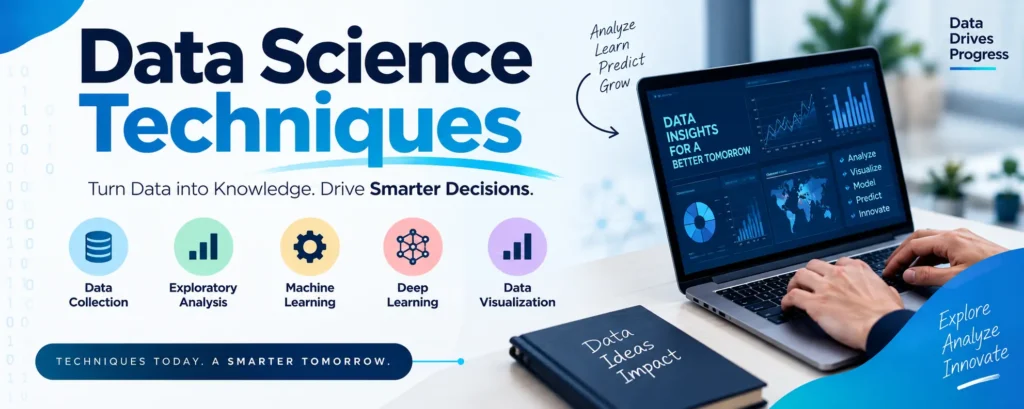
Data Science Techniques
In the era of digital transformation, data science has become one of the most influential fields, combining computer science, statistics, and domain-specific knowledge to extract valuable insights from raw data. As the amount of information generated worldwide continues to grow, the ability to analyze, interpret, and derive meaningful insights from data has become essential.
From predicting market trends and improving healthcare to developing intelligent AI systems, data science helps organizations make better, data-driven decisions across a wide range of industries.
This article explores the core techniques in data science, from fundamental concepts and data preparation to machine learning, visualization, and advanced approaches. Understanding these techniques provides a strong foundation for anyone interested in data science and knowledge discovery.
Table of Contents
Complete Advance AI Topics: Click Here
SQL Tutorial: Click Here
Foundations of Data Science
Three essential components form the foundation of data science: data, algorithms, and models.
- Data: Data is the raw material of data science. It provides the information from which useful insights can be extracted.
- Algorithms: Algorithms are logical procedures used to identify patterns, relationships, and structures within data.
- Models: Models are built using data and algorithms and can be used to make predictions and support decision-making.
A simple way to understand these components is to think of data as the raw material, algorithms as the methods used to process it, and models as the systems that turn the processed information into predictions or useful outcomes.
Types of Data: Structured vs Unstructured
Data can broadly be classified into two major forms: structured data and unstructured data.
Structured Data
Structured data is organized in a predefined format, usually in rows and columns. Relational databases and spreadsheets are common examples. Because the data follows a consistent structure, it is relatively easy to search, filter, analyze, and process.
Unstructured Data
Unstructured data does not follow a fixed structure. Examples include emails, social media posts, images, videos, and audio files. Although this type of data can be more difficult to process, it often contains valuable context and information.
Combining structured and unstructured data can give data scientists a more complete understanding of real-world situations and help them generate more actionable insights.
Data Collection and Cleaning
Before meaningful analysis can begin, data must first be collected and cleaned.
- Data Collection: This involves systematically gathering relevant information from sources such as sensors, databases, APIs, applications, and user input.
- Data Cleaning: Data cleaning involves identifying and correcting errors, duplicates, inconsistencies, missing values, and problematic records.
Data preparation can be time-consuming, but it is an essential part of the data science process. Poor-quality data can result in inaccurate analysis and unreliable conclusions. A clean and consistent dataset provides a strong foundation for trustworthy analysis and informed decision-making.
Exploratory Data Analysis (EDA)
Exploratory Data Analysis (EDA) is an important step used to understand the structure, characteristics, and relationships within a dataset.
Common EDA techniques include:
- Descriptive Statistics: Mean, median, variance, and other statistical measures help summarize data.
- Data Visualization: Histograms, scatter plots, and box plots help identify patterns and unusual values.
- Heatmaps and Clustering: These techniques can help reveal relationships and groups within the data.
EDA turns raw numerical information into useful visual and statistical insights. It can reveal patterns, anomalies, and relationships that may not be immediately visible and helps guide further analysis and model development.
Machine Learning (ML)
Machine Learning is one of the most important areas of modern data science. It enables systems to learn patterns from data and make predictions or decisions without requiring every rule to be explicitly programmed.
Machine learning is widely used in recommendation systems, fraud detection, prediction, classification, and many other applications.
Supervised Learning
In supervised learning, a machine learning algorithm learns from labeled data. For example, a spam detection system can be trained using emails that have already been classified as spam or legitimate.
Unsupervised Learning
In unsupervised learning, the algorithm works with unlabeled data and attempts to discover hidden patterns or groups. Customer segmentation using clustering is a common example.
Machine learning plays a central role in data science by helping organizations automate decisions, predict outcomes, and discover hidden patterns in large datasets.
Feature Engineering
Feature engineering is the process of creating and transforming input variables so that machine learning models can learn more effectively from the available data.
Common feature engineering techniques include:
- Converting categorical data into numerical representations, such as one-hot encoding.
- Handling missing values.
- Scaling numerical features.
- Creating new features by combining existing variables.
Well-designed features can significantly improve model performance. Feature engineering demonstrates that the quality and usefulness of the input data can be just as important as the choice of machine learning algorithm.
Model Evaluation and Selection
After training a machine learning model, it is important to evaluate its performance, accuracy, and ability to generalize to new data.
Some commonly used evaluation metrics include:
- Classification: Accuracy, Precision, Recall, and F1 Score.
- Regression: Mean Squared Error (MSE) and R² Score.
Cross-validation, including techniques such as k-fold validation, can help determine whether a model performs consistently on unseen data. It also helps reduce the risk of overfitting.
The objective is to select a model that provides a suitable balance between model complexity and predictive performance.
Data Visualization
Data visualization connects data analysis with practical decision-making. It converts complex datasets into visual formats that are easier to understand, compare, and communicate.
Popular data visualization tools include:
- Matplotlib and Seaborn for Python-based visualization.
- Tableau for interactive data analysis and dashboards.
- Power BI for business intelligence and reporting.
Charts such as bar graphs, scatter plots, and heatmaps make it easier to identify trends, compare values, discover relationships, and communicate analytical results to both technical and non-technical audiences.
Big Data and Advanced Techniques
The rapid growth of information generated through IoT devices, social media, online transactions, and other digital systems has created the need for technologies capable of processing massive datasets.
Big Data technologies such as Hadoop, Spark, and cloud-based platforms help organizations process and analyze data at a large scale.
Data science also includes advanced techniques such as:
- Deep Learning: Uses neural networks to solve complex problems involving areas such as image recognition, speech processing, and pattern recognition.
- Natural Language Processing (NLP): Enables computers to process, understand, and generate human language.
These advanced approaches are expanding what is possible with data science by enabling systems to understand complex information, learn from data, interpret context, and interact more intelligently.
Download New Real Time Projects:- Click here
Conclusion
The field of data science is broad and continuously evolving. From data collection and cleaning to exploratory analysis, machine learning, feature engineering, and visualization, each technique plays an important role in transforming raw information into meaningful knowledge.
As the amount of data generated around the world continues to increase, understanding and applying data science techniques is becoming increasingly important. These methodologies are not only useful for building predictive models but also for discovering knowledge, supporting innovation, and making smarter data-driven decisions.
Keywords
data science techniques, data science techniques pdf, data science techniques and tools, data science tools for beginners, data science process, data science javatpoint, new data science techniques, applications of data science, data science for beginners pdf, data science, advanced data science techniques, modern data science techniques, geospatial data science techniques and applications, list of data science techniques, overview of different data science techniques, advanced SQL data science techniques, data science techniques and applications, different data science techniques, data science techniques and intelligent applications