Web3 and the Future of Internet
The internet has changed significantly since its early days. What started as a collection of mostly static web pages has evolved into an interactive platform where people communicate, create content, shop, work, and access digital services. Now, another major transformation is being discussed: Web3.
Web3, often described as the decentralized web, introduces technologies designed to change how users interact with online platforms and digital assets. In this article, we will explore what Web3 is, how it has evolved, the technologies behind it, its potential benefits, major challenges, and its possible impact on different industries.
Table of Contents
Complete Advance AI Topics: Click Here
SQL Tutorial: Click Here
The Future of Internet
What is Web3?
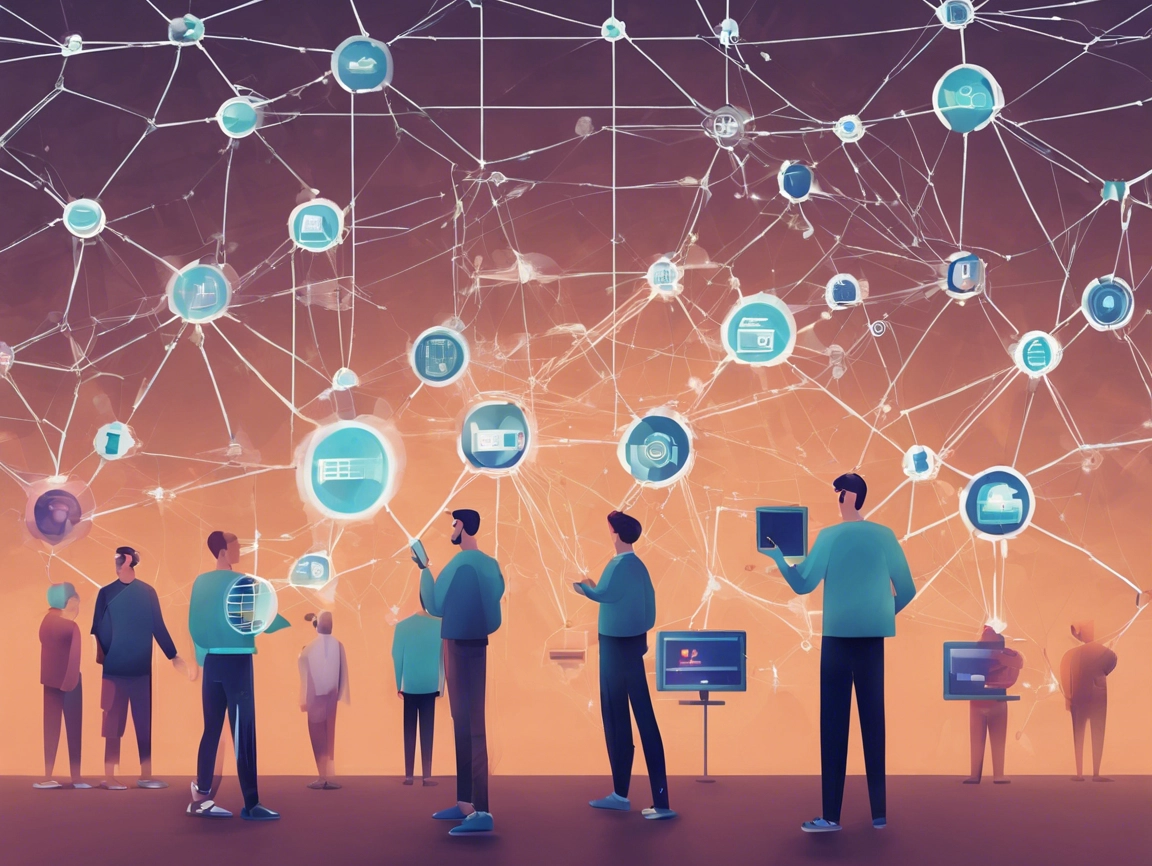
Web3 refers to a vision of the next generation of internet technologies, with a strong focus on decentralization. Unlike Web2, where many popular online services rely on centralized platforms and data storage, Web3 uses decentralized networks to support peer-to-peer interactions.
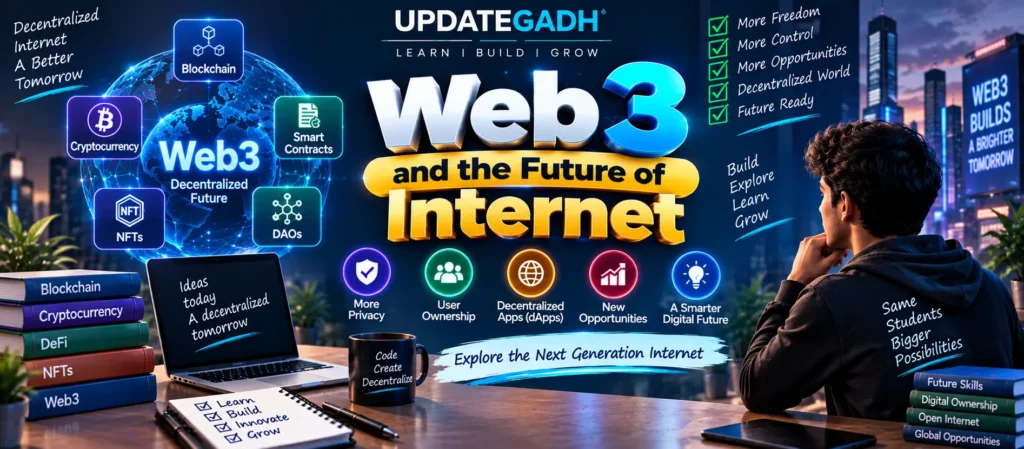
The broader goals associated with Web3 include giving users greater control over their digital assets and data while creating online systems that emphasize transparency and openness. Blockchain technology, cryptocurrencies, decentralized applications (dApps), and smart contracts are some of the major technologies associated with this ecosystem.
The Internet’s Development: From Web1 to Web3
Understanding the evolution of the internet makes it easier to understand why Web3 is being discussed as a new phase of online technology.
- Web1: The early internet was largely made up of static web pages. Users primarily consumed information rather than actively creating or interacting with content.
- Web2: The mid-2000s introduced a much more interactive internet. Social media, user-generated content, online services, and centralized platforms became major parts of the web.
- Web3: Web3 focuses on decentralized networks and aims to give users greater control over digital assets, data, and online interactions through technologies such as blockchain.
Core Technologies Driving Web3
Web3 is built around several technologies that work together to support decentralized digital services.
- Blockchain Technology: Blockchain is a distributed ledger that records information across a network of computers. It can provide transparency and help maintain records without relying on a single central database.
- Cryptocurrencies and Decentralized Finance (DeFi): Cryptocurrencies such as Bitcoin and Ethereum are used within many Web3 ecosystems. DeFi applications use blockchain technology to provide financial services through decentralized platforms.
- Smart Contracts: Smart contracts are programs stored on blockchain networks that can automatically execute predefined conditions. They can reduce the need for intermediaries in certain digital transactions.
- Non-Fungible Tokens (NFTs): NFTs are unique blockchain-based tokens that can represent ownership or rights associated with digital assets and other items.
- Decentralized Autonomous Organizations (DAOs): DAOs use blockchain-based rules and smart contracts to support community-driven governance and decision-making.
How Web3 Promotes Decentralization
One of the central ideas behind Web3 is reducing dependence on centralized intermediaries. Instead of having every transaction or interaction controlled by a single platform, decentralized networks can allow users and systems to interact more directly.
Blockchain-based systems can distribute data and transaction records across a network instead of keeping everything under one central authority. This approach can provide users with greater control over certain digital assets and interactions while also introducing new approaches to privacy and online ownership.
The Role of Cryptocurrencies in Web3
Cryptocurrencies are an important part of many Web3 ecosystems. They can function as digital assets and mediums of exchange within blockchain-based applications. For example, Ether (ETH) is used to pay transaction fees and interact with smart contracts on the Ethereum network.
Web3 projects may also create their own tokens for specific purposes. Depending on the project, these tokens may be used for governance, access to particular features, or participation in an ecosystem.
Applications involving tokenized assets, decentralized finance, and cross-border transactions demonstrate some of the ways cryptocurrency technology can be incorporated into Web3 systems.
Decentralized Finance (DeFi) and Its Impact
Decentralized Finance (DeFi) refers to financial applications built using blockchain technology. These applications aim to provide services such as lending, borrowing, trading, and other financial activities through decentralized systems.
Platforms such as Uniswap and Aave are examples of DeFi applications. DeFi can provide alternative ways of accessing financial services, although users also need to consider risks such as smart-contract vulnerabilities, market volatility, and regulatory uncertainty.
Smart Contracts: The Backbone of Web3
Smart contracts are self-executing programs that operate on blockchain networks. They contain predefined rules and can automatically perform actions when specified conditions are met.
For example, a smart contract could be designed to release payment after a predefined project milestone has been recorded as completed. This type of automation can reduce the need for intermediaries in certain workflows.
Smart contracts are being explored across areas such as finance, digital assets, and supply chain management.
Decentralized Applications (dApps)
Decentralized applications, or dApps, are applications that operate using blockchain networks or other decentralized infrastructure rather than depending entirely on a traditional centralized server.
Examples within the broader Web3 ecosystem include decentralized exchanges, blockchain-based games, and decentralized community platforms. dApps can provide users with different approaches to ownership, transparency, and digital interaction.
However, decentralized applications also face challenges, including scalability, usability, security, and user adoption.
The Rise of Non-Fungible Tokens (NFTs)
Non-Fungible Tokens (NFTs) are unique digital tokens recorded on a blockchain. Unlike fungible cryptocurrencies, where individual units can generally be exchanged on a one-to-one basis, NFTs are designed to represent distinct items or records.
NFTs became particularly well known through digital art and collectibles, but their potential applications can extend to areas such as gaming, music, virtual environments, and digital ownership.
They provide creators with another method of representing and transferring digital assets, although the value and usefulness of individual NFTs can vary significantly.
Decentralized Autonomous Organizations (DAOs)
Decentralized Autonomous Organizations (DAOs) are blockchain-based organizations that use smart contracts and predefined rules to support decentralized governance.
Instead of relying entirely on a traditional centralized management structure, DAO participants can take part in decision-making through governance mechanisms defined by the project. Examples include MakerDAO and Gitcoin DAO.
DAOs demonstrate how blockchain technology can be used to experiment with new approaches to community organization, funding, and digital governance.
Challenges Facing Web3 Adoption
Although Web3 introduces many new possibilities, widespread adoption also depends on addressing several important challenges.
- Scalability Issues: Some blockchain networks have experienced limitations involving transaction speed, network capacity, and transaction costs. Layer-2 technologies and other scaling approaches are being developed to address these issues.
- Regulatory Concerns: Cryptocurrencies, DeFi, NFTs, and other Web3 technologies raise regulatory questions. Governments and regulators continue to develop approaches for addressing these technologies and protecting users.
- User Experience and Accessibility: Wallets, blockchain transactions, private keys, and decentralized applications can be difficult for new users to understand. Simpler and more accessible interfaces are important for broader adoption.
- Environmental Impact: Some blockchain networks have historically required substantial energy, particularly systems based on energy-intensive consensus mechanisms. More energy-efficient approaches, including Proof of Stake, can reduce energy requirements for networks that adopt them.
The Possible Effects of Web3 on Different Industries
Web3 technologies are being explored across a variety of industries. Their potential applications range from financial services to digital media, healthcare, and supply-chain management.
- Finance and Banking: DeFi applications can provide blockchain-based alternatives for activities such as lending, borrowing, and trading.
- Entertainment and Media: NFTs and decentralized platforms can provide new ways for creators to distribute digital content and interact with audiences.
- Healthcare: Blockchain-based systems could be explored for secure data sharing, record management, and improving control over certain types of digital information.
- Supply Chain and Logistics: Blockchain can provide transparent and traceable records that may help organizations monitor products and transactions throughout supply chains.
The Future of Web3 and the Internet
Web3 is still an evolving area of technology, and its long-term role in the internet will depend on how successfully current challenges are addressed. Improvements in scalability, security, usability, regulation, and infrastructure will be important for its continued development.
The concepts associated with Web3, including decentralization, blockchain-based ownership, smart contracts, and decentralized applications, could influence how people interact with digital platforms and assets in the future.
Governments, businesses, developers, and users will all play a role in shaping this development. Finding an appropriate balance between technological innovation, user protection, regulation, and accessibility will be an important part of the Web3 journey.
YT:- DecodeIT
Final Thoughts
Web3 represents an evolving vision for a more decentralized internet. By combining blockchain, cryptocurrencies, smart contracts, NFTs, DAOs, and decentralized applications, it introduces new approaches to digital ownership, online interactions, and financial services.
At the same time, Web3 is not without challenges. Scalability, regulation, security, accessibility, and environmental considerations remain important areas of discussion.
As the technology continues to develop, Web3 could become an important part of the broader digital landscape. Understanding its core technologies, opportunities, and limitations can help students, developers, and technology enthusiasts better understand where the internet may be heading.
Keywords
Web3 and the Future of Internet, What is Web3, Web3, Web3 Technology, Future of Internet, Decentralized Web, Web3 Blockchain, Blockchain Technology, Web3 Applications, dApps, Smart Contracts, Cryptocurrency, DeFi, NFTs, DAOs, Decentralized Finance, Web3 Development, Future of Web3, Blockchain Applications, Web3 Technologies