Types of Agents in AI
AI agents are entities in Artificial Intelligence that are designed to observe their environment and perform actions to achieve particular goals. Their behavior and capabilities can differ widely, from simple systems that respond to immediate inputs to advanced agents capable of learning and making decisions. This blog explains the different types of AI agents, their main characteristics, and examples to help you understand their role in problem-solving.
Complete Advance AI Topics: Click Here
SQL Tutorial: Click Here
Types of Agents in AI
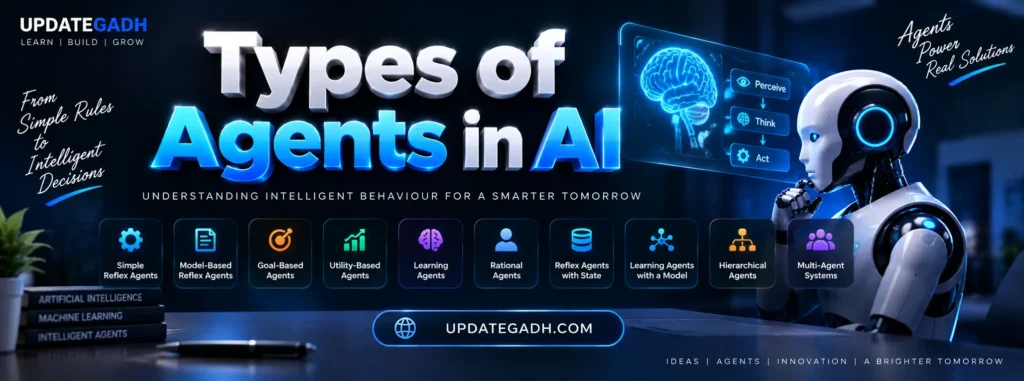
1. Simple Reflex Agents
Simple reflex agents work only with the current input they receive. They do not consider previous states or possible future situations. Their decisions are based on predefined rules connected to the conditions they currently observe.
Characteristics:
- Reactive: Responds directly to the current information received from the environment.
- Fast Response: Makes quick decisions in simple and straightforward environments.
- Lack of Memory: Cannot remember previous situations or adjust its behavior based on past information.
Example:
A thermostat is a simple example of this type of agent. It turns the heating system on when the temperature drops below a specific level without considering previous temperature readings or future conditions.
2. Model-Based Reflex Agents
Model-based reflex agents are an improvement over simple reflex agents because they maintain an internal model of their environment. This allows them to understand changes in the environment and respond accordingly.
Characteristics:
- Contextual Understanding: Uses current information along with information from previous states.
- Improved Decision-Making: Can deal with more complex situations.
- Resource Intensive: Maintaining and using an environmental model may require more computational resources.
Example:
A self-driving car can use road maps, traffic rules, and previous information to navigate safely while responding to changing road conditions.
3. Goal-Based Agents
Goal-based agents operate according to specific objectives. They use information about the environment along with search and planning methods to determine a sequence of actions that can help them reach their goals.
Characteristics:
- Purposeful: Works toward clearly defined goals.
- Strategic: Plans actions to improve the chances of achieving its objectives.
- Adaptive: Can adjust its actions when conditions in the environment change.
Example:
A delivery robot can calculate a suitable route for delivering a package by considering its current location, obstacles, and final destination.
4. Utility-Based Agents
Utility-based agents evaluate the quality of different possible outcomes instead of focusing only on completing a goal. They use utility functions to select actions that provide the most desirable result.
Characteristics:
- Multi-Criteria Analysis: Considers different factors such as cost, risk, and preferences.
- Trade-Offs: Can make decisions by balancing different factors, especially in uncertain situations.
- Complex: Requires advanced models and algorithms to evaluate possible outcomes.
Example:
An investment advisor algorithm can consider expected returns, risks, and individual preferences when recommending suitable investment portfolios.
5. Learning Agents
Learning agents improve their performance over time by learning from their experiences. These agents can use feedback to update their knowledge and modify their behavior.
A learning agent consists of the following components:
- Learning Element: Improves the agent’s knowledge and behavior using feedback.
- Performance Element: Performs actions based on the information available.
- Critic: Evaluates the results of the actions taken by the agent.
- Problem Generator: Suggests actions that can provide new experiences for learning.
Characteristics:
- Adaptive: Continuously improves its behavior through experience.
- Exploration and Exploitation: Balances trying new strategies with using strategies that are already known to work.
Example:
E-commerce recommendation systems can learn from user activities and interactions to provide more personalized product suggestions.
6. Rational Agents
Rational agents aim to select the most appropriate actions based on the information available to them. Their objective is to choose actions that increase the likelihood of achieving their goals.
Characteristics:
- Optimized Decision-Making: Selects actions based on goals or utility.
- Adaptability: Adjusts its actions according to changes in the environment.
- Efficiency: Attempts to achieve goals while making effective use of available resources.
Example:
A self-driving car can use sensors, traffic information, and previous experiences to make decisions that support safe and efficient navigation.
7. Reflex Agents with State
Reflex agents with state improve upon simple reflex agents by maintaining an internal representation of the environment. This allows them to keep track of important information and respond more effectively to changing situations.
Characteristics:
- Internal Memory: Keeps track of information such as battery levels or locations.
- Immediate Reaction: Responds quickly while considering the current internal state.
Example:
A robotic vacuum cleaner can use information about its battery level, location, and cleaning status to decide which tasks it should perform.
8. Learning Agents with a Model
Learning agents with a model combine learning capabilities with an internal model of the environment. They can use the model to simulate possible actions and understand their potential outcomes before making decisions.
Characteristics:
- Simulation-Based: Predicts the possible results of different actions.
- Flexible: Can adjust to situations that may be unfamiliar.
- Resource-Intensive: Simulating different outcomes can require significant computational resources.
Example:
A self-driving car can use a detailed model of traffic patterns to predict possible obstacles and adjust its actions accordingly.
9. Hierarchical Agents
Hierarchical agents organize decision-making into different levels of abstraction. Higher-level components handle broader planning, while lower-level components manage specific tasks and actions.
Characteristics:
- Efficient Problem-Solving: Divides complex problems into smaller and more manageable tasks.
- Structured Decision-Making: Organizes actions systematically across different levels.
Example:
A robot’s top-level system can plan the tasks it needs to perform, while lower-level systems handle sensory information and motor actions.
10. Multi-Agent Systems
Multi-Agent Systems consist of multiple agents that interact with one another to achieve individual or shared goals. These agents can cooperate or compete depending on the situation and their objectives.
Characteristics:
- Decentralized: Individual agents can operate independently.
- Cooperation and Competition: Agents can either work together or compete with one another.
- Scalable: Multiple agents can handle complex and distributed tasks.
Example:
Drone swarms can coordinate during search-and-rescue missions by dividing different areas among themselves to improve search coverage.
Download New Real Time Projects :- Click here
types of agents in ai with examples
different types of agents in ai
explain various types of agents in ai
list the types of agents in ai
types of agents in ai examples
types of agents in ai geeksforgeeks
types of ai agents in artificial intelligence
types of ai agents in ai
how many types of agents in ai