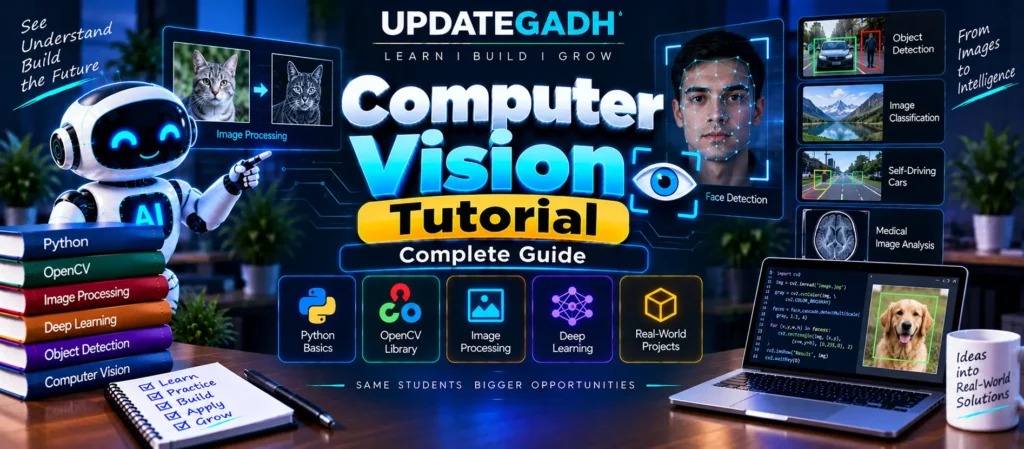
Computer Vision Tutorial
Computer Vision sits at the intersection of computer science and artificial intelligence letting machines interpret and analyze images and videos much like humans do. From self-driving cars to medical diagnosis, it powers some of the most exciting technologies of our time.
Complete Advance AI Topics: Click Here
SQL Tutorial: Click Here
What is Computer Vision?
Computer Vision is an AI subfield that lets machines extract meaning from images and videos. It involves algorithms that recognize patterns, analyze structures, and make decisions based on visual input.
Key Components
- Image Acquisition: Capturing data via cameras or sensors.
- Image Processing: Enhancing or transforming the image.
- Object Detection & Recognition: Identifying and classifying objects.
- Image Segmentation: Splitting an image into meaningful regions.
Prerequisites
- Python basics
- Linear algebra fundamentals
- Machine learning and deep learning concepts
- OpenCV library familiarity
Real-World Applications
- Facial Recognition: Phone unlock, security systems.
- Autonomous Vehicles: Lane/sign/obstacle detection.
- Medical Imaging: Detect tumors in X-rays and MRIs.
- Retail: Customer analytics, smart shelves.
- Agriculture: Crop monitoring via drones.
- Manufacturing: Defect detection on assembly lines.
Tutorial Topics
- Sure, you can replace those points with a more polished and student-friendly version:
- Image Processing — image enhancement, filtering, color spaces, noise reduction, and image transformation.
- Feature Detection & Extraction — edges, corners, contours, key points, SIFT, SURF, and HOG.
- Object Detection — identifying and locating objects using YOLO, SSD, and Faster R-CNN.
- Image Segmentation — separating images into meaningful regions using semantic and instance segmentation, U-Net, and Mask R-CNN.
- Deep Learning in Computer Vision — CNNs, ResNet, MobileNet, transfer learning, and image classification.
- Generative Computer Vision — autoencoders, GANs, image generation, image-to-image translation, and style transfer.
How Computer Vision Works
The pipeline mimics human vision: a camera captures data, algorithms process it, and the system identifies objects using pre-trained models. For example, to recognize a bird, the model trains on thousands of labeled bird images so it can detect patterns in new images.
Project Ideas to Try
- Facial Recognition System
- Object Detection for Self-Driving Cars
- Medical Image Analysis Tool
- Sports Performance Tracking System
Download New Real Time Projects:- Click here
Conclusion
Computer Vision is one of the most exciting AI frontiers from medical imaging to autonomous vehicles. Master Python + OpenCV + deep learning, and you can build production-ready CV applications. For more tutorials, stay tuned to .
computer vision tutorial pdf
computer vision tutorial python
computer vision tutorial projects
computer vision tutorial w3schools
computer vision tutorial for beginners
computer vision tutorial geeksforgeeks
opencv tutorial
deep learning computer vision