Agents in Artificial Intelligence (AI)
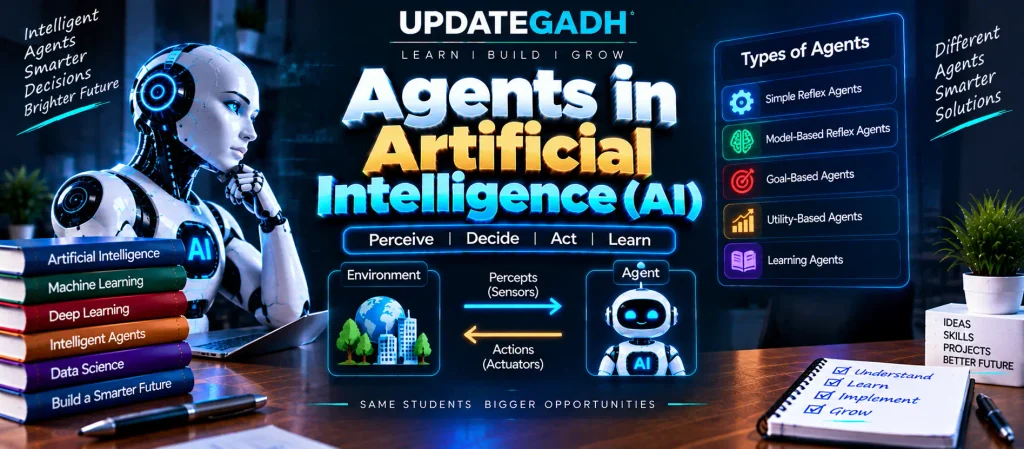
Artificial Intelligence (AI) focuses on developing rational agents that can make decisions and take actions to achieve desired or optimal outcomes. An agent can be a person, machine, software program, or a combination of these systems. AI agents interact with their surroundings by perceiving the environment and selecting suitable actions.
An AI system mainly consists of an agent and its environment. The agent receives information from its environment and acts based on that information. The environment can also contain other agents, which makes interaction an important part of many AI systems.
Download New Real Time Projects :- Click here
What Defines an Agent in AI?
An agent is a system that can perceive its environment and perform actions within that environment. In general, an AI agent works through two basic abilities:
- Understanding the Environment: The agent perceives its surroundings through sensors or other input mechanisms.
- Acting on the Environment: The agent performs actions using actuators or other output mechanisms.
An agent can observe its own actions, but it may not always know the complete outcome of those actions. Its behavior depends on the information available to it and the way it processes that information.
Agent Composition
A basic way to understand the structure of an AI agent is through the following formula:
Agent = Architecture + Agent Program
- Architecture: Architecture refers to the hardware or underlying system on which the agent operates. It may include a robot, computer, camera, or another physical or software platform.
- Agent Program: The agent program contains the logic, strategies, and instructions used to process inputs and determine appropriate actions.
Types of Agents in AI
AI agents can be classified according to their intelligence, complexity, decision-making capabilities, and ability to respond to their environments. The major types of agents are discussed below.
1. Simple Reflex Agents
Simple Reflex Agents make decisions based only on the current state of their environment. They do not use historical information when selecting an action. These agents generally work through condition-action rules, such as: if a particular condition is true, perform a specific action.
Simple reflex agents can work effectively in fully observable environments. However, they have limitations when operating in dynamic or partially observable environments.
- They do not have knowledge about unobservable states of the environment.
- They cannot easily adapt to environmental changes without updating their rules.
2. Model-Based Reflex Agents
Model-Based Reflex Agents address some of the limitations of simple reflex agents by maintaining an internal state. This internal state stores information about parts of the environment that may not currently be observable.
The agent updates its internal state by considering two important factors:
- How the environment changes independently over time.
- How the environment responds to the agent’s actions.
This model-based approach enables agents to work more effectively in dynamic and partially observable environments.
3. Goal-Based Agents
Goal-Based Agents select actions according to specific objectives they want to achieve. They use planning and decision-making processes to determine actions that can move them closer to their desired goal.
Important advantages of goal-based agents include:
- Flexibility: They can modify their actions when goals or environmental conditions change.
- Reasoning: They provide a basis for selecting actions according to clearly defined objectives.
4. Utility-Based Agents
Utility-Based Agents extend the concept of goal-based agents by evaluating different possible outcomes. Instead of simply determining whether a goal has been achieved, they use a utility function to measure how desirable a particular state or outcome is.
Important characteristics of utility-based agents include:
- They can consider trade-offs between multiple objectives, such as cost, speed, and safety.
- They can deal with uncertainty by selecting actions that maximize expected utility.
5. Learning Agents
Learning Agents can improve their performance by learning from experience. Instead of relying entirely on fixed rules, these agents can use feedback and previous experiences to improve their future behavior.
A learning agent consists of four major components:
- Learning Element: Analyzes information and improves the agent’s strategies.
- Critic: Provides feedback about the agent’s performance.
- Performance Element: Performs actions using the knowledge and strategies available to the agent.
- Problem Generator: Suggests exploratory actions that can provide useful learning opportunities.
Properties of AI Environments
The performance of an AI agent depends heavily on the environment in which it operates. AI environments can be described using several important properties.
1. Observable vs. Partially Observable
- Fully Observable: The agent has complete information about the relevant state of the environment.
- Partially Observable: The agent has incomplete information and may need to make decisions under uncertainty.
2. Deterministic vs. Non-Deterministic
- Deterministic: The outcome of an action can be predicted from the current state and selected action.
- Non-Deterministic: The environment introduces randomness or uncertainty, making outcomes less predictable.
3. Static vs. Dynamic
- Static: The environment does not change while the agent is making its decision.
- Dynamic: The environment can change over time while the agent is operating, requiring continuous adaptation.
4. Discrete vs. Continuous
- Discrete: The environment contains distinct states or actions, such as positions on a chessboard.
- Continuous: The environment involves continuously changing states, such as those encountered while driving.
5. Single-Agent vs. Multi-Agent
- Single-Agent: The environment contains one primary decision-making agent.
- Multi-Agent: Multiple agents interact with one another, which can involve cooperation, competition, or both.
6. Accessible vs. Inaccessible
- Accessible: The agent can access the relevant states or information of the environment.
- Inaccessible: The agent has limited access to information about the environment.
7. Episodic vs. Sequential
- Episodic: The environment consists of independent episodes where one action or decision does not significantly depend on previous episodes.
- Sequential: Current decisions can influence future states, so the agent needs to consider previous actions when planning.
Measuring Intelligence: The Turing Test
The Turing Test is a method proposed to evaluate whether a machine can demonstrate intelligent behavior that is difficult to distinguish from human behavior.
In the test:
- An examiner communicates with both a human and a machine.
- The examiner does not know which participant is the machine.
- If the examiner cannot reliably distinguish the machine from the human based on their responses, the machine is considered to have demonstrated behavior associated with intelligence under the test.
The Turing Test is therefore an important concept in the study of Artificial Intelligence because it focuses on a machine’s ability to produce behavior that can appear human-like during interaction.
Complete Advance AI Topics: Click Here
SQL Tutorial: Click Here
Conclusion
Agents in Artificial Intelligence are systems that perceive their environments and take actions according to their goals, rules, knowledge, or learned experience. From simple reflex agents to learning agents, different agent architectures provide different approaches to decision-making and interaction.
Understanding agent types, agent composition, environmental properties, and concepts such as the Turing Test provides an important foundation for studying Artificial Intelligence and intelligent systems.
Keywords
Agents in Artificial Intelligence, types of agents in artificial intelligence AI, What is the Composition of Agents in Artificial Intelligence(AI), types of agents in AI, agents in artificial intelligence AI geeksforgeeks, agents in artificial intelligence AI pdf, agents in artificial intelligence AI examples, rational agent in AI, intelligent agent in AI, structure of agents in artificial intelligence