What is AI
Artificial Intelligence (AI) has become an important part of today’s technology-driven world. From self-driving cars and personalized recommendations on streaming platforms to virtual assistants such as Siri and Alexa, AI is being used in many areas of everyday life.
But what exactly is Artificial Intelligence, and why is it important for students to understand? AI is not only changing the way businesses and industries work but is also transforming education and the way students learn. In this article, we will understand what AI means and explore how it can support students in their academic and professional journeys.
Table of Contents
Complete Advance AI Topics: Click Here
SQL Tutorial: Click Here
What is AI?
Artificial Intelligence (AI) refers to the ability of machines and computer systems to perform tasks that normally require human intelligence. These tasks can include learning, problem-solving, decision-making, understanding language, and recognizing patterns.
AI systems are designed to process information and perform specific tasks based on the data and instructions available to them. Artificial Intelligence can be broadly discussed through two major categories: Narrow AI and General AI.
Narrow AI (Weak AI)
Narrow AI, also known as Weak AI, is designed to perform a specific task or a limited set of tasks. Examples include facial recognition, language translation, recommendation systems, and computer programs that play games such as chess.
Narrow AI is limited to the functions it has been designed or trained to perform. It does not have the general-purpose intelligence required to independently perform every type of intellectual task.
General AI (Strong AI)
General AI, also called Strong AI, refers to a theoretical form of Artificial Intelligence that would be capable of performing a wide range of intellectual tasks similar to human intelligence.
General AI remains a conceptual goal rather than a realized technology. The idea includes the ability to adapt, learn, reason, and handle different types of intellectual tasks instead of being restricted to one specific function.
Today, the practical AI systems people commonly use are primarily forms of Narrow AI, and these systems are already being applied in areas such as education.
How AI Benefits Students
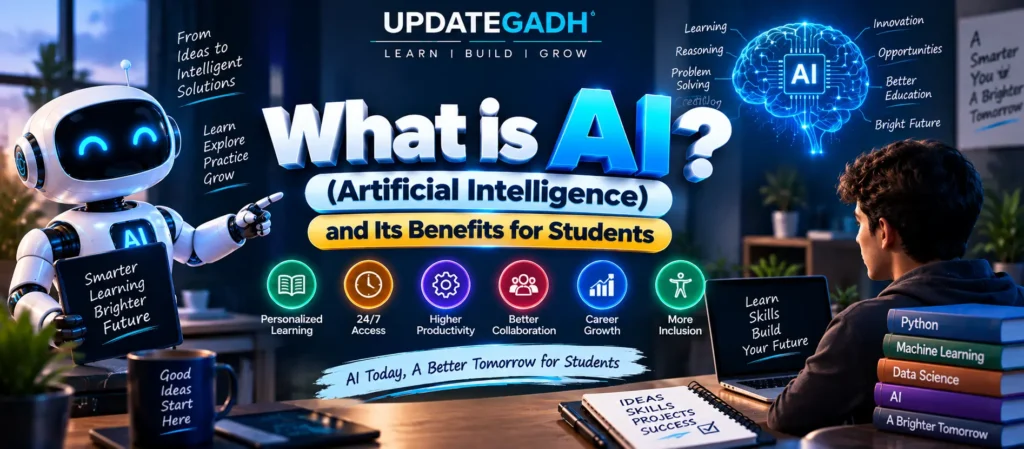
Artificial Intelligence can provide students with several tools and opportunities that can support their learning experience. AI-powered systems can help personalize learning, provide access to educational resources, automate repetitive tasks, support collaboration, and assist with career development.
1. Personalized Learning
One of the important benefits of AI in education is personalized learning. AI systems can analyze a student’s performance and provide learning materials based on their individual strengths and weaknesses.
For example, if a student has difficulty understanding a particular mathematics topic, an AI-powered learning system can provide additional explanations, resources, and practice exercises. This allows students to spend more time working on areas where they need additional support and progress at a pace that suits their learning needs.
2. Round-the-Clock Access to Learning Resources
AI-powered educational tools can provide access to learning resources at different times of the day. Students can use AI tutors, virtual classrooms, interactive applications, and other digital learning resources outside traditional classroom hours.
This flexibility can make it easier for students to study according to their own schedules. Whether they are reviewing a difficult topic or practicing a skill, AI-based educational resources can provide additional support whenever they are available.
3. Increased Efficiency and Productivity
AI can help students save time by assisting with repetitive and organizational tasks. For example, AI-powered tools can help organize study schedules, provide reminders about deadlines, and assist with certain educational tasks.
By reducing the amount of time spent on repetitive activities, students can focus more attention on complex subjects, creative work, problem-solving, and deeper learning.
4. Enhanced Collaboration and Communication
AI-based tools can also support communication and collaboration between students. Virtual classrooms, chatbots, and digital collaboration platforms can make it easier for students to communicate and work together, even when they are not physically in the same location.
AI-powered translation tools can also help reduce language barriers. This can support collaboration between students who come from different linguistic backgrounds and make communication more convenient in educational environments.
5. Career Guidance and Skill Development
AI can help students explore potential career paths by analyzing information such as their interests, strengths, and academic performance. AI-powered career guidance tools can suggest career options and recommend courses or skills that may align with a student’s goals.
AI can also support the development of skills such as coding, data analysis, and problem-solving. These skills are increasingly relevant across many technology-related careers and can help students prepare for professional opportunities.
6. Preparation for Future Careers
Artificial Intelligence is changing the way many industries operate. As businesses increasingly adopt AI, students who understand AI concepts and applications can be better prepared to work with emerging technologies.
Learning about areas such as automation, Data Science, and Machine Learning can help students develop technical knowledge that may be useful in future academic and professional environments.
7. Support for Accessibility and Inclusion
AI can also contribute to making educational resources more accessible. Technologies such as text-to-speech can support students who have difficulty reading visual content, while voice-based technologies can provide alternative ways to interact with digital learning resources.
AI-powered systems can also provide personalized assistance to students with different learning needs. By adapting educational content and providing additional support, these technologies can help create a more inclusive learning environment.
Why Should Students Learn About AI?
Understanding Artificial Intelligence can help students become familiar with one of the major technologies shaping modern society. AI is being used in areas ranging from education and healthcare to finance, entertainment, transportation, and cybersecurity.
For students, learning the fundamentals of AI can also create opportunities to explore related fields such as Machine Learning, Data Science, automation, and software development. Even students who do not plan to become AI specialists can benefit from understanding how AI systems work and how they are being used.
YT:- DecodeIT
Final Thoughts
Artificial Intelligence is no longer simply a concept associated with the future. AI technologies are already being used in education and many other areas of everyday life. For students, these technologies can provide support with personalized learning, access to educational resources, productivity, collaboration, career exploration, and accessibility.
As AI continues to develop, understanding its basic concepts and applications can help students prepare for an increasingly technology-focused world. By learning how to use AI responsibly and developing related technical skills, students can make better use of the opportunities created by this rapidly evolving technology.
Keywords
What is AI artificial intelligence, Artificial Intelligence, AI for students, benefits of AI for students, AI in education, Artificial Intelligence for students, AI technology, types of Artificial Intelligence, Narrow AI, General AI, AI learning tools, AI career guidance, AI and education, Machine Learning, Data Science, AI skills for students