8 Ways AI is Used in Education ( AI)
Introduction
The use of Artificial Intelligence (AI) in education is creating new opportunities to improve learning, support teachers, and provide more personalized educational experiences. At the same time, the growing role of AI can feel both exciting and challenging.
Understanding AI in education requires looking beyond science-fiction ideas where computers completely replace teachers. Instead, AI can be viewed as a technology that supports educators and students while helping make learning more personalized, accessible, and efficient.
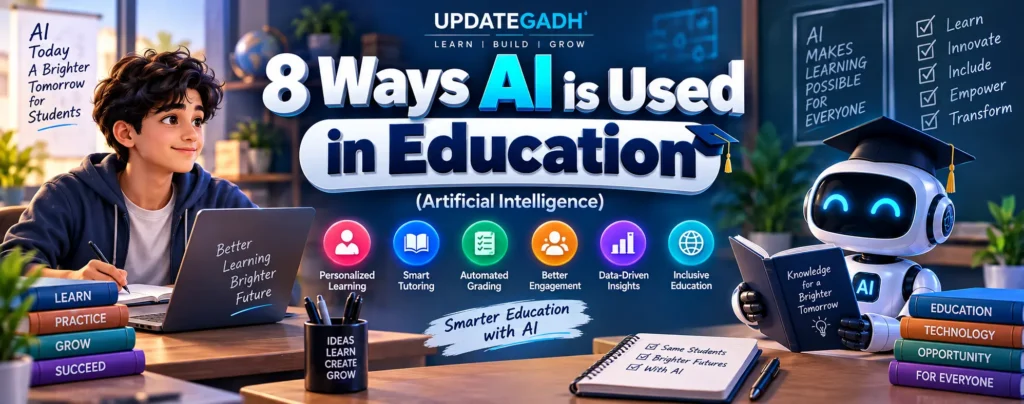
AI is already being explored across different industries, and education is one area where its capabilities can be used in several practical ways. From personalized learning and intelligent tutoring to automated feedback and language translation, AI can support different parts of the educational process.
Table of Contents
Complete Advance AI Topics: Click Here
SQL Tutorial: Click Here
1. Personalized Learning Paths
AI-powered personalized learning is transforming education by tailoring learning experiences to individual students. Every student has different strengths, weaknesses, interests, and learning preferences. AI can analyze information about student performance and use it to support more customized learning experiences.
By identifying areas where a student may need additional practice, AI-powered systems can help create learning paths that match individual needs. Instead of following exactly the same learning experience, students can receive content and activities that are better suited to their current level and progress.
Different educational platforms and AI-based learning tools can use student data to provide personalized recommendations, practice activities, and learning resources.
2. Intelligent Tutoring Systems
Intelligent tutoring systems have brought a new dimension to one-on-one learning, thanks to AI’s capabilities. These systems are designed to provide students with assistance and feedback while they are learning, creating an experience that can resemble working with a personal tutor.
AI tutors can respond to student questions, provide guidance, and adapt their assistance according to the learner’s progress. This can be especially useful when students need additional support outside traditional classroom hours.
One of the potential advantages of AI-based tutoring is availability. Students may be able to access assistance at different times and learn at a pace that works for them. This flexibility can complement the support provided by human teachers.
3. Automated Grading and Feedback
The tedious task of grading assignments is being streamlined through AI, allowing educators to focus on more impactful aspects of teaching. Teachers often spend significant time evaluating assignments and providing feedback. AI can assist with some grading tasks and reduce the amount of repetitive work.
AI-based systems can be used to evaluate different types of assignments, including multiple-choice questions and certain short-answer responses. Some systems can also assist with evaluating written work, although human review remains important for tasks that require deeper judgment and context.
Faster feedback can help students understand their mistakes and identify areas that require improvement. For educators, automated assistance can provide more time to focus on teaching, student interaction, and other important responsibilities.
4. Enhancing Classroom Engagement
AI-powered tools are capturing students’ attention through interactive and immersive learning experiences. Traditional teaching methods can sometimes make complicated subjects difficult to visualize. AI-supported technologies can help create more interactive ways of presenting educational concepts.
Technologies such as Virtual Reality (VR) and Augmented Reality (AR) can create engaging learning environments. These technologies can allow students to explore concepts in ways that go beyond reading textbooks or listening to lectures.
AI-driven educational content can also help make difficult subjects more accessible and engaging. Interactive experiences can encourage students to participate actively in the learning process and explore concepts from different perspectives.
5. Early Detection of Learning Difficulties
AI is playing a role in identifying learning difficulties at an early stage, enabling timely support. Students can sometimes experience challenges that are not immediately obvious. Analyzing learning and performance data can help educators identify patterns that may require additional attention.
AI systems can process information about student performance and identify changes or patterns that may indicate areas where a learner is struggling. These insights can give teachers additional information when deciding how to support individual students.
Early identification can make it easier to provide appropriate assistance and educational resources. Rather than waiting until difficulties become more serious, educators can use available information to consider support strategies at an earlier stage.
6. Adaptive Content Creation
AI’s content creation capabilities are reshaping the way educational materials can be developed and customized. Educational content needs to meet curriculum requirements while also being understandable and useful for different groups of learners.
AI can assist in creating educational materials such as learning resources, online modules, explanations, and other forms of instructional content. These materials can be adapted according to educational requirements and the needs of learners.
AI also has the potential to help educators update educational content as requirements and standards evolve. However, generated educational material should be reviewed by qualified educators to ensure that it is accurate, appropriate, and aligned with learning objectives.
7. Data-Driven Insights for Educators
Educators can use AI’s data analysis capabilities to gain valuable insights into student progress and teaching methods. Educational environments can generate large amounts of information, including student performance, attendance, assessments, and learning progress.
AI can process large datasets and help identify patterns that may not be easy to recognize manually. These insights can support teachers and administrators when evaluating student progress and considering improvements to educational strategies.
Data-driven insights can also contribute to curriculum planning and instructional decisions. By using information about how students are performing, educators can better understand areas that may require additional attention or support.
8. Language Translation and Inclusive Education
AI-powered language translation is helping reduce language barriers and support more inclusive education. Educational institutions may have students who speak different languages or come from multilingual backgrounds. Translation technologies can help make learning materials easier to access for these students.
AI-based translation tools can assist non-native English speakers and learners studying in multilingual environments. They can help translate educational resources and support communication between students and educators.
AI can also contribute to accessibility through technologies such as text-to-speech and speech-to-text. These tools can make educational resources more accessible to students with different communication and learning needs.
Inclusion and Universal Access Using AI in Education
AI has the potential to support inclusion and improve access to educational opportunities for a wider range of learners. AI-powered technologies can help address some of the challenges faced by students who speak different languages, have visual or hearing impairments, or require learning support at a different level.
AI-based educational tools may also provide learning opportunities for students who cannot attend traditional classrooms because of illness or other circumstances. Personalized technologies can support learners who need additional attention in a particular subject or require learning materials that may not be available in their school.
Overall, AI can support educators as they work to address the different physical, cognitive, academic, social, and emotional factors that can affect student learning. The broader goal is to use technology to help create more accessible and equitable learning opportunities.
YT:- DecodeIT
Conclusion: Embracing AI for a Brighter Educational Future
Artificial Intelligence is becoming an increasingly important technology in education. From personalized learning paths and intelligent tutoring systems to automated grading, classroom engagement, learning-difficulty detection, adaptive content, data analysis, and language translation, AI can support many areas of the educational experience.
AI should be viewed as a tool that can complement teachers rather than simply replace traditional teaching methods. Human educators continue to play an important role in understanding students, providing guidance, encouraging creativity, and making decisions that require human judgment.
As AI technology continues to develop, educators and institutions can explore responsible ways to integrate it into learning environments. When used thoughtfully, AI can help create more personalized, accessible, and engaging educational experiences.
Keywords
8 Ways AI is Used in Education, AI in education, Artificial Intelligence in education, uses of AI in education, AI education tools, benefits of AI in education, personalized learning with AI, intelligent tutoring systems, automated grading, AI for teachers, AI learning technology, inclusive education with AI