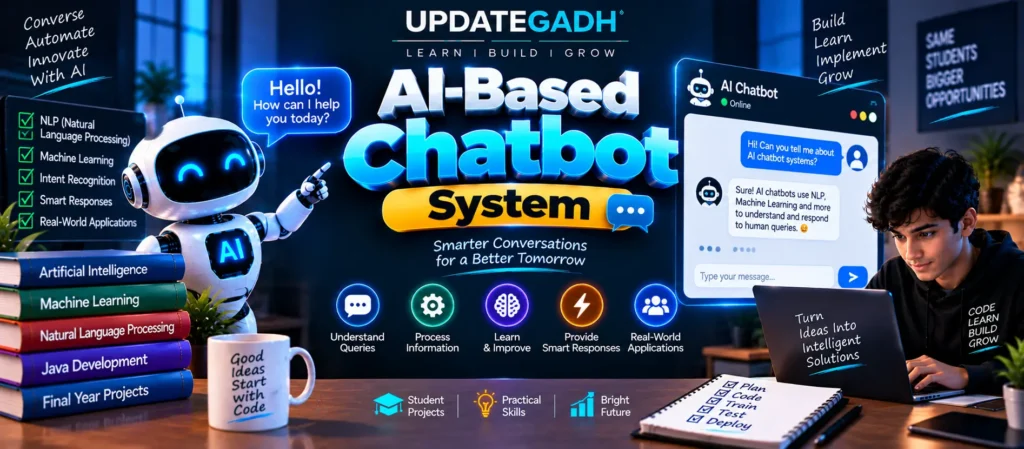
AI-Based Chatbot System
An AI-based chatbot system is a software application designed to simulate human-like conversations using Artificial Intelligence. Unlike traditional chatbots that mainly depend on predefined scripts and fixed responses, AI-powered chatbots can process user input, understand language, identify intent, and generate relevant responses.
Modern AI chatbots commonly use technologies such as Natural Language Processing (NLP), Machine Learning (ML), and Deep Learning to understand conversations and provide more useful interactions. They are being used across industries to automate communication, answer questions, assist customers, and provide information.
In this article, we will explore what an AI-based chatbot system is, how it works, its major benefits, common applications, and its future possibilities.
Table of Contents
Complete Advance AI Topics: Click Here
SQL Tutorial: Click Here
What is an AI-Based Chatbot System?
An AI-based chatbot is a computer program that communicates with users through text or, in some cases, voice. It uses Artificial Intelligence techniques to analyze user messages and provide appropriate responses.
Traditional rule-based chatbots generally follow predefined conversation paths. AI chatbots can use NLP and Machine Learning techniques to process more flexible user inputs and provide responses based on the information and models available to them.
How Do AI Chatbots Work?
An AI chatbot processes a user’s input through several important stages. These stages help the system understand what the user is asking and determine an appropriate response.
1. Natural Language Processing (NLP)
Natural Language Processing (NLP) enables the chatbot to work with human language. It analyzes the user’s text or speech and converts the input into information that the system can process.
NLP helps the chatbot identify important words, understand the structure of a message, and determine what the user is trying to communicate.
2. Machine Learning (ML)
Machine Learning can be used to help chatbots recognize patterns in user interactions and improve their ability to handle different types of queries.
Depending on the system, Machine Learning models can be trained using conversational or other relevant datasets. This allows the chatbot to make predictions or classifications based on learned patterns.
3. Intent Recognition
Intent recognition determines the purpose behind a user’s message. For example, a user might ask about placing an order, checking an account, or requesting information.
Identifying the intent helps the chatbot select a response or action that is relevant to the user’s request.
4. Entity Recognition
Entity recognition involves identifying important pieces of information within a user’s message. These can include names, dates, locations, products, or other relevant details.
Recognizing these entities can help a chatbot understand the context of a request and provide a more specific response.
5. Response Generation
After processing the user’s message, the chatbot generates an appropriate response. Depending on the system’s design, the response may come from predefined templates, a knowledge base, or an AI model capable of generating responses dynamically.
The final response is then presented to the user through the chatbot interface.
Benefits of AI-Based Chatbot Systems
The growing use of AI chatbots is largely driven by their ability to automate communication and handle large numbers of user interactions. Some of their key benefits include:
1. 24/7 Availability
Unlike human support agents, chatbots can operate continuously without requiring shifts or breaks. This allows organizations to provide automated assistance at different times of the day.
Continuous availability can be particularly useful for organizations serving customers across different time zones.
2. Scalability
AI chatbots can handle multiple conversations at the same time. A well-designed system can support many users simultaneously without requiring a separate human agent for every conversation.
This scalability can help organizations manage high volumes of routine questions and requests more efficiently.
3. Cost-Effective Automation
Chatbots can automate repetitive customer-support tasks and reduce the amount of manual work required for common queries.
By handling routine interactions automatically, organizations can allow human support teams to focus on more complex issues that require human attention.
4. Personalized Interactions
AI chatbots can use available conversation context and user information to provide more relevant interactions. Depending on how the system is designed, it may consider previous interactions, preferences, or other information while responding.
This can make automated conversations more useful and relevant to individual users.
5. Reduced Human Error
For repetitive tasks that follow clearly defined workflows, chatbots can provide consistent responses based on their programmed logic or trained models.
This consistency can help reduce certain types of mistakes that may occur when humans repeatedly perform the same routine tasks.
6. Faster Response Times
AI chatbots can process many common requests and provide responses within a short period. Users do not necessarily need to wait for a human representative when their question can be handled automatically.
Faster responses can improve the overall experience for users seeking basic information or assistance.
7. Learning and Adaptability
Machine Learning-based chatbot systems can be designed to improve their performance using additional data and feedback. As the system is developed and evaluated, its models can be updated to handle relevant patterns more effectively.
This provides an opportunity to build chatbot systems that become more capable as they are improved over time.
Common Applications of AI Chatbots
Customer Service
AI chatbots are commonly used for customer service. They can answer product-related questions, provide basic troubleshooting assistance, and support routine customer requests.
Industries such as retail, banking, and telecommunications can use chatbots to automate frequently asked questions and other support activities.
Healthcare
In healthcare-related applications, chatbots can be used to answer general questions, assist with appointment scheduling, provide reminders, and deliver basic information.
Healthcare chatbot applications require appropriate safeguards, especially when handling sensitive information or providing health-related information.
E-Commerce
Online shopping platforms can use AI chatbots to guide customers through different stages of the shopping process. A chatbot can assist with product questions, recommendations, order-related information, and post-purchase support.
This can make it easier for customers to find information without always requiring assistance from a human representative.
Education
AI-based chatbots can also be used in education to assist students with course information, deadlines, study guidance, and general academic questions.
They can also work as learning assistants by explaining concepts and helping students explore topics through conversational interactions.
Travel and Hospitality
Airlines, hotels, and travel companies can use chatbots to provide booking assistance, answer travel-related questions, manage certain reservation requests, and provide updates.
Automating routine travel queries can help organizations provide information to customers more quickly.
Future of AI-Based Chatbots
AI chatbot technology continues to evolve, and future systems may become more capable of handling different communication formats and interaction styles.
Multilingual Support
Improved language-processing capabilities can enable chatbots to communicate with users in multiple languages. This can make chatbot services accessible to a wider range of users and reduce language barriers.
Emotion Recognition
Future chatbot systems may use technologies designed to recognize signals associated with user emotions and adjust their responses accordingly.
However, interpreting emotions through technology is complex, and such systems need to be designed carefully to avoid incorrect assumptions about a user’s emotional state.
Voice Interaction
Voice-based interaction is another important direction for chatbot development. Integrating chatbots with voice assistants can allow users to communicate with AI systems through spoken commands instead of only typing messages.
This can make conversational systems more convenient and accessible in situations where typing is not practical.
Augmented Reality and Virtual Reality
AI chatbots may also become part of Augmented Reality (AR) and Virtual Reality (VR) environments. Such integration could allow users to interact with conversational AI within more immersive digital experiences.
YT:- DecodeIT
Conclusion
An AI-based chatbot system combines technologies such as NLP, Machine Learning, intent recognition, entity recognition, and response generation to create automated conversational experiences.
These systems can provide benefits such as continuous availability, scalability, faster responses, and automation of repetitive tasks. They are already being explored across customer service, healthcare, e-commerce, education, and travel.
As Artificial Intelligence continues to develop, chatbot systems may become more capable of supporting multilingual communication, voice interaction, and immersive AR or VR experiences. At the same time, responsible development, accurate information, privacy, and appropriate human oversight remain important considerations when building and deploying AI chatbots.
Keywords
What is an AI-Based Chatbot System, AI-Based Chatbot System, AI chatbot system, Artificial Intelligence chatbot, AI chatbot, chatbot using AI, AI chatbot project, chatbot system, NLP chatbot, Machine Learning chatbot, AI chatbot applications, benefits of AI chatbot, how AI chatbots work, chatbot technology, AI chatbot for students