What is Generative AI
Technology is evolving rapidly, and Generative AI has become one of the most talked-about developments in recent years. It is more than just another technology trend. Generative AI is changing the way people create content, learn new concepts, solve problems, and interact with technology.
For students, Generative AI can be a useful learning companion. It can help with brainstorming, research, writing, creativity, language learning, and personalized study. But what exactly is Generative AI, how does it work, and how can students use it effectively? Let’s explore these questions in detail.
Table of Contents
Complete Advance AI Topics: Click Here
SQL Tutorial: Click Here
Generative AI
Understanding Generative AI
Generative AI refers to Artificial Intelligence systems that can create new content based on patterns learned from existing data. Depending on the model, it can generate text, images, music, code, and other forms of content.
Generative AI is built using advanced Machine Learning techniques and models. Technologies such as GPT (Generative Pre-trained Transformer) and GANs (Generative Adversarial Networks) are examples of approaches used in Generative AI.
These systems can process information from their training data and generate new outputs based on the instructions or prompts provided by users.
The Rise of Generative AI
Generative AI is opening new possibilities for creativity and learning. A student can use an AI tool to brainstorm a story, generate ideas for a project, create visual concepts, or explore different ways of understanding a topic.
This technology gives students new ways to experiment and develop their ideas. Instead of limiting creativity, Generative AI can act as an assistant that helps students explore possibilities and improve their work.
How Generative AI Works: A Peek Behind the Curtain
Generative AI systems learn from large amounts of data. For example, a text-based model such as GPT is trained using large collections of text and learns patterns in language. When a user provides a prompt, the model uses those learned patterns to generate a relevant response.
Similarly, image-generation models are trained using large collections of images and learn patterns related to visual content. They can then generate new images based on the instructions provided by the user.
Generative AI is therefore not simply a creativity tool. Its capabilities can also be applied to education and learning in several useful ways.
How Generative AI is Useful for Students
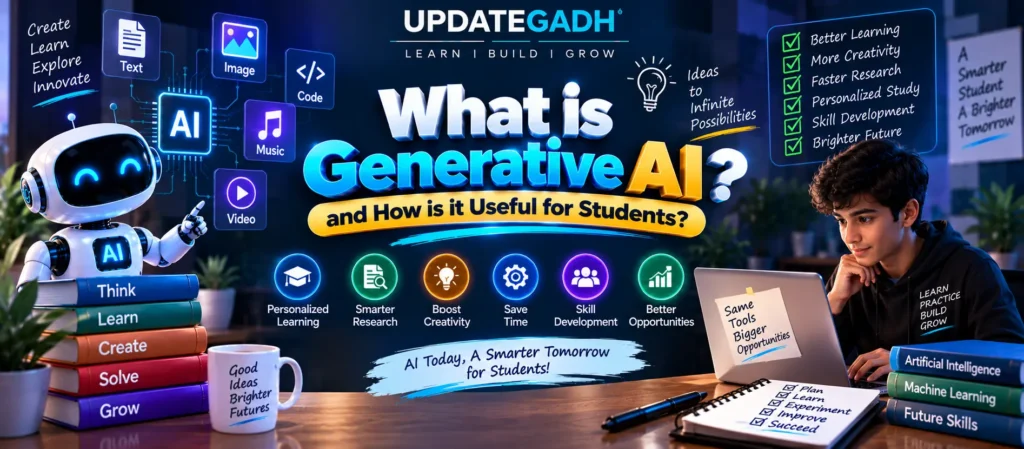
1. Personalized Learning Experiences
Generative AI can help provide students with learning experiences that are better suited to their individual needs. Students can ask an AI tool to explain a difficult topic in simpler language, provide additional examples, or create practice questions.
This can be particularly useful when a student needs additional explanation or wants to study a subject at their own pace. Instead of using exactly the same learning approach for every topic, students can request explanations that match their current level of understanding.
2. Enhancing Creativity
Generative AI can be particularly useful for students involved in creative subjects such as writing, music, design, and presentations. It can help brainstorm ideas, create initial drafts, suggest concepts, or develop creative directions.
Students can then review, modify, and improve the generated material using their own knowledge and creativity. In this way, AI can serve as a starting point while the student’s ideas and decisions remain an important part of the final work.
3. Streamlining Research
Research can sometimes be time-consuming, especially when students need to understand a large amount of information. Generative AI can assist by summarizing provided information, explaining difficult concepts, organizing ideas, and suggesting possible research topics.
These capabilities can help students save time and spend more effort understanding and analyzing the subject. However, students should verify important information using reliable sources rather than accepting every AI-generated response without checking it.
4. Breaking Language Barriers
Generative AI can also support language learning and communication. Students can use AI tools to translate text, practice conversations, improve vocabulary, and understand difficult sentences.
This can be especially helpful for students who are learning in a language that is different from their first language. AI-based language assistance can provide additional practice and help students become more comfortable with communication.
5. Assistance in Writing and Editing
Writing is another area where Generative AI can provide useful assistance. Students can use AI tools to brainstorm ideas, organize their thoughts, improve sentence structure, and identify grammatical mistakes.
Generative AI can also help students overcome writer’s block by suggesting possible starting points or ideas. Students should still review and edit the final content so that their own understanding, writing style, and ideas are represented accurately.
Real-Life Applications: How Students Are Using AI
1. AI-Powered Study Companions
AI-powered study tools can act as digital learning companions that are available whenever students need additional assistance. Students can use these tools to create summaries, generate flashcards, prepare practice questions, and review important concepts.
Such tools can make revision more interactive and can help students organize their study sessions around specific topics or subjects.
2. Creative Projects and Assignments
Students are also using Generative AI while working on creative projects and academic assignments. AI can help generate story ideas, presentation concepts, design suggestions, and other starting points for projects.
Students can then develop these ideas further and add their own creativity. This approach can help them experiment with different concepts while also building their digital and creative skills.
3. Overcoming Learning Challenges
Generative AI can provide alternative explanations when a student finds a particular concept difficult to understand. For example, a student can ask for a simpler explanation, step-by-step guidance, additional examples, or practice questions.
This flexibility can make learning more accessible for students with different learning preferences and needs. Instead of relying on only one explanation, students can explore a topic through different approaches.
The Ethical Considerations: A Balanced Approach
Although Generative AI provides many useful opportunities, students should learn to use it responsibly. Issues such as plagiarism, misinformation, inaccurate answers, privacy, and over-reliance on AI need to be considered when using these tools.
Students should use Generative AI as a learning assistant rather than as a shortcut for completing their academic work without understanding it. They should verify important information, follow their institution’s rules, and make sure that submitted work reflects their own learning and effort.
The Future of AI in Education
The role of AI in education is likely to continue developing as Generative AI technologies become more capable. Future educational tools may provide increasingly personalized learning experiences, interactive tutoring, intelligent study assistance, and new ways for students to interact with educational content.
AI-powered virtual learning environments and personalized learning journeys could provide students with more flexible ways to study. At the same time, responsible use, human guidance, and critical thinking will remain important parts of the learning process.
Embracing the Power of AI
Generative AI is more than a technological innovation; it can be a powerful learning and creativity tool for students. From personalized explanations and research assistance to writing, language learning, and creative projects, it can support students in many different ways.
The key is to use Generative AI thoughtfully. Students can combine AI assistance with their own knowledge, creativity, critical thinking, and effort to get meaningful results. When used responsibly, Generative AI can become a valuable part of the modern learning experience.
YT:- DecodeIT
Final Thoughts
Generative AI is changing how students interact with technology and educational resources. It can help learners explore ideas, understand difficult subjects, improve their writing, practice languages, and develop creative projects.
However, the technology should complement learning rather than replace it. Students who learn to question AI-generated information, verify facts, protect their privacy, and contribute their own ideas can make more effective use of these powerful tools.
Keywords
What is Generative AI, Generative AI for students, benefits of Generative AI, Generative AI in education, AI for students, how Generative AI works, Generative Artificial Intelligence, AI learning tools, Generative AI applications, AI study tools, AI for education, Generative AI benefits, AI writing tools, AI research tools, AI creativity tools, future of AI in education