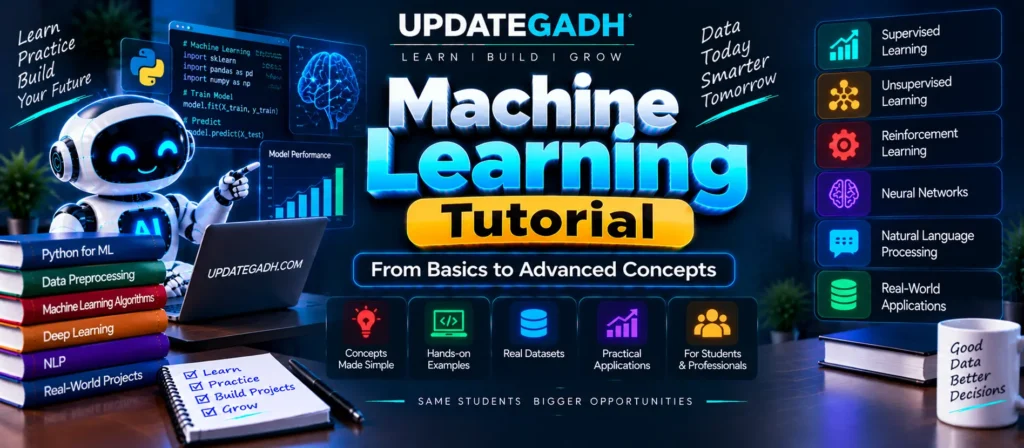
Machine Learning Tutorial
This Machine Learning Tutorial is designed for both beginners and experienced professionals who want to understand the fundamentals and advanced concepts of Machine Learning (ML). Whether you are a student starting your journey in data science or a professional looking to strengthen your existing knowledge, this guide provides a structured introduction to important machine learning concepts.
Machine Learning has become an important part of modern Artificial Intelligence and is widely used to build systems that can learn from data, identify patterns, and make predictions.
Download New Real Time Projects :- Click here
What is Machine Learning?
Machine Learning (ML) is a branch of Artificial Intelligence (AI) that focuses on developing systems capable of learning from data and improving their performance without being explicitly programmed for every task.
While Artificial Intelligence focuses broadly on creating systems that can perform tasks associated with human intelligence, Machine Learning enables systems to analyze data, recognize patterns, draw conclusions, and make predictions.
Key Takeaway: Machine Learning is a part of Artificial Intelligence, although not every AI system necessarily depends on Machine Learning.
Features of Machine Learning
- Self-Learning: Machine learning systems can learn from available data and improve their performance without requiring explicit programming for every situation.
- Pattern Recognition: ML algorithms can identify complex patterns and relationships within datasets.
- Efficiency with Data: Organizations generate large amounts of data, and Machine Learning can help analyze this information to identify useful relationships and support decision-making.
- Automation: Machine Learning can automate certain tasks and improve performance based on previous data and experiences.
Introduction to Machine Learning
Machine Learning has its roots in the development of intelligent systems capable of performing tasks with limited human intervention. Over time, advances in computing, algorithms, and data availability have helped ML become an important technology across many industries.
Today, Machine Learning is used in areas such as healthcare, finance, education, retail, entertainment, and many other domains.
Getting Started with Machine Learning
To learn Machine Learning effectively, it is important to understand its basic principles before moving toward advanced algorithms and models.
- An Overview of ML: Understand how Machine Learning differs from traditional programming and how models learn patterns from data.
- The Role of Data: Learn about data collection, preprocessing, analysis, and the importance of high-quality data.
- Applications: Explore practical applications such as facial recognition, recommendation systems, and fraud detection.
Understanding Data in ML
Data is one of the most important components of a Machine Learning system. The quality and quantity of available data can directly influence the performance of a machine learning model.
For this reason, preparing and managing data is an essential part of the Machine Learning workflow.
Key Topics in Data Processing
- Data Cleaning: Identifying and handling inconsistencies, missing values, and other data-quality issues.
- Feature Scaling: Transforming numerical features into suitable ranges for algorithms that can be affected by differences in feature scales.
- Label and One-Hot Encoding: Converting categorical information into numerical representations that machine learning algorithms can process.
- Balancing Datasets: Applying techniques such as SMOTE to address imbalanced datasets when appropriate.
Types of Machine Learning
1. Supervised Learning
Supervised Learning works with labeled data. The model learns from examples where the expected output is already known. It is commonly used for tasks such as classification and regression.
For example, spam detection can be treated as a classification problem, while predicting house prices can be treated as a regression problem.
Common Techniques:
- Naive Bayes
- Logistic Regression
- Decision Trees
Popular Libraries:
- Scikit-learn
- TensorFlow
- PyTorch
2. Unsupervised Learning
Unsupervised Learning works with unlabeled data and attempts to discover hidden patterns, structures, or relationships within the dataset.
Common applications include clustering and dimensionality reduction.
Common Methods:
- K-Means Clustering
- DBSCAN
- Principal Component Analysis (PCA)
3. Reinforcement Learning
Reinforcement Learning involves an agent interacting with an environment and learning through rewards and feedback. The objective is to learn actions that help maximize the accumulated reward.
Reinforcement Learning can be applied to areas such as game development and robotics.
Gradient Descent and Optimization
Gradient Descent is an important optimization algorithm used in Machine Learning. It helps models minimize an error or loss function by gradually adjusting model parameters in a direction that reduces the error.
Variants of Gradient Descent
- Batch Gradient Descent: Uses the complete training dataset to calculate each update.
- Stochastic Gradient Descent (SGD): Updates model parameters using individual training examples.
- Mini-Batch Gradient Descent: Uses small batches of training examples for each update.
Neural Networks
Neural Networks are computational models inspired by the structure and functioning of biological neural systems. They are widely used in Deep Learning and can handle complex tasks involving images, text, and other types of data.
Key Neural Network Architectures
- Artificial Neural Networks (ANNs): General-purpose neural network architectures that can be used for various prediction and classification tasks.
- Convolutional Neural Networks (CNNs): Commonly used for image-related and computer vision tasks.
- Recurrent Neural Networks (RNNs): Designed to process sequential data and can be used for tasks involving sequences.
Natural Language Processing (NLP)
Natural Language Processing (NLP) is a field that focuses on enabling computers to process and understand human language. It connects computational systems with human communication and is used in applications such as chatbots, language processing, and sentiment analysis.
Core NLP Techniques
- Text Preprocessing: Includes techniques such as tokenization, stemming, and lemmatization.
- Language Modeling: Includes approaches and architectures such as sequence-to-sequence models, LSTMs, and Transformer models.
Dimensionality Reduction
Dimensionality Reduction involves reducing the number of features or dimensions in a dataset while attempting to retain important information.
Reducing unnecessary dimensions can help improve computational efficiency and can be useful when working with high-dimensional datasets.
Some dimensionality-reduction methods include:
- Linear Discriminant Analysis (LDA)
- Principal Component Analysis (PCA)
Real-World Applications of Machine Learning
Machine Learning is already being used across many industries to analyze data, automate processes, and support decision-making.
- Healthcare: Machine Learning can be used for predictive diagnostics and applications related to personalized medicine.
- Finance: ML can support credit scoring and fraud detection.
- Retail: Machine Learning can be applied to targeted advertising and demand forecasting.
- Entertainment: Recommendation systems can provide personalized content suggestions on platforms such as Netflix and Spotify.
Complete Advance AI Topics: Click Here
SQL Tutorial: Click Here
Conclusion
Machine Learning is a major area of Artificial Intelligence that enables systems to learn from data and identify useful patterns. Understanding data preprocessing, learning types, optimization, neural networks, NLP, and dimensionality reduction provides a strong foundation for further study.
As Machine Learning continues to develop, its applications are expanding across industries. For students and professionals, learning these core concepts is an important step toward building practical skills in Artificial Intelligence and Data Science.
Keywords
Machine Learning Tutorial, machine learning tutorial w3schools, machine learning tutorial pdf, machine learning tutorialspoint, machine learning – javatpoint, machine learning tutorial for beginners, machine learning tutorial python, machine learning tutorial free, machine learning tutorial youtube, machine learning, machine learning course, machine learning tutorial geeksforgeeks