Subsets of Artificial Intelligence
Artificial Intelligence (AI) has become a major part of modern technological innovation, transforming industries and changing the way we interact with machines. After understanding the fundamentals of AI, it is important to explore its major subsets. Each subset focuses on a different aspect of intelligent systems and contributes to the wide range of AI applications we see today.
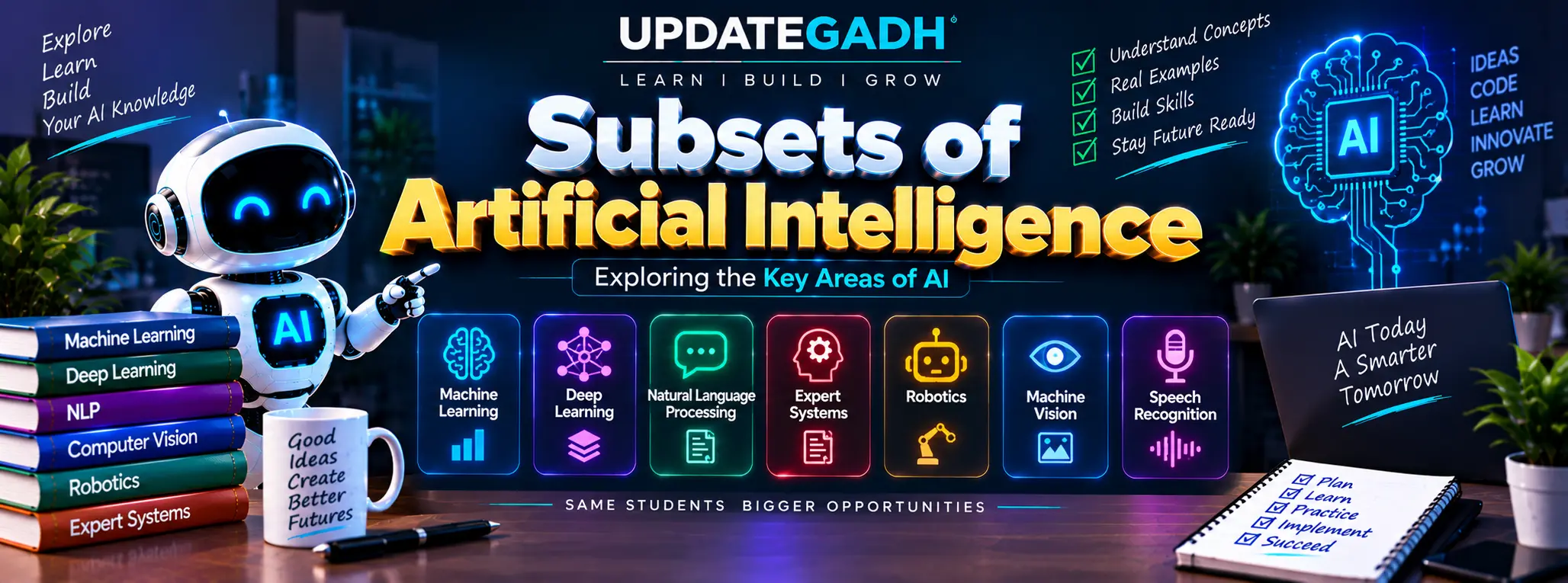
The most prevalent subsets of Artificial Intelligence include:
- Machine Learning (ML)
- Deep Learning (DL)
- Natural Language Processing (NLP)
- Expert Systems
- Robotics
- Machine Vision
- Speech Recognition
Among these areas, Machine Learning plays an important role in developing real-world AI solutions. Let us explore these subsets in detail and understand their significance.
Table of Contents
Complete Advance AI Topics: Click Here
SQL Tutorial: Click Here
1. Machine Learning (ML)
Machine Learning is an important subset of Artificial Intelligence that enables machines to learn from data and experience without requiring explicit programming for every task. By analyzing historical data, machine learning algorithms can identify patterns, make predictions, and support decision-making.
Download New Real Time Projects: Click here
Key Features of Machine Learning
- Algorithm-Driven: Machine learning systems use algorithms to learn from data and improve their performance.
- Pattern Recognition: ML algorithms can identify useful patterns and insights from large datasets.
- Automation: Machine learning reduces the need to manually program every possible situation.
Types of Machine Learning
1. Supervised Learning
- Machines learn from labeled datasets.
- The model learns relationships between inputs and known outputs.
- It can then predict outputs for new data.
Subcategories:
- Classification: Categorizes data into predefined classes or labels.
- Regression: Predicts continuous numerical outcomes, such as stock prices.
2. Reinforcement Learning
In reinforcement learning, an agent learns by interacting with an environment and receiving feedback in the form of rewards or penalties. The objective is to learn actions that maximize the overall reward.
Subtypes:
- Positive Reinforcement: Encourages desirable actions by providing rewards.
- Negative Reinforcement: Encourages desired behavior by removing or avoiding unfavorable conditions.
3. Unsupervised Learning
Unsupervised learning focuses on discovering patterns and structures in datasets without labeled outputs.
Subcategories:
- Clustering: Groups data points based on similarities.
- Association: Identifies relationships and connections between variables or items.
2. Natural Language Processing (NLP)
Natural Language Processing (NLP) is a subset of Artificial Intelligence that focuses on enabling machines to understand, interpret, and respond to human language.
NLP plays an important role in technologies such as Siri, Google Assistant, and Cortana, allowing computers to process human language in text and speech form.
Applications of NLP
- Text and speech processing
- Sentiment analysis
- Language translation
3. Deep Learning (DL)
Deep Learning is a subset of Machine Learning that uses artificial neural networks with multiple layers to learn complex patterns from data. It is inspired by the structure and functioning of the human brain.
How Deep Learning Works
- Input Layer: Receives the raw input data.
- Hidden Layers: Process the input using mathematical operations and learn relevant patterns.
- Output Layer: Produces the final result or prediction.
Applications of Deep Learning
- Image Recognition
- Self-Driving Cars
- Speech Recognition
4. Expert Systems
Expert Systems are AI-based systems designed to replicate certain decision-making abilities of human experts. They use structured knowledge and rules to solve specific problems and provide recommendations or conclusions.
Features of Expert Systems
- High Performance: Can provide solutions within their specific knowledge domain.
- Reliable and Responsive: Can consistently apply stored knowledge and rules to a problem.
- Knowledge-Based: Uses structured knowledge to support decision-making.
An example mentioned in this context is spell-check suggestions in Google Search.
5. Robotics
Robotics combines Artificial Intelligence with engineering to design and develop intelligent robots that can perform tasks autonomously or semi-autonomously.
AI-powered robotics can enable robots to perceive their surroundings, make decisions, and perform tasks with limited human intervention.
Example: Sophia, a humanoid robot, demonstrates social interaction capabilities supported by AI-driven robotics.
6. Machine Vision
Machine Vision enables machines to analyze and interpret visual information. It is used in various applications where computers need to process images or other forms of visual data.
Applications of Machine Vision
- Object Recognition
- Counting Items
- Quality Inspection in Manufacturing
Machine vision can help automated systems inspect products, identify objects, and analyze visual information efficiently.
7. Speech Recognition
Speech Recognition is a technology that enables machines to interpret spoken language and convert it into machine-readable information. Modern speech recognition has progressed beyond simple transcription and can also support direct command execution.
Applications of Speech Recognition
- Voice-Controlled Systems: Used in virtual assistants and other voice-based applications.
- Industrial Automation: Supports voice-based interactions in industrial environments.
- Navigation Systems: Enables users to provide spoken commands and instructions.
Categories of Speech Recognition
- Speaker Dependent: Designed to adapt to or recognize a specific user.
- Speaker Independent: Designed to work with different users without being specifically trained for one speaker.
YT:- DecodeIT
Conclusion
The different subsets of Artificial Intelligence each contribute to the development of intelligent technologies in their own way. Machine Learning enables systems to learn from data, Deep Learning handles complex patterns, NLP works with human language, Expert Systems support knowledge-based decisions, Robotics combines AI with physical machines, Machine Vision processes visual information, and Speech Recognition enables machines to understand spoken commands.
Understanding these AI subsets provides a strong foundation for exploring Artificial Intelligence and its applications across different industries and technologies.
Keywords
subsets of AI diagram, 4 main areas of artificial intelligence, artificial intelligence is intelligence shown by, Subsets of Artificial Intelligence, machine learning is a subset of artificial intelligence, subsets of artificial intelligence pdf, deep learning is a subset of machine learning, Subsets of Artificial Intelligence: A Deep Dive into the Building Blocks of AI, machine learning is a subset of artificial intelligence focused on building systems, foundation models is a subset of artificial intelligence, artificial intelligence, machine learning, subsets of artificial intelligence with examples