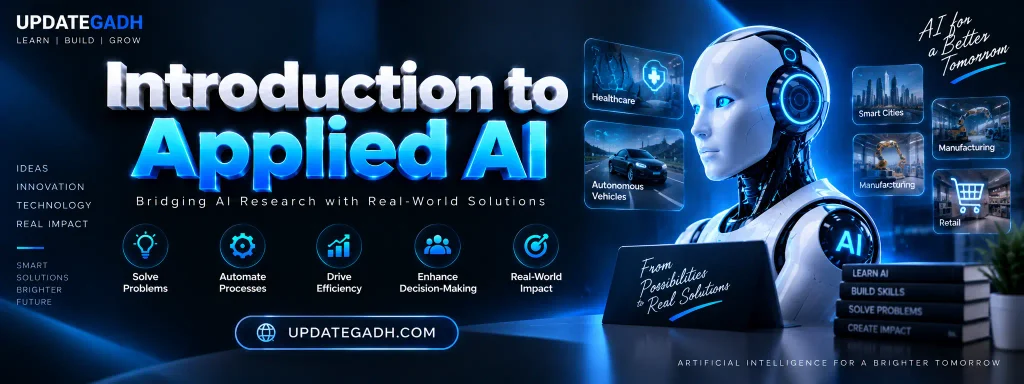
Introduction to Applied AI
Artificial Intelligence (AI) has developed from a theoretical field into a powerful technology that is transforming the world around us. Applied AI, also known as operational or practical AI, connects AI research with real-world applications. It uses intelligent algorithms to solve specific problems, automate processes, and develop useful solutions across different industries. From healthcare diagnostics to autonomous vehicles, applied AI is playing an important role in technological development by improving efficiency, supporting decision-making, and changing customer experiences.
Table of Contents
Complete Advance AI Topics: Click Here
SQL Tutorial: Click Here
Introduction to Applied AI
What is Applied AI?
Applied AI refers to the practical use of AI technologies for solving real-world problems. While theoretical AI focuses on expanding AI research and its capabilities, applied AI brings these developments into everyday operations. It helps optimize tasks and provides practical benefits across different areas.
Core Components of Applied AI
Applied AI combines advanced technologies, processes, and methodologies to create practical solutions. Its main components include:
- AI Algorithms:
AI algorithms form the foundation of applied AI. They allow machines to learn from data and make decisions. Common techniques include:
- Supervised learning
- Unsupervised learning
- Reinforcement learning
- Data Collection and Preprocessing:
High-quality data is essential for applied AI. It involves collecting, cleaning, and transforming data so that it can be effectively used to train models. This helps produce reliable insights and accurate predictions. - Feature Engineering:
Feature engineering involves identifying useful patterns in raw data and creating features that can improve model performance and predictive capabilities. - Model Selection and Training:
Selecting the appropriate model, such as neural networks, decision trees, or ensemble methods, is important. Training these models with labeled datasets allows them to identify patterns and make predictions. - Evaluation and Validation:
AI models are tested using metrics such as accuracy, precision, recall, and cross-validation. These methods help determine whether the models can perform effectively on unseen data. - Deployment and Integration:
Applied AI involves integrating trained models into production environments. This can be achieved through cloud platforms, APIs, or embedded systems to make the models useful in real-world applications. - Monitoring and Maintenance:
Continuous monitoring helps identify performance changes and prevents performance drift. It allows models to adjust to changing data and maintain their effectiveness. - Ethical and Regulatory Considerations:
Responsible AI development takes privacy, fairness, and accountability into consideration. Regulations such as GDPR and HIPAA are important for protecting users’ interests.
Business Benefits of Applied AI
Organizations in different industries use applied AI to improve processes, enhance customer experiences, and gain competitive advantages. Some important benefits include:
- Increased Efficiency:
Automating repetitive tasks reduces the amount of human effort required, helping lower costs and reduce turnaround times. - Data-Driven Decisions:
AI can process large datasets and identify useful insights, helping organizations develop better strategies and reduce risks. - Enhanced Customer Experiences:
Chatbots, recommendation systems, and sentiment analysis can help businesses provide more personalized interactions and improve customer loyalty. - Predictive Maintenance:
AI can identify possible equipment problems in advance, helping reduce downtime, improve performance, and lower maintenance costs. - Fraud Detection:
AI can identify unusual patterns in financial transactions and cybersecurity systems, helping organizations protect themselves from potential risks. - Supply Chain Optimization:
AI can support activities such as demand forecasting and route optimization, helping streamline operations, reduce costs, and improve delivery speed.
Real-World Use Cases of Applied AI
- Healthcare:
- AI is transforming areas such as diagnostics, personalized treatment planning, and drug discovery.
- Machine learning models can analyze medical images and genomic data, supporting precision medicine.
- Finance:
- AI algorithms can predict stock trends, optimize portfolios, and identify fraudulent activities.
- Manufacturing:
- Predictive maintenance can reduce downtime, while AI-based quality control can help identify product defects.
- Retail:
- Recommendation systems can provide personalized shopping experiences, helping improve sales and customer satisfaction.
Challenges in Applied AI
Although applied AI provides powerful solutions, it also comes with several challenges:
- Data Bias: Models trained using biased data can reproduce or increase existing inequalities.
- Ethical Concerns: Privacy, security, and accountability need to be given proper attention during AI development and implementation.
- Interpretability: Some AI models, particularly deep learning systems, can operate like “black boxes.” Greater transparency is therefore needed to build trust in their results.
Future Trends in Applied AI
- Advances in Deep Learning:
Progress in neural networks is expected to improve areas such as language understanding, image recognition, and automation. - AI in Healthcare:
AI can support remote diagnostics, integration with wearable technologies, and precision treatment, helping create a more proactive approach to healthcare. - Autonomous Systems:
AI can improve autonomous technologies, including self-driving vehicles and robotic automation, particularly in dynamic and unstructured environments. - Smart Cities:
AI-powered solutions can contribute to urban planning, traffic management, and improved energy efficiency. - Collaborative AI:
Collaborative AI focuses on partnerships between humans and AI, with systems designed to support and enhance human decision-making rather than simply replace it.
Ethical Implications and Limitations
For applied AI to achieve its full potential, it is important to address its limitations and ethical challenges.
- Transparent governance frameworks should be developed to help manage potential risks.
- Ethical AI practices should focus on fairness, privacy, and accountability.
Download New Real Time Projects :- Click here
PHP PROJECT:-
Tags
Introduction to Applied AI introduction to ai programming introduction to applied technology introduction to applied ai applied ai vs generative ai applied generative ai course applied artificial intelligence degree introduction to applied ai Introduction to Applied ai pdf applied artificial intelligence salary Introduction to Applied ai ppt introduction to applied ai revolutionizing industries with intelligent Solutions introduction to applied ai applied artificial intelligence syllabus applied ai vs ai applied artificial intelligence course introduction to applied ai notes Introduction to Applied AI: Revolutionizing Industries with Intelligent Solutions