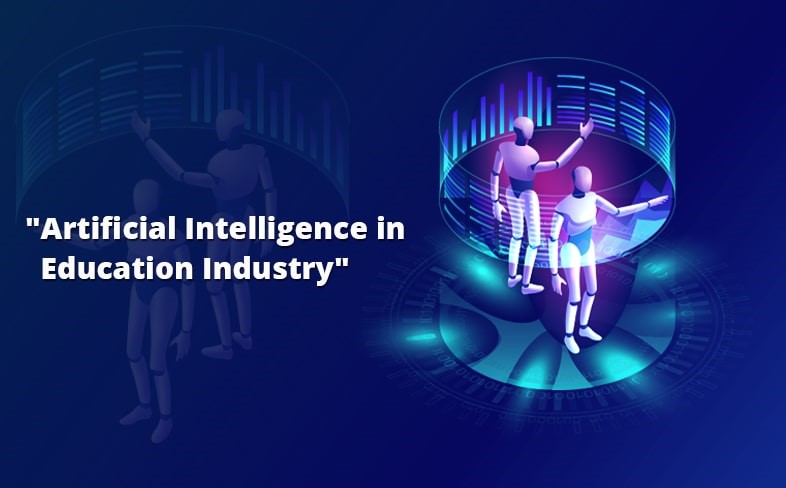
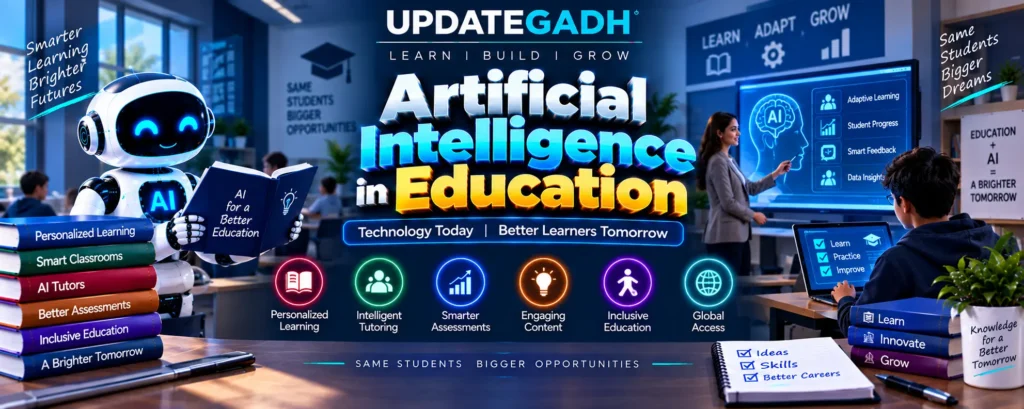
Artificial Intelligence in Education
Education plays an important role in personal and professional development. Over the years, educational systems have continuously evolved to meet the changing needs of students, teachers, and society. New teaching methods, digital learning resources, and updated curricula have all contributed to improving the learning experience.
Today, Artificial Intelligence (AI) in education is emerging as an important technology that can support students, teachers, and educational institutions. AI is not about replacing human teachers with machines. Instead, it can be used to improve teaching methods, personalize learning, automate repetitive activities, and make educational resources more accessible.
Schools, colleges, and universities around the world are exploring AI-powered technologies to create more flexible and engaging learning environments. This article explains the major applications, benefits, and future possibilities of Artificial Intelligence in Education.
Table of Contents
What is AIED (Artificial Intelligence in Education)?
Artificial Intelligence in Education (AIED) refers to the application of Artificial Intelligence technologies to improve teaching and learning experiences. AI is a branch of computer science that focuses on developing systems capable of performing tasks associated with human intelligence, such as learning, reasoning, pattern recognition, and decision-making.
The integration of AI into education, particularly higher education, began to develop during the 1970s. Early research focused on creating flexible and personalized learning environments. Over time, AI technologies have evolved to support a wider range of educational activities.
Important trends in AIED include:
- Intelligent Tutoring Systems
- Smart Classrooms
- Adaptive Learning Platforms
- Pedagogical Agents
These technologies aim to make learning more personalized, accessible, engaging, and effective.
Download New Real Time Projects: Click here
Applications of AI in Education
1. Automating Basic Activities
AI can help teachers save time by automating repetitive activities such as grading tests and assignments. For example, AI-based systems can efficiently evaluate multiple-choice questions and can also assist with certain types of short-answer assessment.
Human evaluation remains important for essays and answers that require deeper interpretation, creativity, or contextual understanding. By reducing routine administrative work, AI can give teachers more time to focus on teaching and interacting with students.
2. AI Tutors for Additional Support
Students learn at different speeds, and teachers may not always be available to provide individual assistance whenever a student needs it. AI-powered tutoring systems can help address this gap by providing personalized support in subjects such as mathematics, writing, and other foundational areas.
As AI technology continues to develop, tutoring systems may become capable of supporting increasingly complex and analytical learning tasks.
3. Feedback Systems
AI-powered feedback systems can provide students and teachers with information about learning performance in real time. These systems can analyze student responses, identify areas where learners are experiencing difficulties, and provide useful feedback.
AI-based educational platforms can also help personalize feedback so that students receive guidance when they need it, allowing them to identify weaknesses and improve their understanding.
4. Identifying Gaps in Learning
AI can help educators identify common learning difficulties among students. For example, if a large number of students provide incorrect answers to a particular question, an AI-based system can highlight the topic as an area that may require additional explanation.
This information can help teachers adjust their lessons and provide additional learning material where necessary.
5. Changing the Role of Teachers
AI is not intended to eliminate the importance of teachers. Instead, it can change how teachers spend their time. AI can assist with activities such as grading, administrative work, and basic student support.
This allows teachers to focus more on mentoring students, facilitating discussions, encouraging critical thinking, and supporting deeper learning. AI tools can also provide additional resources for students who want to study independently.
6. Personalized Learning
One of the major applications of AI in education is personalized learning. AI systems can analyze a student’s learning patterns, performance, and progress to help create customized learning experiences.
Personalized systems can recommend suitable resources, exercises, or study plans based on individual learning requirements. Future AI systems may also use additional signals to identify confusion or disengagement and adapt learning content accordingly.
7. Smart Content Creation
AI can assist educators and institutions in creating digital educational content such as lessons, study materials, interactive activities, and simulations.
Smart content creation can support education through:
- Digital Lessons: E-books, study guides, and short learning modules.
- Visualizations: Interactive visuals and simulations that can make difficult concepts easier to understand.
- Content Updates: Helping educational materials remain relevant and aligned with current information.
8. Accessibility for Students with Special Needs
AI technologies can contribute to more inclusive education by providing tools that assist students with different accessibility requirements.
For example, speech-based technologies can support students who have difficulty interacting through traditional input methods, while text-to-speech systems can help students with visual impairments access written content.
These technologies can make educational resources more accessible to a wider range of learners.
9. Universal Access
AI-powered educational platforms can provide learning resources to students regardless of their physical location. Digital learning environments allow students to access educational content from different locations and study according to their own schedules.
This can help expand access to educational resources that may previously have been limited by geographical or other barriers.
Benefits of AI for Students
1. 24/7 Access to Learning
AI-powered educational tools can be available at any time, allowing students to study, practice, and ask questions outside traditional classroom hours.
2. Enhanced Engagement
Interactive lessons, personalized recommendations, simulations, and adaptive learning experiences can make learning more engaging and relevant to individual students.
3. Reduced Pressure
Virtual assistants and AI-powered learning tools can allow students to ask questions and receive assistance without feeling uncomfortable about asking the same question repeatedly. This can help students build confidence while learning at their own pace.
The Future of AI in Education
The future of Artificial Intelligence in education is expected to focus on increasingly personalized and supportive learning environments. Three important areas include performance personalization, bias reduction, and combined assistance between AI systems and teachers.
1. Performance Personalization
AI systems can continue to improve personalized learning by analyzing detailed information about student progress and performance. This can help provide learning recommendations that are better aligned with individual needs.
2. Bias Reduction
AI-based assessment systems can apply predefined evaluation criteria consistently. When designed and monitored appropriately, such systems may help support more standardized evaluation processes.
3. Combined Assistance
AI can complement teachers by handling certain administrative and repetitive tasks. This can allow educators to dedicate more time to teaching, mentoring, communication, and other activities that require human interaction.
Complete Advance AI Topics: Click Here
SQL Tutorial: Click Here
Conclusion
Artificial Intelligence in Education is creating new possibilities for how students learn and how teachers deliver education. From AI tutors and personalized learning to automated assessment, smart content creation, accessibility tools, and feedback systems, AI can support many parts of the educational process.
However, AI should be viewed as a supporting technology rather than a replacement for teachers. Human guidance, creativity, communication, and mentorship remain important parts of effective education.
As AI continues to develop, its responsible integration into schools, colleges, and universities can help create more flexible, accessible, and personalized learning experiences for students.
Keywords
artificial intelligence in education pdf, artificial intelligence in education essay, artificial intelligence in education article, artificial intelligence in education ppt, artificial intelligence in education journal, artificial intelligence in education research paper, AI in education examples, artificial intelligence for school students, artificial intelligence, what is AI, artificial intelligence in education in India, AI education, Artificial Intelligence in Education, AI in education, benefits of AI in education, applications of AI in education