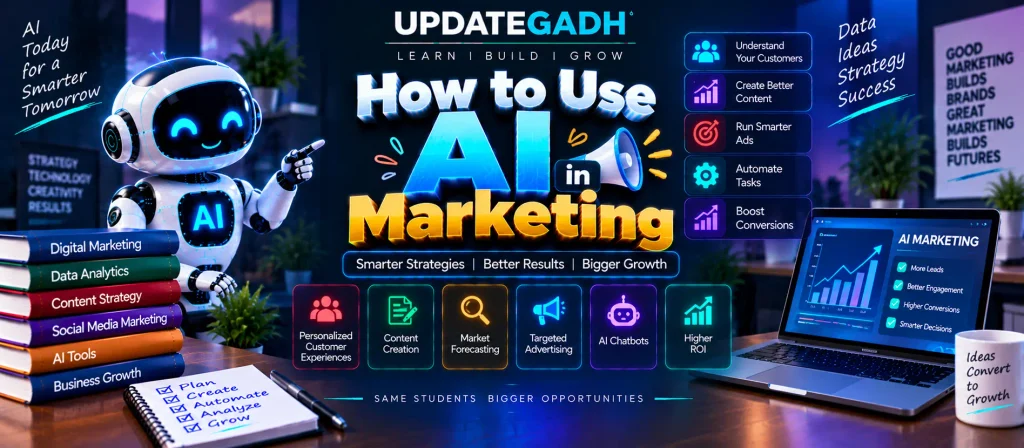
How to Use AI in Marketing
Artificial Intelligence (AI) is transforming the marketing industry by helping businesses understand customers, automate repetitive tasks, analyze data, and create more personalized experiences. From improving customer interactions to optimizing advertising campaigns, AI has become an important technology for modern marketing professionals.
In this tutorial, we will explore how to use AI in marketing and examine the different ways businesses can apply artificial intelligence to improve their marketing strategies, customer experiences, and overall efficiency.
Download New Real Time Projects :- Click here
Understanding the Role of AI in Marketing
Artificial Intelligence is no longer just a futuristic technology. It is being used across different industries to analyze information, automate processes, and support decision-making. In marketing, AI combines advanced technology with creative strategies to help businesses deliver more relevant and personalized experiences.
For marketers, AI can bridge the gap between large amounts of data and useful insights. By analyzing customer behavior, preferences, and market trends, AI can help businesses better understand their audiences and develop strategies based on available information.
Applications of AI in Marketing
1. AI in Search Engines
AI has significantly improved the way search engines understand user queries and provide relevant results. Modern search systems can interpret vague, incomplete, or misspelled queries and still provide useful results.
E-commerce platforms can use AI-powered search systems to help customers discover products even when their search terms are incomplete or contain errors.
For marketers, AI-powered search can make it easier for customers to discover products and services. A better search experience can improve user engagement and make the overall customer journey more convenient.
2. Market Forecasting
AI can help marketers analyze historical information and current patterns to identify potential market trends and changes in customer demand. These insights can support planning and decision-making.
For example, an inventory manager can use AI-based analysis to identify periods when demand may increase and plan promotional activities accordingly. Aligning inventory with expected demand can improve operational efficiency and help businesses provide a better customer experience.
3. Programmatic Advertising
Programmatic advertising uses automated systems and algorithms to manage the buying and placement of digital advertisements. AI can analyze customer behavior, preferences, and other available data to help determine where and when advertisements should be displayed.
AI can also support retargeting strategies by identifying users who have previously interacted with a product or service. Marketers can then create more relevant campaigns based on customer interests and behavior.
This approach can help businesses improve the relevance of their advertising campaigns and make better use of their advertising budgets.
4. Content Creation and Strategy
AI can assist marketers with different stages of content creation. By analyzing audience information and content requirements, AI tools can help generate ideas and create targeted written material.
Marketers can also use AI-generated insights to develop content strategies that are better aligned with audience interests and customer needs. This can help businesses maintain consistent content production while focusing human effort on creativity, editing, and strategic decisions.
5. Chatbots for Customer Interaction
AI-powered chatbots are widely used to support customer interactions. These virtual assistants can respond to multiple customer queries and provide information without requiring a human representative for every interaction.
For smaller businesses or organizations with limited customer service teams, chatbots can provide a scalable way to manage common customer questions. Their availability can also help businesses provide support outside traditional working hours.
By responding quickly to customer queries, AI chatbots can contribute to a smoother customer experience and help businesses manage large volumes of interactions.
6. Dynamic Pricing
Dynamic pricing uses data and AI-based analysis to adjust prices according to factors such as demand, market conditions, and customer behavior. This approach allows businesses to respond more quickly to changes in the market.
During periods of high demand, businesses can use pricing insights to make informed decisions. Similarly, AI can help identify situations where discounts or promotional offers may be appropriate.
By continuously analyzing market changes, AI can support more flexible pricing strategies and help businesses make data-driven decisions.
7. Enhancing Ad Performance
AI-powered analytics can provide marketers with detailed information about the performance of their advertising campaigns. Metrics such as click-through rates, geographic performance, audience behavior, and platform-specific results can be analyzed to understand campaign effectiveness.
These insights can help marketers identify which parts of a campaign are performing well and which areas may require improvement. AI can also assist with identifying patterns and potential trends, allowing businesses to adjust their marketing strategies based on available data.
Benefits of AI in Marketing
Using AI in marketing can provide several practical benefits. Businesses can use artificial intelligence to automate repetitive processes, analyze large amounts of information, understand customers, and support more personalized marketing activities.
- Improved Customer Understanding: AI can analyze customer behavior and preferences.
- Marketing Automation: Repetitive marketing tasks can be supported through automation.
- Personalized Experiences: Customer data can be used to create more relevant interactions.
- Data Analysis: AI can process large amounts of marketing information efficiently.
- Better Campaign Optimization: Performance insights can help marketers refine their campaigns.
- Improved Efficiency: Automation can reduce the time required for repetitive tasks.
How to Choose the Right AI Marketing Approach
The right use of AI depends on the marketing goals of a business. Before implementing an AI-based solution, marketers should identify the problem they want to solve, understand the available data, and determine which processes can benefit from automation or intelligent analysis.
Businesses should also review AI-generated results carefully and combine automated systems with human judgment. This is especially important when marketing decisions involve customer data, brand communication, or sensitive information.
Complete Advance AI Topics: Click Here
SQL Tutorial: Click Here
Conclusion
Artificial Intelligence is changing how businesses approach modern marketing. From search engines and market forecasting to programmatic advertising, content creation, chatbots, dynamic pricing, and advertising analytics, AI can support many areas of the marketing process.
Understanding how to use AI in marketing allows businesses and marketers to make better use of data, automate repetitive activities, and develop more personalized customer experiences. When AI technology is combined with human creativity and strategic thinking, it can become a valuable part of a modern marketing workflow.
Keywords
How to Use AI in Marketing, 15 examples of artificial intelligence in marketing, ai in marketing examples, benefits of ai in marketing, artificial intelligence in marketing pdf, free ai tools for marketing, ai marketing tools, what is one example of ai being used for social good, ai marketing course, how to use ai in marketing and sales, how to use ai in marketing automation, how to use ai in marketing agency, how to use ai in marketing analytics, how to use ai in marketing research, how to use ai in marketing with examples, how to use ai in digital marketing, how to use ai in stock market analysis, how to use ai for market analysis, how to use ai as a marketing tool, how to use ai in marketing strategy