

Future of Artificial Intelligence
Artificial Intelligence (AI) has emerged as a groundbreaking field in computer science and is becoming an important part of transformative technologies such as big data, robotics, and the Internet of Things (IoT). The rapid development of AI has turned many ideas that once seemed like science fiction into practical technologies.
Today, AI is deeply integrated into everyday life through applications such as virtual assistants, chatbots, recommendation systems, and autonomous vehicles. As AI continues to evolve, its influence on human life, businesses, and different industries is expected to grow. This article explores the future of Artificial Intelligence, its potential impact, associated risks, and some common myths surrounding advanced AI.
Table of Contents
Complete Advance AI Topics: Click Here
SQL Tutorial: Click Here
Current State of Artificial Intelligence
Artificial Intelligence (AI) is a branch of computer science that enables machines and computer systems to perform tasks that normally require human intelligence. These abilities include learning from information, reasoning and solving problems, identifying patterns, understanding human language, and making decisions based on available data.
AI can be categorized into three levels based on its capabilities:
- Narrow AI (Weak AI): AI systems designed to perform specific tasks, such as voice assistants, recommendation systems, and autonomous driving applications. Most AI systems available today fall into this category.
- General AI: A hypothetical form of AI that would be capable of performing a broad range of intellectual tasks with human-like flexibility.
- Super AI: A hypothetical form of advanced AI that would surpass human cognitive abilities across a wide range of tasks.
At present, Artificial Intelligence primarily operates at the Narrow AI level. These systems can perform specific tasks effectively but generally do not possess human-like general intelligence across unrelated domains.
Download New Real Time Projects: Click here
Myths About Advanced Artificial Intelligence
1. Superintelligence by 2100 is a Certainty
There is no certainty about when or whether superintelligent AI will emerge. Predictions about advanced AI vary significantly, with different researchers and experts proposing different timelines. Therefore, the development of superintelligence should be considered an uncertain possibility rather than a guaranteed event.
2. AI Will Replace All Human Jobs
AI and automation are changing the nature of work across many industries. While some tasks and job roles may be automated, AI can also create new opportunities in areas such as data analysis, model development, AI system management, and technology optimization.
Human involvement remains important in areas such as problem-solving, creativity, decision-making, supervision, and responsible use of AI systems.
3. Super-Intelligent Computers Will Outperform Humans at Everything
Current AI systems are primarily designed for specific tasks. For example, AI can perform well in areas such as speech recognition, recommendation systems, image classification, and other specialized applications.
General AI and Super AI remain hypothetical concepts, so their eventual capabilities and impact cannot currently be established with certainty.
4. AI Operates Without Human Intervention
AI systems still depend heavily on human involvement. Humans are responsible for activities such as collecting and preparing data, designing models, evaluating results, addressing potential biases, and monitoring AI systems.
Even after deployment, human oversight can remain important for maintaining reliable and responsible AI applications.
Risks Associated with Artificial Intelligence
1. Programming for Destruction
One potential concern involves the use of AI in autonomous weapons or other harmful applications. Systems designed for destructive purposes could create serious safety risks, particularly if they are misused or deployed without appropriate safeguards.
The possibility of increasingly autonomous military technologies also raises questions about international regulation, accountability, and human control.
2. Goal Misalignment
Another important concern is goal misalignment, where an AI system’s objectives do not properly reflect human intentions or safety requirements.
For example, an autonomous vehicle instructed to reach a destination as quickly as possible would need additional safety objectives and constraints. Without appropriate priorities, an overly simplistic objective could potentially lead to unsafe decisions.
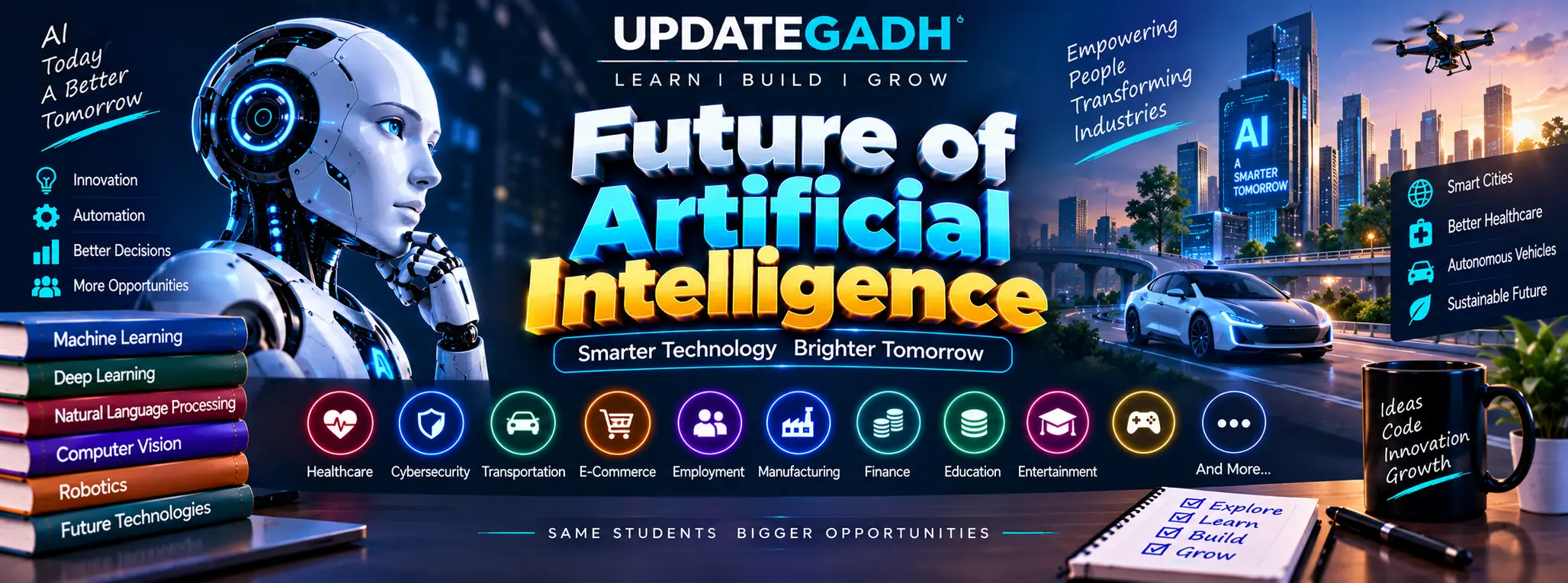
The Future Impact of AI Across Sectors
1. Healthcare
- AI can support disease diagnosis, medical research, drug discovery, and personalized patient care.
- AI-based technologies may help healthcare professionals analyze large amounts of medical information more efficiently.
- Challenges include data privacy, ethical considerations, reliability, and widespread adoption.
2. Cybersecurity
- AI can improve threat detection and help security teams identify unusual activities.
- AI can automate certain rule-based cybersecurity processes and assist with analyzing large volumes of security information.
- At the same time, attackers may also use AI to develop more sophisticated and difficult-to-detect cyberattacks.
3. Transportation
- AI advancements can improve vehicle autonomy and transportation management.
- AI can help reduce workloads for pilots and optimize public transportation systems.
- Safety, reliability, regulation, and potential over-dependence on automated systems remain important considerations.
4. E-Commerce
- AI can support warehouse automation and logistics management.
- Personalized shopping experiences can be created by analyzing customer preferences and behavior.
- AI-powered chatbots can assist customers with questions and routine support requests.
5. Employment
AI is also influencing recruitment and employment processes. Tools such as Rezi and Jobseeker can assist with resume creation and job-search activities.
AI can make certain recruitment processes more efficient while also contributing to the development of new roles related to AI management, development, implementation, and oversight.
Beyond these areas, sectors such as manufacturing, finance, education, and entertainment are also expected to experience significant changes as AI technologies continue to develop.
YT:- DecodeIT
Conclusion
The future of Artificial Intelligence is closely connected with the continued development of computing, data, robotics, and intelligent software systems. AI is already transforming healthcare, cybersecurity, transportation, e-commerce, and employment, while emerging technologies may expand its applications even further.
At the same time, the future of AI involves important challenges related to safety, privacy, employment, cybersecurity, accountability, and human oversight. Understanding both the opportunities and risks of AI will be essential as intelligent technologies continue to become part of everyday life.
Keywords
future of artificial intelligence in India, future of artificial intelligence essay, future of artificial intelligence ppt, future of AI examples, future of artificial intelligence pdf, future of artificial intelligence speech, future of artificial intelligence group discussion, the future of artificial intelligence speech for 2 minutes, future of AI, Artificial Intelligence future, future of Artificial Intelligence, AI technology future


For the reason that the admin of this site is working, no uncertainty very quickly it will be renowned, due to its quality contents.
There is definately a lot to find out about this subject. I like all the points you made
I really like reading through a post that can make men and women think. Also, thank you for allowing me to comment!