Air Quality Prediction Using Deep Learning
Introduction
Air Quality Prediction Using Deep Learning is a machine learning project developed by UPDATEGADH to forecast Air Quality Index (AQI) values using historical environmental and regional data. With rapid industrialization, urban expansion, and increasing population density, maintaining healthy air quality has become an important challenge. Poor air conditions can affect human health and are associated with respiratory problems, reduced quality of life, and wider environmental concerns.
The project uses a hybrid CNN-LSTM model that combines convolutional layers for identifying patterns with recurrent LSTM layers for learning relationships within time-series data. Historical air-quality, meteorological, industrial, and population information is processed to generate AQI predictions.
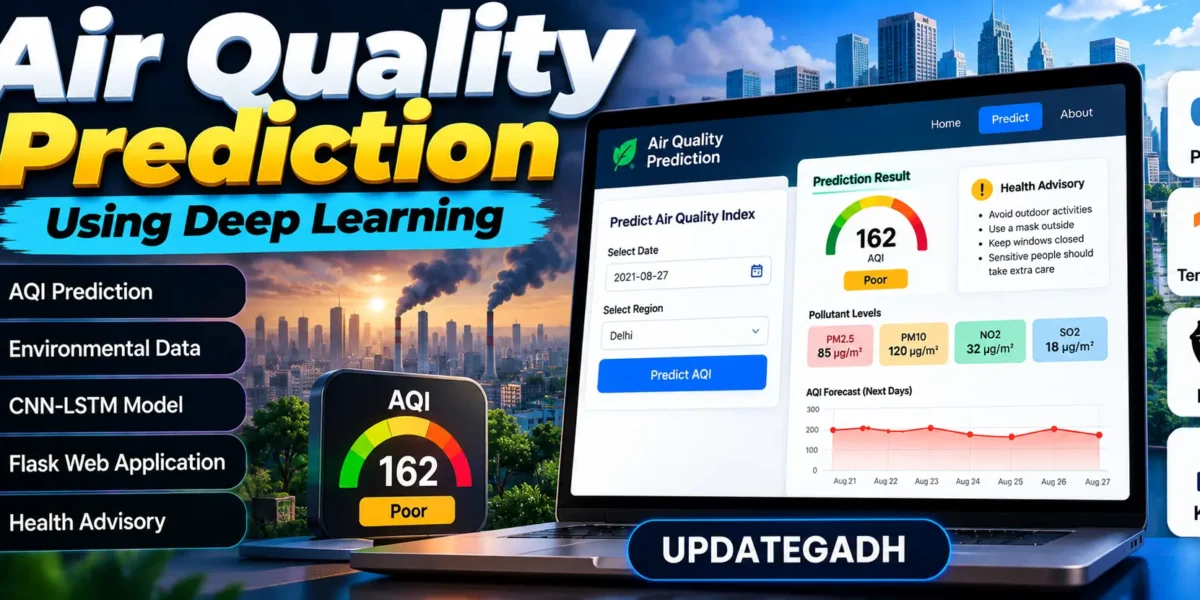
Along with the machine learning model, the project provides a dynamic web application where users can enter relevant information and receive an AQI forecast together with an appropriate health advisory. This combination of deep learning and web development makes the project useful as both an academic learning resource and a practical prediction application.
Complete Advance AI Topics: Click Here
Real Time Projects on YouTube:- DecodeIT
Project Overview
| Attribute | Details |
|---|---|
| Project Name | Air-quality-prediction (AQI Forecast System) |
| Language/s Used | Python (Flask, TensorFlow/Keras), HTML/CSS (Bootstrap) |
| Database | None (CSV/Excel files packaged in /data) |
| Type | Machine Learning + Web App (Time-Series Forecasting) |
What Is the Project About?
Air quality can influence health and everyday activities, making timely AQI information useful for individuals and organizations. This project predicts AQI values so users can make decisions such as changing outdoor plans or taking precautions when pollution levels are high.
The core prediction system is based on a hybrid 1D CNN + LSTM neural network developed with TensorFlow and Keras. The project contains trained model files, including /models/conv_lstm_hyb.h5 and supporting .h5 variants. It also includes a KMeans clustering model stored as /models/kmeans.pkl.
The prediction functionality is connected to Flask views and HTML templates. The main interface is available through /templates/index.html, while prediction results are displayed through /templates/predict.html.
Why Air Quality Prediction Is Relevant
The quality of the air people breathe can affect both short-term and long-term health. Pollutants may contribute to health problems involving the respiratory and cardiovascular systems and can have broader effects on quality of life.
Urban areas with high population density, industrial development, and expanding infrastructure can experience significant air-quality challenges. Forecasting AQI at a regional level provides useful information that can help people understand expected air conditions and take suitable precautions.
Data Collection
The project combines information from four major categories:
- Air Quality: SO, NO, PM.5, PM
- Meteorology: temperature, wind speed, surface pressure, precipitation, humidity
- Industry: number of industries and industrial units
- Population: area-wise population information
Prepared input files are available in the /data directory. These include input_for_app.csv for prediction-related inference and input_cluster.csv for clustering. Location information within the dataset is processed using KMeans clustering for regional grouping.
Project Structure
app.py: Flask application containing routes for date and region input and prediction rendering./templates/: Containsindex.htmlfor the input interface andpredict.htmlfor displaying prediction results./static/style.css: Provides front-end styling./data/: Contains cleaned and engineered input files, includinginput_for_app.csv,input_cluster.csv, and the original Excel data./models/: Stores the trained deep learning models and KMeans clustering model.requirements.txt: Contains the required Python dependencies.Procfile: Contains the deployment commandweb: gunicorn app:appfor Heroku.
Important: The date selector available in the application is limited to 2021-08-27, which corresponds to the final data period used during model training.
The Hybrid 1D CNN-LSTM Network
Time-series AQI prediction requires a model that can recognize patterns within multiple variables while also understanding how those variables change over time. The project combines two neural network approaches for this purpose.
- 1D CNN: Detects short-term patterns across pollutant and meteorological input variables.
- LSTM: Captures temporal relationships and longer-term dependencies through its memory mechanism.
The CNN component extracts local features from the input sequences, while the LSTM component learns longer-range dependencies. Before training, the data-processing pipeline performs null-value handling, outlier filtering, resampling, feature standardization, and supervised sequence generation.
The model training process uses Huber loss and the Adam optimizer with scheduled learning rates. Training was performed for up to 100 epochs with early stopping. Evaluation includes metrics such as MAE, MSE, RMSE, and MAPE. The deployed hybrid model is stored as conv_lstm_hyb.h5.
Available Features
- Regional AQI Prediction: Forecasts air quality for clustered regions using the available input data.
- Date-Based Forecast: Allows users to select a date within the available data period and receive an AQI prediction.
- AQI Category and Guidance: Displays the AQI category, including Good, Satisfactory, Moderate, Poor, Very Poor, or Severe, along with health guidance and visual indicators.
- Deployment Ready: Includes
Procfileandrequirements.txtfor deployment using Heroku. - Packaged Models and Data: Provides trained
.h5deep learning models and clustering artifacts along with the prepared datasets.
Download complete source code
Installation Guide for VS Code
Step 1: Install Prerequisites
Install Python 3.10 and Visual Studio Code with the Python extension.
Step 2: Open the Project Folder
Extract the project files and open the project directory in VS Code using File > Open Folder.
Step 3: Create a Virtual Environment
Open the VS Code terminal and execute:
python -m venv .venvActivate the environment on Windows:
.venv\Scripts\activateFor macOS or Linux:
source .venv/bin/activateStep 4: Install Dependencies
Upgrade pip and install the packages listed in the requirements file:
pip install --upgrade pip
pip install -r requirements.txt
Step 5: Run the Application
Start the Flask application with:
python app.pyAfter the server starts, open the displayed local URL in your browser.
Alternative Flask Command
Flask can also be started using the Flask CLI.
set FLASK_APP=app.py
flask run
On macOS or Linux, the corresponding environment variable command is:
export FLASK_APP=app.py
flask run
Usage
User
- Open the web application.
- Select a date and region.
- Click the Predict button.
- View the predicted AQI value, category, and health guidance.
Student or Researcher
- Explore the
/datadirectory to understand the processed input files. - Study the model-training and clustering scripts to understand the methodology.
- Retrain the models using newer datasets when appropriate.
Admin or Maintainer
- Maintain dependency consistency according to
requirements.txt. - Deploy the application using
gunicorn app:appwith Heroku or a similar platform. - Replace the files inside
/modelswhen updated trained models become available.
Contributing
Contributors should maintain consistent code formatting and update the Flask backend and HTML templates together when modifying existing functionality. Sample data should be provided in the /data directory when required for testing. Improvements should also include clear documentation so that other developers can understand the changes.
Final Thoughts
The Air Quality Prediction project demonstrates how machine learning concepts can be connected with a practical web application. The complete workflow covers data preparation, preprocessing, deep learning model development, clustering, AQI forecasting, and Flask-based deployment.
From a student’s perspective, the project provides an opportunity to understand how a hybrid CNN-LSTM model can be applied to environmental time-series data. It also demonstrates how trained models and prepared datasets can be integrated into a web interface where users can enter information and receive prediction results.
The project combines environmental data, deep learning, and web development into one practical application. Its packaged models, datasets, Flask components, and deployment files make it a useful reference for students and learners exploring air-quality prediction and deep learning applications.
Project Keywords: air quality prediction using machine learning GitHub, air quality prediction using machine learning project report, air quality prediction using machine learning IEEE paper, air quality prediction using machine learning Kaggle, air quality prediction dataset, air quality prediction project, air quality prediction using machine learning project PPT, air quality prediction GitHub, air quality prediction using deep learning GitHub, air quality prediction using deep learning PDF, air quality prediction using deep learning in Python, air quality prediction using deep learning 2022.