What Is AI Computer Vision Reasoning
Artificial Intelligence (AI) is changing how computers understand the world. One of its important developments is AI Computer Vision Reasoning, which helps machines analyze images, understand visual relationships, and answer questions based on visual information.
Traditional computer vision systems can identify objects in an image. However, vision-reasoning systems aim to go further by interpreting scenes, connecting visual details, and drawing conclusions. This technology has applications in healthcare, education, robotics, autonomous vehicles, and industrial automation.
In this tutorial, you will learn what AI Computer Vision Reasoning is, how it works, its types, applications, advantages, challenges, and future scope.
Table of Contents
Complete Advance AI Topics: Click Here
Real Time Projects on YouTube:- DecodeIT
What Is AI Computer Vision Reasoning?
AI Computer Vision Reasoning is the use of artificial intelligence to analyze visual information and draw meaningful conclusions from images, videos, diagrams, and other visual inputs.
It combines computer vision techniques with reasoning capabilities to help machines understand not only what is visible but also how different objects relate to one another.
This approach is useful for applications that require more than simple image classification or object detection.
How Does AI Computer Vision Reasoning Work?
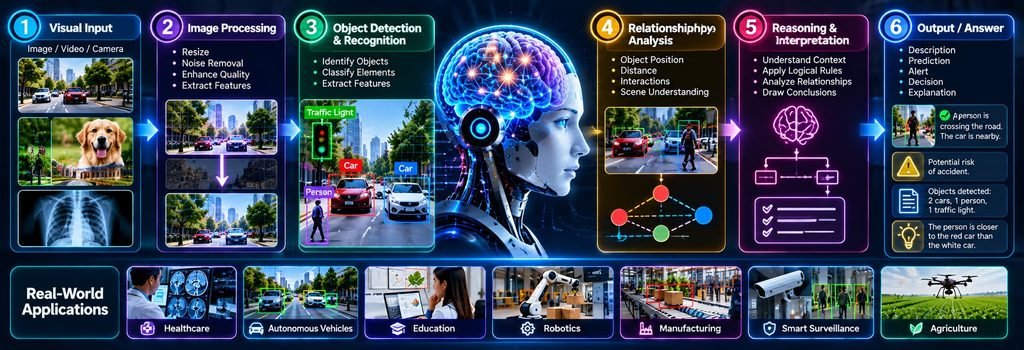
AI Computer Vision Reasoning typically involves the following steps.
1. Visual Input Collection
The system receives an image or video from a camera, uploaded file, screenshot, or another visual source.
2. Image Processing
The input is processed to extract useful visual information. Depending on the application, this may include resizing images, reducing noise, or preparing the image for analysis.
3. Object Detection and Recognition
The AI identifies relevant objects, shapes, colors, text, and other visual features. Models may use image classification, object detection, or image segmentation.
4. Relationship Analysis
The system examines the relationships between objects, including their positions, interactions, and movement. This helps it understand the overall scene.
5. Reasoning and Interpretation
The system combines visual evidence with the user’s question or task to produce an interpretation. More advanced applications may perform multiple reasoning steps or use additional tools.
6. Output Generation
Finally, the system provides an answer, description, prediction, or task-specific result.
Types of AI Computer Vision Reasoning
1. Spatial Reasoning
Spatial reasoning helps AI understand object positions, distances, and directions. For example, it can determine whether a bag is beside a chair or blocking a doorway.
2. Relational Reasoning
This approach identifies relationships between objects or people in a image, such as person holding phone or vehicle parked beside a building.
3. Temporal Reasoning
Temporal reasoning analyzes changes across video frames to understand movement and events over time. It can help identify when a vehicle changes direction or when an object moves.
4. Logical Reasoning
Logical reasoning applies rules and relationships to answer visual questions. For example, a system may identify which object satisfies a specific set of conditions.
5. Causal Reasoning
Causal reasoning attempts to determine possible causes of observed events. However, an image alone may not provide enough evidence to establish why an event occurred.
Computer Vision vs. AI Computer Vision Reasoning
| Feature | Computer Vision | Vision Reasoning |
|---|---|---|
| Main purpose | Processes and analyzes visual data | Interprets visual information and answers questions |
| Object detection | Identifies objects | Uses detected objects as evidence |
| Relationships | May detect basic relationships | Can analyze multiple relationships |
| Output | Labels, boxes, masks, or scores | Answers, explanations, or decisions |
These categories can overlap. Modern computer vision systems may include reasoning capabilities, while vision-reasoning systems often rely on conventional computer vision techniques.
Real-World Applications of AI Computer Vision Reasoning
1. Healthcare
AI can assist medical professionals by analyzing medical images or highlighting potentially important patterns. Medical decisions still require appropriate clinical validation or professional oversight.
2. Autonomous Vehicles
Vision-reasoning systems can help interpret road scenes, identify vehicles, recognize traffic signs, or assess potential hazards.
3. Education
AI tools can analyze diagrams, mathematical problems, charts, and scanned notes to help students understand visual information.
4. Robotics
Robots can use visual information to locate objects, recognize obstacles, navigate environments, and plan actions.
5. Manufacturing
Computer vision systems can inspect products, detect visible defects, and help manufacturing teams improve quality control.
Technologies Used in AI Computer Vision Reasoning
- Python: A popular programming language for developing AI applications.
- OpenCV: A library used for image processing and video analysis.
- PyTorch: A framework for developing and running machine learning models.
- TensorFlow: A framework for building and deploying machine learning applications.
- YOLO: A family of models commonly used for object detection.
- Vision-Language Models: Models that connect visual understanding with natural-language tasks.
- Large Language Models: Can help interpret visual descriptions and generate answers when integrated with suitable vision capabilities.
Advantages of AI Computer Vision Reasoning
- Automates parts of visual analysis.
- Helps understand complex images and diagrams.
- Supports the identification of visual patterns and relationships.
- Allows users to ask questions about visual content.
- Can assist decision-making when supported by reliable evidence.
- Supports applications across different industries.
Limitations of AI Computer Vision Reasoning
Despite its advantages, AI Computer Vision Reasoning has several challenges.
- Visual errors: Models may overlook small objects or misinterpret complex scenes.
- Incorrect conclusions: AI may generate answers that are not supported by the available visual evidence.
- Computational requirements: Advanced models can require substantial processing power and memory.
- Data quality: Some applications require diverse, accurately labelled training data.
- Privacy: Images and videos may contain personal or sensitive information.
For reliable results, vision-reasoning systems should be tested carefully, and human review should be used where accuracy is essential.
Future Scope of AI Computer Vision Reasoning
The future of AI Computer Vision Reasoning is closely connected to multimodal AI, robotics, intelligent assistants, and autonomous systems.
Potential developments include better visual question answering, more capable educational assistants, improved industrial inspection, and robots that can understand their surroundings more effectively.
As these technologies advance, researchers will continue working to improve accuracy, reduce computational costs, protect privacy, and make AI-generated conclusions more reliable.
Conclusion
AI Computer Vision Reasoning combines visual perception with techniques that help machines interpret relationships and solve visual problems. It enables AI systems to move beyond identifying objects and toward answering questions about what images represent.